

By Jay Sorgi
for the Register
Is humanity building a new Tower of Babel at the intersection of artificial intelligence (AI) and modern society, as the Holy Father has intimated that we might be doing? How should we respond when the subject of such technology converges with the truths of God-given dignity and the need to protect the good of all?
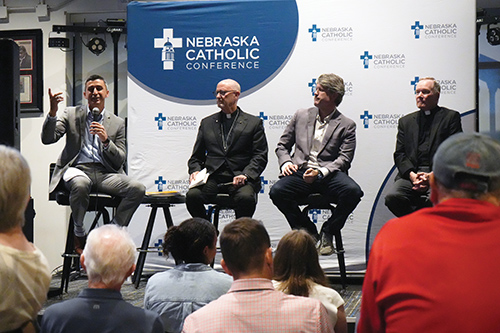
Bishop James Conley and Nebraska Attorney General Mike Hilgers joined a panel discussion drawing hundreds to the high-impact of AI through the lens of the Catholic faith during “Bishop & Brews: Human Dignity, AI and the Common Good” on Thursday, Sept.17, at the Post in Lincoln.
“Who are we as a human being and a human community and how can AI be tailored in a way that AI is not driving us, we’re driving AI as a tool?” said Tom Venzor, the executive director of the Nebraska Catholic Conference. He moderated the panel which was also joined by
Click here to see photos from the event.
Father Kevin Fitzgerald, SJ with the Creighton University School of Medicine in Omaha. “Really, that was a huge theme.”
Much of these themes stem from Pope Leo XIV’s recent encyclical letter Magnifica Humanitas which he shared in May in response to the moral, theological and societal questions posed by the growing capability of artificial intelligence to mirror and perhaps surpass human capability in certain areas.
“We’re undergoing major sort of revolutionary changes. We talked a lot about the fact that we are in a change of era, not just simply an era of change,” Venzor said. “It really stuck out that we have to constantly remind ourselves who we are and whose we are. We are children of God. We are made in the image and likeness of God. We have intellect, we have will, we have affectivity, we have a call for love of neighbor, a love of community. We are sort of our brother’s keeper. We have all these social responsibilities, and we have to be reminded of those.”
The panel covered countless areas where that need for a reminder exists, from the educational formation of young people to health care and bioethics, from how AI and what Venzor called “its cousin, social media” affect young people in increasing anxiety and addiction, proper government regulation of AI, even the issue of using AI in war.
“Artificial intelligence can be used for surveillance, manipulation and discrimination,” the Holy Father said Sept. 24 to a session of the Pontifical Academy of Sciences. “Sophisticated cyber capabilities and autonomous weapons may, when developed or deployed without adequate safeguards and human oversight, introduce new dangers to security and international peace.”
“Pope Leo [said] that AI is not morally neutral. That doesn’t mean it’s evil, doesn’t mean it’s morally good, but he recognizes that depending on how AI models are developed, they’re just not simply neutral,” Venzor said. “They’re going to be designed in a way to be morally good or morally evil, and we have to recognize that.”
Venzor cited positive uses of AI, such as Magisterium AI which exclusively uses church documents to help someone find answers to Catholic questions. But he recognizes large-language models and frontier AI models offer concerns about what data is being used, who it belongs to and how it’s being scraped.
“There’s all sorts of questions about how that data is being used and will be used and for what ends and will it be used for good ends or will it be used for terrible ends like creating autonomous warfare,” he said.
Venzor also described how the panel talked about each person’s own responsibility in what AI is being modeled after, because people create data which reflects the brokenness of humanity.
“At the end of the day, they’re also being programmed based on who we are, how we’ve behaved. We’re fallen and we’re broken,” Venzor said.
“How we can help develop these AI models in the future is to ensure that we’re putting good things into the internet, putting good things into the world so that when these things are being trained, it’s being trained on things like mercy and love and compassion, and not merely profit, gain and exploitation.”
Venzor also suggested savviness in how people use consumer power to mold a more moral market, but additionally to be faithful citizens in the public square, to influence lawmakers on how to set parameters of an industry that has seen little if any regulation at the federal level.
“We have regulatory power at the state level to deal with how AI is being developed and how it’s being regulated,” he said. “Attorney General Hilgers has sued some of the major big tech companies on the social media front to get a $17 billion settlement because of addictive technologies incorporated into social media platforms to hurt kids and to addict kids. So there’s a lot of things we can be doing.”
The other question Venzor posed for all involves a mindset pivot from what so many people of faith understandably are feeling about AI, one that reminds us to hope in the One who is above anything that can be artificially created, the One who created us to be much more than data points and what an algorithm says we are.
“How can we live in this change of era in a way that remains rooted in Jesus, remains rooted in the Gospel, remains rooted in hope and love, and not be people who are fearful or scared or worried or anxious, but really that Gospel value of hope and light?” he asked.
“There’s something greater in the meaning of human. There’s something greater about what it means to be human. And AI and the conversations about it are a great chance for us to evangelize on who the human person is, [how] you’re just not a laborer who has to produce for their company. You’re a human being with rights and dignity.”
