

Q. Did Jesus ever appear as a different nationality?
A. When artists are Catholic, it is natural for them to want to paint pictures of Jesus. When they do, they often imagine that Jesus is someone who looks like he’s from their own culture. This isn’t deliberately trying to be historically inaccurate. For most of the history of the Church, travel has been difficult, and books – especially books with illustrations – have been rare. Most people would have had very little idea of how people from other cultures would have looked, or dressed.
Because of this, and because, for many centuries, Catholicism was centered in Europe, a lot of our sacred art depicts Jesus as European, often with rather pale skin and brown hair. Occasionally, you might even find a blond Jesus, such as in the illustrations in the Irish “Book of Kells.”
But what did Jesus actually look like?
There was no photography in the time of Jesus. No paintings of Jesus that might have been made by people who knew him survive. St. Luke supposedly painted an icon of Mary and the Child Jesus, but it has been lost.
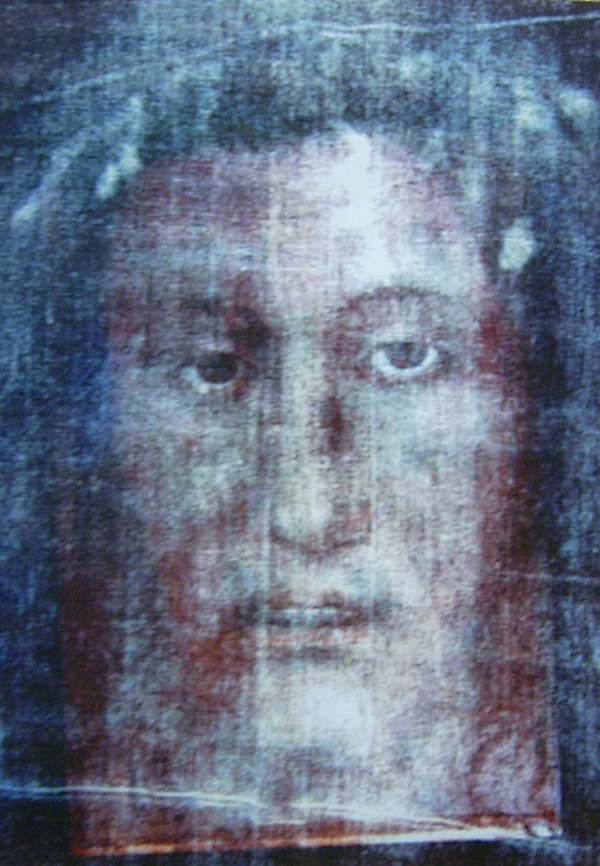
What we do have is the miraculous image from the life of Jesus: the Shroud of Turin. The Shroud of Turin is a linen burial cloth that is believed to have covered the body of Jesus after His crucifixion. An unknown process left the imprint of a crucified man on the cloth. Catholics are permitted to believe in its authenticity, but not required.
The Shroud image is not a color image, so it doesn’t tell us anything about Jesus’s skin color. But it tells us plenty about Jesus’s facial features!
There are plenty of full-color images based on the Shroud of Turin. The darker-colored ones would fit right in with a lineup of images from a “middle eastern man with beard and long hair” image search (I checked). The lighter-colored ones would fit right in with a lineup of images from a “Hasidic Jewish man with a beard and long hair” image search (I checked that, too). Hasidic Jews are typically of Eastern European descent, so they would be more
European-looking than the Jews of Jesus’s time. All of which fits with what we actually know of Jesus’s background according to the Scriptures: He is biologically Jewish, descended from people who had lived in the Middle East for thousands of years, but without any of the European blood that entered many Jewish populations in later years.
Jesus almost certainly looked like a Middle Eastern Jew when He walked this earth.
There is, of course, another miraculous image worth considering: the full-color image of Our Lady of Guadalupe in Mexico, an image of Jesus’ biological mother, given to us presumably from Herself. She is often described as looking mestiza, a blend of Spanish and Indigenous that matches what many Mexicans look like, and she certainly may have chosen to appear that way, to help the Spaniards and the Indigenous people accept Christ, and each other. But Our Lady of Guadalupe could be Middle Eastern, too! The two groups actually look very similar in paintings, despite being from opposite sides of the world!
How does this compare to how Jesus appeared in visions? Did He appear like Himself, a Middle-eastern Jewish man? Or did he appear more like the people He was appearing to?
There have been a lot of visions of Jesus and Mary over the years, even if you only count the approved ones. These visions don’t always include a physical description. But one vision did result in a specific painting. The appearances of Jesus to St. Faustina resulted in the painting of the Divine Mercy Image by Eugeniusz Kazimirowski, under the direction of St. Faustina. This image of Jesus is very European-looking, with light brown hair, very light skin, and European facial features. While St. Faustina was not happy with the painting, it was simply because Jesus was not beautiful enough, not because the painter had gotten His race wrong, or anything like that. In fact, several times in her Diary, St. Faustina describes Jesus appearing to her as He is painted. This would seem to indicate that, when Jesus appeared to St. Faustina, He chose to look European, rather than Middle Eastern or Jewish.
So yes. It would seem that, at least once, Jesus chose to appear as a nationality different from what He actually was.
This question was answered by a Fr. Evan Winter, pastor of St. John the Baptist Parish in Minden and Holy Family in Heartwell.
Write to Ask the Register using our online form, or write to 3700 Sheridan Blvd., Suite 10, Lincoln NE 68506-6100. All questions are subject to editing. Editors decide which questions to publish. Personal questions cannot be answered. People with such questions are urged to take them to their nearest Catholic priest.
