

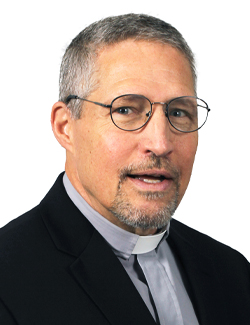
By Deacon Matthew Hecker, Ph.D.
Communications
St. Joseph Parish, Lincoln
If you are reading this, you are a consumer of Catholic media.
Why does the Church bother herself with the business of media and communications? Isn’t that more properly a secular function? Especially in the internet and smartphone age, don’t we already have an excessive amount of news and information? We do, but frankly, it’s all the more reason why the Church needs to be present and active in this arena.
 In John 18:38 we hear Pontius Pilate famously ask Jesus, “Quid est veritas?” (What is truth?). That scene, leading up to the Crucifixion, occurred in approximately 33AD. Fast forward to 2025, and much of humanity still seeks an answer to that question. In an era where we often hear phrases such as “my truth” and “your truth,” what is truth?
For his part, Pilate was responding to the statement made by Jesus (Jn.18:37), “For this I was born and for this I came into the world, to testify to the truth. Everyone who belongs to the truth listens to my voice.” Previously in John 14:6 Jesus proclaimed, “I am the way the truth and the life.”
Jesus not only speaks the truth, he is the TRUTH. In 2025 as in 33AD, that’s a bold claim. And here’s the thing: if Jesus is right (and he is) then that reality has enormous consequences. Jesus Christ is God, incarnate. He is the second person of the Holy Trinity and he speaks and is the truth. Period! In philosophy, it’s called objective truth, which is the idea that a statement or belief is true independently of the person who holds it.
Recently, a young blogger, Philip Koslowski, noted: “In C.S. Lewis’ "The Screwtape Letters," the ‘senior demon’ Screwtape reveals one very interesting plan of the devil. In order to drive us away from God, Satan chooses to distract us with ‘Noise.’ He knows that if we are overrun by countless distractions that we will be unable to hear the voice of God in silence.”
Interestingly, our enemy knows the truth about Jesus. In the gospels, the recorded interactions Jesus had with demons indicate demons know the truth about Jesus. Like in “The Screwtape Letters,” if life were a game of football, our enemy’s strategy would be to blitz us, from every direction, on every play. The idea being to keep us so distracted, so uncertain and so unsure of ourselves that eventually like Pilate, we throw up our hands and ask, ‘what is truth?’
Thus, it is not by accident that we live in an extraordinarily noisy world filled with distractions. The diabolical intent is to surround us with “noise” in order to keep us from hearing and acting on the truth. So then, how can we hear and know the truth?
Jesus promised not to abandon us to our enemy and the world, and he didn’t. He left us his Church. The Church gives us the word of God, the sacraments, and the authentic teaching authority of the Magisterium. In Holy Mass, we hear the word of God proclaimed, we hear the teaching authority exercised in the homily, and we receive the sacrament of the Eucharist. In part, that’s why the Second Vatican Council referred to Mass as both the “source and summit of our faith.”
However, a full week consists of 168 hours. Sunday Mass is roughly one hour long. Where else then, do we hear the truth proclaimed? That’s the role of Catholic media. The Church has long understood that the real work of hearing and acting on the truth happens outside the sanctuary walls. Therefore, the Church has to have an active, evangelical presence outside the sanctuary.
In short, that explains the reason for having printed bibles, letters and exhortations written by popes and bishops, statements made by councils, the Catechism of the Catholic Church, pastoral and moral theology and so on. The Church holds an astounding treasury of revealed wisdom and knowledge, accumulated over 2,000 years. However, it is of little use if it is unknown to her children.
The role of faithful Catholic media is to present to her children, in accessible format, the truth that is our Catholic faith. This “format” takes many different forms and shapes, some better known than others. We know of EWTN, Spirit Catholic Radio, the Southern Nebraska Register, Our Sunday Visitor, Word on Fire, apps like Hallow and Laudate, numerous Catholic magazines and webpages, the “Bible in a Year” podcast and plentiful other online institutes and programs designed to teach. The principle that unites and guides all faithful Catholic media is simply this: to be of unwavering service in sharing the truth with the people of God.
This Lent, perhaps, is a very good time to unplug from the noise and the distractions from the truth. Spend a little more time in prayer and access some form of faithful Catholic media, in order to encounter and better know and love the Truth.
