
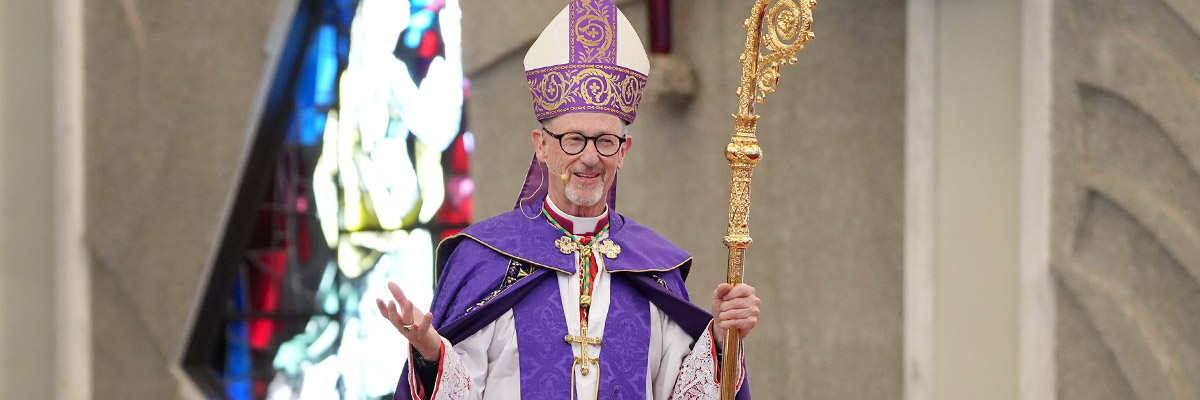
Most Rev. James D. Conley, S.T.L., Auxiliary Bishop of Denver, a keynote presenter, delivered the following address at Denver's annual Living the Catholic Faith Conference. "Cor Ad Cor Loquitur: Heart Speaks to Heart" is a phrase taken from a letter from Saint Francis de Sales to one of his spiritual directees. Bishop Conley focused on the idea that souls are won over to Christ one heart at a time, by supernatural grace and by the example of virtue and goodness in other people.
Having purified your souls by your obedience to the truth... love one another earnestly from the heart (1 Pt 1:22).
First of all, let me say that it is an honor and a privilege to have been invited to present one of the keynote addresses at this year's "Living the Faith Conference." I have heard about the Denver conference for a number of years now, and have always been impressed. Every year there is such a good "line up" of speakers and this year is no exception. And not only are there excellent speakers who are presenting topics that really help us to live our Catholic faith with greater conviction and authenticity, but there is also the opportunity for prayer with the celebration of the Holy Eucharist each day and the opportunity to receive the Sacrament of Confession, as well as time to spend in quiet prayer and adoration before Our Lord in the Blessed Sacrament. In the words on the cover of the brochure advertising the Conference, we all given "an opportunity to broaden, deepen and strengthen our faith."
And I can think of no better time of the year to have a Conference such as this, than at the very beginning of this holy season of Lent. The season of Lent is given to us by the Church each year for the purpose of reexamining and renewing our spiritual lives by preparing our hearts, through prayer and penance, to renew our baptismal consecration to God on Easter, and to enter more deeply into the Paschal Mystery of God's love, the saving mystery of the Passion, Death and Resurrection of Jesus Christ our Lord and Savior. To put it very simply, Lent is a time to deepen our personal response to God's universal call to holiness, the call to repentance and conversion, the call to become saints. The theme for this year's Conference "Live with conviction: for the love of Christ compels me" is taken from Saint Paul's Second Letter to the Corinthians (2 Cor 5;14), as we celebrate this special two thousandth jubilee year of the birth of Saint Paul.
As some of you might know, I have just come from the city of Guadalajara in Mexico, arriving in Denver last night, where I am in the midst of a six week intensive Spanish language course. The reason why I chose this city in Mexico is because I was told that Guadalajara has a rich Catholic tradition and is a city where the Catholic faith is very alive and active. In the short time I have been there (a little over a week), I have found this to be very true. The Archdiocese of Guadalajara has the largest seminary in the world with an enrollment of around a thousand seminarians, 700 of whom are seminarians studying for the Archdiocese of Guadalajara.
The language program I am in is "one on one" program and my teachers are very well prepared and competent, as well as very "patient" with me and my tendency to fall back into Italian, which is my default mode. In a "one on one" learning environment, four hours in the morning and two hours in the afternoon, there is no opportunity to daydream or look out the window, which is good for me, even though at the end of the day I am exhausted. My teachers are also very Catholic and much of what we discuss in class is centered on the Catholic faith..
I am staying with a wonderful host family, Francisco and Laura Romo, who, unbeknownst to me, signed me up to offer Mass in Spanish on the second day of my arrival at a nearby convent of cloistered Carmelite nuns, because their regular chaplain has been sick. I have offered Mass for the nuns every day since I arrived, including yesterday. Because the nuns are behind the cloistered grill, I can't really tell if they are laughing at my poor Spanish or are just filled with the joy of the Lord. Even though those first few days were frightening, I can't imagine a more understanding and forgiving Congregation upon whom to try out my new Spanish!
The Romo family live about a block from the local Catholic parish church, which is named, not surprisingly, after Our Lady of Guadalupe, in the neighborhood known as Chapalita. I quickly discovered that this corner parish is the spiritual center and hub of daily life in this part of Guadalajara. In the parish there are six Masses celebrated each day and twelve Masses on Sunday. Next to the church is a beautiful Eucharistic Adoration chapel where people come and go all day long to spend time in quiet prayer before our Lord in the Blessed Sacrament. I know we are not supposed to watch other people when we come to pray, but I can't help but notice the different kinds of people who come into that chapel to pray, so natural and so effortless and so very ordinary, young teenagers, business men on their way to, or home from work, mothers with infants in their arms and children in strollers, elderly grandmothers escorted by their macho grandsons, and poor indigenous peasants whose lives are very difficult but whose faith is very strong. A custom they have, which I have never seen before, is when they the chapel, after their double genuflection, they back their way out of the chapel, never turning away from the Blessed Sacrament until they reach the door. I had never seen this before.
On Ash Wednesday, in addition to the six daily Masses, ashes were distributed on the hour throughout the whole day until 10:00 at night. I received my ashes on my way home from class in the afternoon, having celebrated Mass early in the morning for the Carmelite nuns. As I was kneeling in the back of the church waiting to go up to receive my ashes, the whole message of Lent, the call to prayer, penance and alms giving, crystallized and became abundantly clear to me. I got in line to go up to receive my ashes, a sign of self denial, our own mortality and our need for conversion "remember man that you are dust and unto dust you shall return," along side the young and old, rich and poor, all sinners, all in need of conversion, all striving to be better than we are.
There were huge signs with huge letters posted outside the church reminding us of the days of fasting and abstinence during Lent, fully aware that in our human weakness we forget the laws of the Church and we need to be reminded.
And as if this were not enough, street venders were set up outside the church and all along the street selling "los tamales verdura" (vegetarian tamales) and other meatless dishes for people to take home or eat on the spot as we begin our Lenten fast. It was truly a marvel to behold, a culture fully and thoroughly infused with the Catholic faith.
As the ashes were being distributed, priests were hearing confessions in the confessionals, people were praying in the adoration chapel and the faithful kept coming and going in great numbers, all with their big smudge of ash on their foreheads, off to work or to school, in such a routine, unconscious and unassuming way. This was a part of the fabric of their lives, so normal and so real. At the end of the distribution of ashes every hour, volunteers went through the congregation taking up a collection, a meager collection to be sure, but, like the widow's mite in the gospel, these were people of faith who realized their need to give out of their own want. Their donation was more for their own spiritual good, than for the benefit of the poor who will receive their tithe.
Prayer, penance and almsgiving, it was all there in a "snapshot," before my eyes. Even though I barely know the language and I found myself deeply immersed in a culture that is very different than my own, I felt absolutely and totally at home, and proud to be a Catholic.
I begin with this story, because it is a good way to introduce my talk this afternoon entitled: Cor ad cor loquitur (heart speaks to heart). Because of the fact of the Incarnation, the coming of God as man, the Word made flesh, our world has been sanctified by the presence of God. God has invested himself into our world in an irrevocable and permanent way. In the words of the poet and priest, Gerard Manly Hopkins, in his poem entitled God's Grandeur: "the world is charged with the grandeur of God."
And if the world, therefore, is charged within by a supernatural force, because of the Incarnation, then we need only the eyes of faith to see God's manifest presence in one another, and in the events and actions of our lives and in the lives of everyone around us. And this energy, this force, is none other than God's love, the love that moves the stars and the heavens above, and, most of all, the love that moves the human heart. We are all icons of God's love and presence in the world. My new friends in Chapalita have become icons to me, showing me the way, inspiring my faith and leading me to a deeper love of Jesus Christ. The faith of others and the example of their lives, speak to our hearts, cor ad cor loquitur, of God's love in the world.
Saint Peter wrote:
| Having purified your souls by your obedience to the truth for a sincere love of the brethren, love one another earnestly form the heart. You have been born anew, not of perishable seed but of imperishable, through the living and abiding word of God. |
That imperishable seed, of course, is the love of Jesus, through whom we have been purified and born anew through our baptism. This is the love that speaks to every human heart and beckons us to obedience to the truth, the truth of God's love and will in our lives.
Heart speaks to heart, cor ad cor loquitur - the Heart of God first speaks to our hearts, it is He who has initiated this romance and not us - as Saint John reminds us: "not that we have loved God, but that he has loved us and sent his son" - then we, in turn, speak that same truth in love to one another, "a sincere love of the brethren," as St. Peter writes, "loving one another earnestly from the heart."
Cor ad cor loquitur was the motto of the great 19th century British convert to the Catholic faith and leader of the Oxford Movement, the Venerable John Henry Cardinal Newman. Newman actually presumed that these words were either from the bible or from the popular spiritual classic: Imitation of Christ, because they were so familiar to him all his life. It was only when he was named a Cardinal of the Church in 1879 at the age of 78, that he chose these words as his cardinalatial motto. He discovered that these words were actually from a letter by Saint Francis de Sales, the 17th century spiritual writer and Bishop of Geneva, written to one of his spiritual directees, from which Newman had quoted some 25 years earlier in a public letter on university preaching. He incorporated these words into his famous work on education entitled: The Idea of a University (page 410), and described how learning is a species of friendship and that were learn, primarily by the example of others.
By the way, when I found out that Newman actually took this motto from someone else, I didn't feel so bad about taking Cor ad cor loquitur as my own episcopal motto.
Newman is perhaps most famous, at least in England, for his preaching. He served as the chaplain to the students at the University of Oxford during his Anglican years. The young Anglican cleric would preach at the Vespers service every Sunday evening at the university church, Saint Mary the Virgin, and the undergraduates would flock to the church to hear his sermons. It caused such a stir in the university in the 1820s and 1830s, that the colleges actually had to change their dinner hour in order to accommodate the students' desire to attend vespers and here Dr. Newman preach. The students who regularly attended his sermons in those days would often say that it was as if Newman was speaking directly to their heart in his sermons.
Newman is arguably one the three most famous converts in the history of the Catholic Church, Saint Paul and Saint Augustine being the other two. One of the common characteristics that all three of these famous converts share in common is the fact that it is difficult to separate their lives from their writings. The events, occasions, and experiences of their lives became the purpose and inspiration for their writings. When you read their great writings, you can't help but think of the events and the adventures that were occurring in their lives at that time. Very few writers are like this. They were not abstract thinkers and writers, but rather very real, and the concrete experiences in their lives shaped and formed their writings.
Cardinal Newman was not a "systematic theologian." He did not sit down to write treatises on theological subjects in a systematic way. He considered himself an "occasional" writer. Not that he would only write "occasionally," for Newman was a prolific writer. But rather he would be prompted to write because of certain "occasions" and events that transpired in his life.
When I made my first retreat as a Catholic after my conversion to the Catholic Church during my college years, our retreat master suggested that we should all make a general confession sometime during the retreat. By a general confession I thought he meant that we should make a confession in which we confess our sins in a general and vague manner and I thought, "Now isn't this convenient!" I actually learned that a "general confession" is a confession that encompasses the sins one's entire life, which is quite a different thing.
Newman was an "occasional" writer because occasions of grace in his life inspired him to write.
Newman was a great believe in Divine Providence. He believed very clearly that God was fully engaged in this world and fully engaged in the lives of individuals. As is so often the case, we don't realize this until we look back on our lives and see how God was working all along. It is only later that we can put the puzzle together and see God's providential hand. We only come to understand later why certain things happened the way they did in our lives, why this or that particular person entered into our lives, or why events occurred at particular times in our lives.
If only we could have the presence of mind and the grace to see God's providential hand at every moment and to see the eternal significance of events and occasions in our lives as they are actually occurring at any given moment.
But we have to take it on faith. We believe that this is true and this is at the heart of what I said about the world being charged by God's presence and His grandeur. Nothing really happens randomly, everything and every life have meaning and purpose. And this is why we all have such an important role to play in the history of salvation. One soul at a time, one heart at a time, cor ad cor.
In a talk he gave to business leaders in Toronto, Canada, on Tuesday, our own Archbishop Charles Chaput put it like this:
| Our lives matter. We're here for a reason. One life, lived well, won't change the world -- but it's s a start. That's where revolutions start; with one life. So lead well, with honesty, generosity and vision; with moral character and unselfishness. Lead well, not only with what you say, but with what you do -- and in your example, that's where the renewal of your nation's public life will begin. (Archbishop Charles J. Chaput, Toronto 2/23/09) |
This is because our God is a personal God, not an impersonal force or energy who simply created the world and then retreated from it. Because of the fact of the Incarnation, the coming of Jesus as man, God entered the world definitively, and the Holy Trinity, our triune God, remains ever engaged in the human drama.
In and through Jesus Christ, God never ceases to communicate with us personally, cor ad cor, until the end of time. Christ continues to call us, first in Baptism, and then throughout our lives, whether we choose to listen and obey him or not, beckoning us to union with Him in His Most Sacred Heart. If we fall from baptismal grace, He calls us to repent and convert, He calls us "from grace to grace, and from holiness to holiness, while life is given us" (Parochial and Plain Sermons, vol. VIII, 2, p. 23).
In my own life, I look back on the people, the events and the various influences in my life and I marvel at God's providential ways. I marvel at His hidden but firm and steady hand in my life, every step of the way. "Underneath the apparent chaos of life lies a strange and wonderful order" in the world (Odd Hours by Dean Koontz pg. 220).
My undergraduate years at the University of Kansas and the blessing of a great books program in which I found myself enrolled as a college freshman, really set the tone for my entire life. It was then that my heart was first opened to truth, goodness and beauty, through the reading of the great literary works of western culture.
But my conversion to the Catholic Church, as I have only come to realize in later years, was much more than merely an intellectual conversion. I have often said that I read my way into the Catholic Church and in some sense this is true. The historical claim of the Catholic Church had a powerful influence on my conversion. I came to understand the meaning of what Cardinal Newman once said after his conversion, "to be deep in history is to cease to be Protestant."
But even more that the intellectual and historical aspect of my conversion to the Catholic Church, it was the personal friendships, the example of my teachers and the faith of others that really spoke to my heart. The quiet and unassuming living out of the Catholic faith in the lives of those around me, convinced me that I needed to be in the Catholic Church. The example of deep and authentic faith in ordinary Catholics who were just trying to love God in the best way they could, going to Mass, receiving the sacraments, trying to overcome their faults, going to confession, praying the Rosary, trying to be kind, patient, compassionate, and forgiving, and not always succeeding in the way that they wished, in a word, people trying to grow in holiness --- ultimately had the biggest influence on my conversion to the Catholic faith.
Not very much unlike at all, from the multitude of faithful who came to the church of Our Lady of Guadalupe in Chapalita on Wednesday to receive their ashes, "living out their faith with conviction" but within the very ordinary, simple and common experiences of everyday life.
Newman once wrote, and I often quote him because I know this to be true from my own life:
That next to the power and force of supernatural grace, the greatest influence over the human heart is the example of goodness and virtue in another person (Grammar of Assent).
If we all stop and think about this, we can see that it is true in our own lives. Those who have had the biggest impact in our lives, our parents, our siblings, our friends, our teachers, our co-workers, are those people who have truly loved us and have spoken to our heart through their lives and their example so much so that we have wanted to be like them, we were inspired to be a better person because of their good example. People who live with conviction because the love of Christ compels them, make a difference on other people's lives and they make a difference in the world.
In another one of his Anglican sermons preached to the undergraduates at University of Oxford entitled: Personal Influence, the Means of Propagating Truth, Newman claims that no one can be won for Jesus Christ and His Church merely by means of argumentation. Credible witnesses are more important than words. The truth of the Gospel down through the centuries, Newman writes: "has been upheld not as a system, not by books, not by argument, nor by temporal power, but by the personal influence of such men..., who are at once teachers and the patterns of it" (Fifteen Sermons Preached Before the University of Oxford Between 1826 and 1843, Sermon III, p. 40)
Newman urges his students and he urges all of us that if we deeply ponder the revealed truths of our faith through the sacred scriptures, and then live out this faith in the common and ordinary actions and duties of our everyday lives, then we will influence others towards the good in ways that we will never know. The man who does this, Newman writes, "while he is unknown to the world, yet, within the range of those who see him, he will become the object of the feelings different in kind from those which mere intellectual excellence incites. The men commonly held in popular estimation (by the world)... become small as they are approached; but the attraction exerted by unconscious holiness, is of an urgent and irresistible nature; it persuades the weak, the timid, the wavering, and the inquiring..." (Ibid pp. 94-95).
The faithful who seriously strive for holiness are generally very few in number in the history of the Church and yet, they are enough to carry on, as Newman would say: "God's noiseless work" (Ibid, p. 96).
When the then Cardinal Joseph Ratzinger, was once asked the question, as Prefect for the Congregation for the Doctrine of the Faith, about the general health and strength of the Catholic Church in the world today, he paused for a moment and then answered: "the Church is very healthy today. She is young and vigorous and growing. But she is just much smaller than most people think" (Ratzinger Report).
Through our lives of fidelity, sacrifice in obedience to the truth and authentic love of Jesus Christ, we become the best and most credible witnesses through whom the divine truth is passed on "cor ad cor" to future generations. The holiness of the Apostles, illuminated by Christ, passed on His light to others who again passed it on to others, who passed it on others again and again to our very day. Faithful Christians, willing to take their faith seriously and to live it out with conviction, become the bearers of light, bright torches in world of darkness and gloom. Illuminated by the light of Christ, they have an overwhelming influence on others, enkindling the fire of Christ in their hearts.
Newman resigned his chaplaincy at Oxford and his position as professor in 1842 and retreated to his mission parish of Littlemore which is about three miles outside of the city of Oxford, when he could no longer justify remaining in the Anglican church. At the same time, he was not convinced of the Catholic claim. He knew that if he became Catholic, his glorious days at Oxford would be gone forever.
To help resolve his dilemma, again motivated by a real occasion in his life, he began writing a book in which he would try and trace certain doctrines of Christianity down through history to see how they developed over the centuries and entitled the book: An Essay on the Development of Christian Doctrine. He wanted to trace the development of certain fundamental Christian doctrines to see if they had been changed or if they had deviated over the course of history. After three years of writing, he finally had to lay his pen down because he became convinced that the Catholic Church was the one church where Christian doctrine had truly developed under the guidance of the Holy Spirit while remaining true to its apostolic roots.
When it came time to be received into the "one true fold of the Redeemer" as Newman referred to the Catholic Church, he asked to be received by an obscure Italian Passionist missionary priest by the name of Father Dominic Barberi, now Blessed Dominic Barberi, whom he had never met, but only heard of by reputation. Fr. Dominic came to England as a missionary from Italy in the 1840s with a burning desire in his heart to convert all of England back to the Catholic Church. Fr. Dominic would preach on the street corners of London to anyone who would listen to him.
Newman had heard a story about Fr. Dominic and how one day he was preaching on a street corner in London in the dead of winter and some school boys were making fun of his Italian accent. Fr. Dominic continued to preach and one of the boys picked up a stone and threw it at Fr. Dominic and it hit him in the head. It happened to be the day after Christmas, the feast of Saint Stephen, the first Christian martyr, who was stoned to death for Christ. Remembering this, Fr. Dominic knelt down and picked up the stone, winked at the boy and put the stone in his pocket.
This was the priest whom Newman chose to hear his first confession and to receive him into the Catholic Church.
Conclusion
As I mentioned at the beginning of my talk, when God the Father sent his only Son into the world to redeem the world from sin and to open the gates of heaven and eternal life to all who would believe, the world was forever changed. God became invested in the world in a new and very personal way. He took the flesh of a woman who was a virgin, chosen by God, with her consent of course, to be his Mother. He was conceived in her womb by the power of the Holy Spirit and was born into this world nine months later. Mary was the virgin's name and it was from her heart, that his human heart was formed. It was from her body that he was nourished and raised to manhood. It was from her love that he first experienced in his human heart, the love of another human being - cor ad cor loquitur - heart speaks to heart.
The night before he died on the cross, Christ instituted the Holy Eucharist, the sacrament of his body and blood, in order to guarantee his personal presence in the world until the end of time. And when Jesus, our Savior, ascended into heaven to return to the right hand of his Father, he left his Church, then only a small band of fervent believers, trying to live up to their master's call. But he sent the Holy Spirit to guide the Church in truth until the end of time.
The personal dimension of Christianity finds its most intimate expression in the Holy Mass, "the source and summit of Christian life," as the Second Vatican Council proclaims. In the mystery of the Eucharist, God never ceases to speak to us cor ad cor . When we receive the Lord in Holy Communion we are privileged to communicate directly with God himself in a personal and intimate way, cor ad cor. This is why those precious moments immediately following Holy Common are so powerful and intimate. Receiving the Lord in Holy Communion, in the words of Saint Augustine, we become what we are and are meant to be: the Mystical Body of Christ on earth. Thus we are enabled and empowered to love as he loved, and to pass on this love to others cor ad cor.
In the Eucharist, the Sacred Heart of Jesus remains present in the Church and draws all hearts to himself. Let me end with a prayer to the Sacred Heart of Jesus, composed by the Venerable John Henry Cardinal Newman:
| O most Sacred Heart, most loving Heart of Jesus, Thou art concealed in the Holy Eucharist, and Thou beatest for us still. Now as then Thou sayest, Desidero desideravi - "with desire I have desired." I worship Thee then with all my best love and awe, with my fervent affection, with my most subdued, most resolved will. O my God, when thou dost condescend to suffer me to receive Thee, to eat and drink Thee, and Thou for while takest up Thy abode within me, O make my heart beat with Thy Heart. Purify it of all that is earthly, all that is proud and sensual, all that is hard and cruel, of all perversity, of all disorder, of all deadness. So fill it with Thee, that neither the events of the day nor the circumstances of the time may have power to ruffle it, but that in Thy love and Thy fear it my have peace" (J.H Newman, Meditations and Devotions, pp. 373-74). |
