
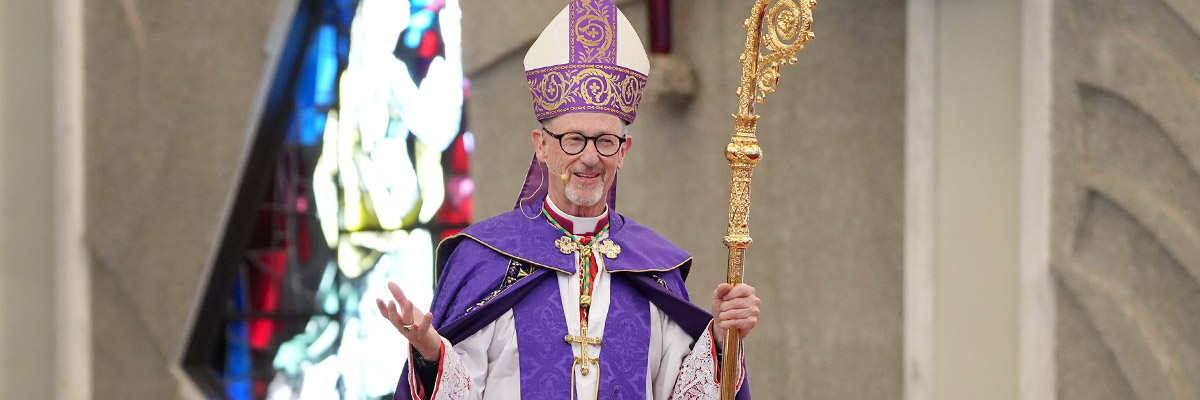
Institute for Catholic Liberal Education’s national conference in Washington, D.C.
July 14, 2022
Bishop James Conley
The title of this talk is: Logos: In the beginning was the Word – The nature and power of language.
After some further prayer, reflection and some slight modifications, I would like to add a subtitle to the talk: The End of Education!
I’m not using the word “end” as in the destruction of education, but rather in the traditional Thomistic use of the word “end.” That is to say, the purpose or goal of education. St. Thomas believed that to truly understand a subject, one must know the “end” or “purpose” of what we are wanting to know.
For us as Christians, Jesus Christ, the Logos, is the end or purpose of everything. As St. John Paul II would never tire of saying; “Jesus Christ is the answer to the question that is every human life.”
I would like to begin this talk with two stories.
The first is told by my good friend and former boss, Archbishop Charles Chaput. He tells the story of an acquaintance of his, an economics professor, who runs the doctoral program in economics at an Ivy League university. His program is one of the very best in the country. He was asked once what he values most in the undergrad background of his doctoral candidates – management theory? Accounting? Finance? Those sorts of things.
His answer was none of the above. What he especially looks for is an education in the traditional liberal arts and some fluency in our cultural heritage. And he explained why. If you want to excel in the social sciences, he said, it helps to start by knowing who and what a human being actually is, to be grounded in a sound human anthropology.
Economics is traditionally called “the dismal science,” a term coined by Thomas Carlyle, the famous 19th century Scottish writer and philosopher. He knew that manipulating market data can be tedious, soulless work. The liberal arts are precisely the opposite; they enrich the human soul and its greatness. And if they’re taught with energy and joy, they’re anything but tedious. Great literature, art, and music, along with the skills of grammar, logic, and rhetoric, are a path not just to knowledge, but even more importantly, to wisdom. A huge amount of today’s educational orthodoxy is about mastering technique and acquiring more and more information. To be sure, these things are good, as far as they go. But they don’t go far enough. A real education is about meaning – in other words, developing the character and moral vocabulary to understand and properly apply the facts and skills we acquire. Words matter.
As I said above, real education must always have an end or a goal. That’s what the roots of a word like “education” mean. The Latin verb educare comes from the words ex and ducere, to “lead out” toward some goal.
The second story I’d like to begin with is geared toward Beatle fans, of which I am one. Paul McCartney turned 80 years old last month on June 18. He recently published a 2-volume work entitled: The Lyrics: 1956-Present, by the classical publisher, Penguin Books. In this 2-volume book-set, Paul McCartney tells the background and the inspiration for 154 of his songs.
I recently listened to a podcast interview between the publisher and Paul McCartney. When Paul was asked about the major influences on his lyrics, he pointed to his education. He attended the Liverpool Institute for Boys, a 7-12 public school in Liverpool, England. He began to relate the books that he read in school, works like the epic poems of Homer and Virgil, the Odyssey and the Aeneid which he read in the early grades. He mentioned authors such as Chaucer, Shakespeare and Milton, particularly The Miller’s Tale from the Canterbury Tales by Chaucer. He said he laughed all the way through the tale for its bawdiness and outrageous humor. In the upper grades he read Dickens, Dylan Thomas and Lewis Carroll, whose description of the Walrus was the inspiration for the song, I am the Walrus on the White Album. Providentially, he met John Lennon at a church festival when he was 15 and, I guess the rest is history.
Whether you are a Beatles fan or not, the lyrics, words and melodies of those songs, absolutely captured the imagination of a whole generation. They spoke to the hearts and the imaginations of millions around the world, people of all languages. As a side note, Paul McCartney also studied Latin, German and Spanish at the Liverpool Institute for Boys. The Beatles really made their debut on the world stage in Hamburg, Germany, where they sang many of their songs in German! The point is, “words matter.” The nature and power of language can never be underestimated.
I begin with these two stories to illustrate the point that whether you are university professor of social sciences or a rock and roll star, a good grasp of language and familiarity with great literature can take you a longways.
We all know the nursery rhyme: Humpty Dumpty sat on a wall/ Humpty Dumpty had a great fall/ all the king’s horses and all the king’s men/ couldn’t put Humpty together again. It’s a kindergarten classic. And the character behind the rhyme has an interesting history. Humpty began his career 300 years ago as the name on a cannon in the English Civil War. His work as a talking egg in the fairytale industry came much later. His importance for us in this session is his co-starring role, with Alice, in Lewis Carroll’s very strange children’s story, Through the Looking Glass, published in 1871.
Humpty has an exchange with Alice in that book that’s worth noting. He says, in a rather nasty tone, that “When I use a word, it means just what I choose it to mean – neither more nor less.” Put simply: Humpty, and Humpty alone, decides whatever his words mean. It’s the kind of Promethean self-assertion that marks Humpty Dumpty as one of the most prophetic political and educational theorists of the modern era. Here's why.
Words are the basis of thought, belief, and action. A rich vocabulary expands our subtlety and precision not just in our verbal expression, but also in our thought. Thus – when properly used – language builds up the dignity of our species. Think of the plays of Shakespeare; the novels of Dickens; the poetry of Wordsworth and Hopkins; the works of Augustine and Aquinas.
To the degree that a word accurately reflects reality – words like unborn child, man and woman, male and female – it tells the truth. And as Jesus himself once said, Jesus who is the aboriginal Word or logos, “the truth will make you free.” Not always comfortable. Not always happy. But truly liberated, and always free.
On the other hand, dishonest, misleading words do the opposite. They confuse and demean us. And in the mouths of bad people, they do massive damage. Josef Pieper, the great German Catholic philosopher, wrote a short, simple text half a century ago – Abuse of Language, Abuse of Power. In it, Pieper argues that much of today’s advertising, public relations, and political lobbying – and now we might add, much of our public education -- is designed to bend the truth; to manipulate its target audience toward morally ambiguous ends. The outcome is predictable. In Pieper’s words, “Public discourse itself, separated from the standard of truth, creates [an epidemic of] vulnerability to the reign of the tyrant.” Or as Hilaire Belloc put it more crudely, “half-truths are like half bricks, you can through them twice as far.” Or, to put it another way, “verbal engineering always precedes social engineering.”
Pieper and Belloc were not alone in their worry about language. In his great 1946 essay, “Politics and the English Language,” George Orwell wrote that, “in our age, there is no such thing as ‘keeping out of politics.’ All issues are political issues, and politics itself is a mass of lies, evasions, folly, hatred, and schizophrenia.” The deceit and confusion don’t stay at the level of our politics. They inevitably trickle down into our public classrooms in the form of critical race theory, revisionist civics, and disordered sexuality.
We have a government of law, checks, and balances, designed to be of the people, by the people, for the people. In order for that to work, it needs literate citizens with a high degree of self-mastery, community loyalty, and moral sense. It needs mature adults willing to listen and not merely rant; willing to subordinate their private appetites and egos to the common good. This is why the moral framework of American public education is so important. And here, again, I’m speaking of the traditional liberal arts. Education shapes – or should shape – responsible citizens. The root of that word “responsible” literally means “answering to,” or obedient to, some higher purpose or authority, to a greater end.
Thus, the absence of God in the vocabulary of our public discourse is a statement about God. It’s an implied affirmation of his non-existence, or at least his irrelevance to human affairs. And that has practical consequences, because a concept like “the common good” is inescapably moral. It involves what each of us should and should not do to sustain our shared community life. Education of the young always involves more than simply sharing facts; it’s more than merely an information delivery system. It’s also about teaching the difference between virtue and vice, right and wrong, truth and lies. At its best, education is part of the glue that holds the country together as a unified people. So when the education system becomes ideologically corrupt, the nation begins to suffer. People conclude that they’ve lost their share of ownership in their own country.
And that’s exactly what many of us feel today.
The ferocity of verbal abuse, physical violence, and irrational hatred unleashed by otherwise “progressive” people with the downfall of Roe is instructive. Roe v Wade was always a judicial coup; a badly reasoned decision that invented a “right” to abortion out of whole cloth, unrelated to the Constitution or democratic process. But we now live in an environment where emotion substitutes for logic; where people have lost the skills of careful reasoning and cultural memory; where there’s your truth, and Ann’s truth, and Bill’s truth, and my truth. Which really means that there’s no truth at all; just the naked will to power. And the powerful make the rules to serve their own purposes, not the common good.
The American founding was shaped by Enlightenment reason and biblical morality; in other words, by a keen sense of both the dignity of human beings, and their fallenness. The founders had confidence in man’s ingenuity to build a better future, but also a realism about his weakness rooted in historical memory. They understood that the human person is utterly unique and unlike any other creature; that freedom is not license; that there is no freedom without commensurate responsibilities; that a God who created nature and humanity does exist; that there are such things as natural law and objective truths that ground the world in reality; and that a real community is more than a collection of people joined together by the same antagonisms, illusions, and sins.
We seem to be losing nearly all these little wisdoms. And that’s dangerous, because in a technological age addicted to its tools, in a nation with our wealth and global influence, our capacity for damage to human life and dignity is immense.
Back in Nebraska, we are at the height of the growing season and words are a bit like plants. They’re living organisms. We can kill them with abuse, but otherwise they develop naturally, from their seeds, over time. Take the word “liberty,” for example. Its Latin root is libertatem, meaning the condition of a free man as opposed to a slave. The word “blessing” has a similar history. In Hebrew, its root is barak, which means to kneel or to praise. Barak developed into the word baruch, as in Baruch hashem Adonai, which means “Blessed be the name of the Lord.”
Professor John Senior, my mentor in the Integrated Humanities Program at the University of Kansas, and my godfather as an adult convert, was fascinated with such words and their etymologies. And here’s the simple reason why. Our civilization’s idea of the “blessings of liberty” has always – whether we admit it or not -- been rooted in the virtue of obedience, our willing and mutually shared submission to higher, godly realities worthy of human worship. Real freedom is not self-assertion. It’s self-gift and self-sacrifice grounded in a humble self-knowledge. We become free first by mastering ourselves for the sake of others, and then receiving the same gift from them. We’re not little planets revolving around the star of our own self-importance. We’re complementary social creatures, and our souls starve if we feed only our own egos and appetites.
Here's the point: Words matter. And this is why a truly “liberal” education matters – an education alert to both humanity’s greatness and its limits; an education in the liberal arts and the richness of our moral and cultural heritage.
Many years ago, Neil Postman, the late media scholar, wrote a clever little essay titled “My Graduation Speech.” Postman wasn’t a Christian, nor – to my knowledge – was he even religious. But he had a very good grasp of what any good education must do. In his essay he argued that, sooner or later in life, everyone belongs to one of two tribes. We’re either Athenians or Visigoths: persons of maturity, self-restraint, and concern for others, with a hunger for beauty and truth; or self-centered, emotional bullies with cloddish tastes, coarsened language, and vulgar souls. He noted that it’s “much harder to be an Athenian, for you must learn how to be one, [and then] you must work at being one, whereas we’re all, in a way, natural-born Visigoths. That’s why there are so many more Visigoths than Athenians.”
A university degree or the lack of it, he said, doesn’t determine your tribe. There are plenty of lawyers, doctors, public officials, and professors who would fit quite comfortably in any barbarian camp. Some of them are running the country right now. And there are quite a few bus drivers, stay at home moms, and sanitation workers who, because of the humility and integrity of their lives, have an Athenian soul. People not tools are decisive, and their character shapes the future.
In his book The End of Education, Postman added that, at its best, schooling should be about “how to make a life, which is quite different from how to make living. Such an enterprise is not easy to pursue, since our politicians rarely speak of it, our technology is indifferent to it, and our commerce despises it. Nonetheless it’s the weightiest and most important thing” to consider for anyone interested in building or rebuilding a humane civilization.
This is why Postman was so skeptical of today’s messianic hype about computers and related new technologies in education. Postman was never a Luddite. He understood and respected the positive strengths of computers in classrooms. But he also stressed that the role of new technologies in our schools should “be discussed without the hyperactive fantasies of cheerleaders.” Especially after the disasters of the last century, we need to remember that all new technologies “are Faustian bargains, giving and taking away, sometimes in equal measure,” but too often and too negatively in unexpected and unwelcome directions. Today’s spike in the mental and other medical problems of young people is vivid proof.
A sober education in the good and bad of new tech tools is one of the most urgent needs of young students. And this is something Catholic schools, with their grounding in biblical faith and Christian anthropology, are uniquely equipped to do – assuming we have the commonsense to do it. Reading a book is a fundamentally different experience from scanning a computer screen. It produces a different and deeper emotional and intellectual response. A computer screen is composed of thousands of animated electrons. It encourages restlessness. It creates a background radiation of mental noise. An absorbing book produces the opposite: mental focus, silence, and a kind of interior rest or stability. To put it another way, the screen and the printed page -- over time -- produce two very different types of persons with different imaginations and different abilities in the crucial human work of thinking.
Which brings us back to the end of education, its telos or purpose.
A liberal arts education, at its best, reminds students why they’re human and what that means. It gives them the ability to rejoice in the grandeur of the human experience, to make sense of its sufferings, to respect its natural limits, and to acknowledge at least the possibility of transcendent things beyond this world.
And this is why the work you do matters.
