
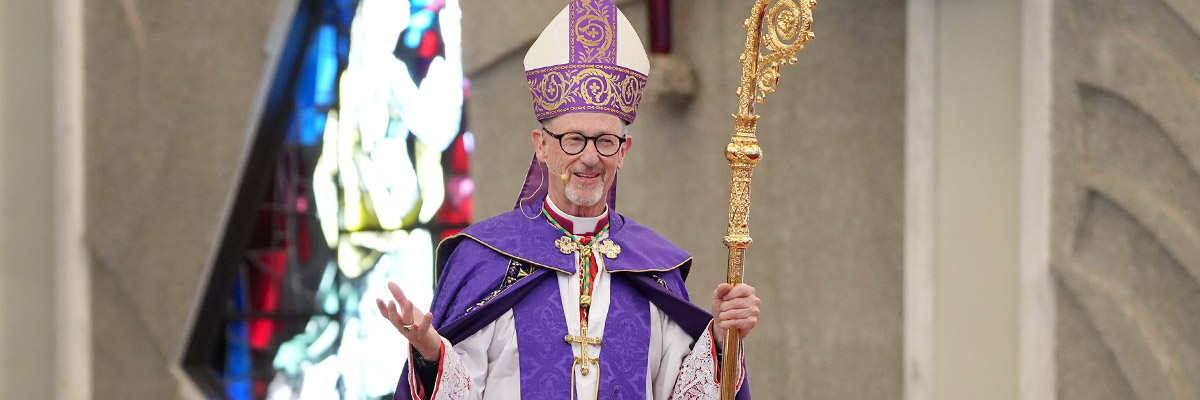
Most Rev. James D. Conley, D.D., S.T.L., Bishop of Lincoln, delivered the following homily during his installation Mass at the Cathedral of the Risen Christ in Lincoln, Neb.
Click here to read news coverage of the Installation Homily.
Your Excellency, Archbishop Vigano, archbishops and bishops, my dear brother priests, deacons and seminarians, consecrated men and women religious, my dear brothers and sisters in Christ.
I moved from Denver to Nebraska on November 6th, exactly two weeks ago today. And in that time I’ve experienced my first Husker victory and my first Runza sandwich. Both were pretty awesome.
I’ve also already eaten more kolaches than I care to admit.
But with those things behind me, I think it is fair to say that I am now a Nebraskan.
And I am pleased to welcome all our guests from out of town. Welcome to the Cornhusker State and to the city of Lincoln.
As many of you know, I am a graduate of the University of Kansas. The seeds of my conversion began there. But after college, I spent a year in a rural monastery in France and I even tried my hand at truck farming in north central Kansas, not far from the Nebraska border. Those are the places where I learned to pray. Those are the places where I learned to hear the voice of the Lord. The rhythms of the rural life are at the heart of my own spiritual life. So I’m grateful to the Lord who has brought me here to Lincoln.
I’ve been reflecting lately on the words of the great Nebraska author Willa Cather, who once wrote: “When I strike the open plains, something happens, I'm home. I breathe differently. That love of great spaces, of rolling open country like the sea—it's the great passion of my life” (from My Antonia).
The great passion of our lives as Christians must be Jesus Christ. But the plains are vast and beautiful, where the providence of God is evident. Willa Cather was right - and very wise.
I recently learned that the city of Lincoln began in 1856 as Lancaster, Nebraska. In 1867, to commemorate the death of Abraham Lincoln, the city changed its name. Lincoln has a long history of honoring great men. With that in mind, I think it is appropriate that we honor a dear friend and my predecessor - Bishop Fabian Bruskewitz. I am grateful for his 20 plus years of faithful, courageous and steadfast episcopal leadership of the Diocese of Lincoln.
Before Mass, Bishop Bruskewitz and I were discussing how grateful we are that so many people have come to Lincoln to celebrate this historic occasion with us. This is Thanksgiving week and tomorrow is one of the busiest travel days of the year. Your presence here is an honor for us. With deep gratitude, we thank you.
Today we celebrate the installation of a bishop. This is an historic moment in the life of our local Church and in the life of the Church universal. But the focus of today’s Mass is not the installation of a bishop. The focus of this Mass and the focus of every Mass is the redeeming sacrifice of Christ on the altar; the Lord truly made present to us. I pray that we encounter him in joy and in humility.
The Gospel for today’s Mass gives us the perfect image of Christ, our Savior. We are worshipping today in the Cathedral of the Risen Christ. But the Christ of today’s Gospel is the crucified Christ - the suffering servant, who like a sheep was led to the slaughter. He is the Anointed One, who was pierced for our sins.
It is the crucified Christ upon whom we gaze today. As Christians we worship his pierced and sacred heart. “They will look upon the one whom they have pierced” (Jn. 19:37). And so we entrust our hearts to his.
Today we celebrate the Votive Mass of the Sacred Heart of Jesus. In the Preface to the Eucharistic Prayer, we give thanks to God who “gave himself up for us with a wonderful love and poured out blood and water from his pierced side, the well-spring of the Church’s Sacraments, so that, won over to the open heart of the Savior, all might draw water joyfully from the springs of salvation.”
This “wonderful love” wants to win over our hearts. He wants to nourish us from his own side - through the sacramental life, and he wants to give us the gift of himself. Christ died in order to literally pour himself out for us in the grace of the sacraments. The sacraments, particularly the Holy Eucharist, are the channels of God’s grace which flows into our souls.
Christ crucified is the beautiful and harrowing mystery of our faith. It seems inconceivable, unreasonable, and unjust that the God of the universe conquers death by dying on a cross. The scandal of the Incarnation is that Christ became man to die on a cross, between two criminals, so that we could share in the life of God for all eternity.
But the love of God is found precisely at the foot of the Cross. The blood and water that pours forth from the side of Christ, is that fountain of mercy that culminates in Christ’s resurrection and in ours. We gaze at the crucified Christ because the crucifixion leads to the victory.
St. Bonaventure understood this clearly. He gazed at the crucified Christ and asked: “Who will not return love for love? Who will not embrace a heart so pure? We, who are made of flesh, will repay love with love. We will embrace our wounded one, whose hands and feet ungodly men have nailed; we will cling to his side and to his heart.”
We who wish to become saints in heaven, to share in the victory of the Resurrection, must begin by clinging to the pierced and sacred heart of Jesus Christ. Our hearts must become like his. We who wish to be saints must be willing to die like Christ, to die to sin and to ourselves. This is our only response.
My brother bishops, there is nothing more important for a bishop than the care of souls. If the Church is to flourish in the world today, if the New Evangelization is to really take root, if we are to truly build a culture of life - holiness must begin with us. Last week in Baltimore, Cardinal Dolan put it like this: “we cannot engage culture unless we allow him to first engage us.” And, if we want the New Evangelization to take root, it starts on our knees with the conversion of our own hearts.
My brother bishops, we must be the first to gaze upon the crucified Christ.
In the 6th Century, Pope St. Gregory the Great wrote his famous Pastoral Rule (Regula Pastoralis.) Aside from Scripture, it is the Church’s best manual for bishops. Gregory’s advice was clear. A man called to episcopal ministry must “die to all passions of the flesh and lead a spiritual life… He must put aside worldly prosperity… He must fear no adversity… He must be a man who is not stopped by a disobedient spirit… He must be moved to forgive… he must sympathize with the frailties of others. He must rely on the Lord.”
My brother priests, like many of you, I attribute my vocation to the influence of Blessed John Paul II.
In 1979, on a bright autumn day, I stood in a cornfield in Des Moines, Iowa, as this new pope celebrated Mass on the Feast of Saint Francis of Assisi. His message was beautiful, especially because it was rooted in the spirituality of rural life. But John Paul’s witness was more important than his message. Even by 1979, John Paul’s life was characterized by suffering—under the Nazis and then the Communists; through the death of his mother, his father, and his brother.
I was 24 years old in October of 1979. I watched a man whose life was defined by suffering, but who, at the same time, radiated joy and hope. As John Paul celebrated the Eucharist, I marveled at the wonder he exhibited. He was 59 years old, which seemed to me at the time to be ancient.
But he was energetic and joyful.
St. Ireneaus says that: “the glory of God is man fully alive.” John Paul was fully alive in his priesthood. I wanted to share in that life.
I later came to realize the magnitude of John Paul’s suffering. He was shot in 1981. He contracted Parkinson’s. More importantly, he felt the sorrow of suffering souls. He suffered with them.
But in that suffering, John Paul saw the Resurrection. He saw the redemption. John Paul’s heart was transformed into the Sacred Heart of Jesus Christ. As he gazed upon the pierced Redeemer and shared his suffering, he came to know the love of God.
Brothers, our priesthood should be characterized by joy. Our sufferings can transform our hearts into the Sacred Heart of Jesus. They can allow us to love as Christ loves.
Priests of Lincoln, we are brothers in priesthood. We are collaborators in ministry. We are stewards of God’s mysteries for our people. We offer the Eucharist together today as a sign of our solidarity in the Lord. I look forward to our fraternity and our friendships.
Blessed John Henry Cardinal Newman once wrote in the midst of his conversion to the Catholic Church: “to live is to change, and to be perfect is to have changed often.”
Perhaps some of you are wondering what changes you might see in the Diocese of Lincoln. This diocese has a rich Catholic history, solid and strong. I look forward to continuing the good work of my predecessors, especially Bishop Bruskewitz and Bishop Flavin, who have provided stellar episcopal leadership for over 40 years.
But Newman also said, unless he be mistaken for advocating change for sake of change, that the Church “changes only in order to remain the same.” Christ is the same today, yesterday and forever. As the Church faces new challenges and addresses new needs, we will need to work together to continue the new evangelization in the Diocese of Lincoln. The Church is constantly renewing herself so that, in the words of Saint Augustine, she remains “ever ancient and ever new.”
My brother priests, my commitments to you are simple. The first is that I am available to you: your lives are important to me. Please, never hesitate to be in touch with me when you need to. The second is that I will pray for you. You have been in, and will continue to be, in my intentions for Mass. Be assured that I will fast for you, intercede for you, and remember you daily in the Holy Sacrifice of the Mass.
I ask for your prayers as well. I thank you for the Masses you have already offered for me and for the diocese. I also ask for your patience as I learn a new diocese. I ask for your creativity and your ideas. You know the needs of the Church here. You have great pastoral gifts. Please share with me your hopes, and your ideas, for the Diocese of Lincoln.
Finally, I ask that you continue to strive for holiness. You were made for greatness. We are all made for greatness. And your bishop wants nothing more from you than sanctity. The Church needs holy priests now more than ever. Let us commit together to living the priesthood with joy.
My beloved seminarians, you are a supreme blessing to the diocese. The Lord has blessed the Diocese of Lincoln with an abundance of vocations to the priesthood. You give us great hope and I am so grateful that you have traveled back to Lincoln from Philadelphia and Emmitsburg, as well as our own seminary, Saint Gregory the Great, and are here with us today. And, please God, I look forward with joy to ordaining you deacons and eventually priests.
And dear consecrated women, brides of Christ, you point us to heaven by your vocation. We thank God for your generous witness to the Sacred Heart of Jesus and your “yes” to his invitation.
Dear lay faithful. Your greatest vocation is to holiness. In your daily lives, God has given you the opportunity to become holy. Family life, professional life, your social and cultural and public lives are all venues for love and sacrifice. You are called to love with the self-giving love of Jesus Christ. As Archbishop Chaput said recently: “the only thing that matters is to be a saint. That’s what we need to be. That’s what we need to become.”
Your holiness can transform the world. This is especially clear as we begin the Year of Faith.
Last month, our Holy Father, Pope Benedict XVI, began the Church’s Year of Faith. He said that the Year of Faith is “a pilgrimage into the deserts of today’s world, taking with us only what is necessary, the Gospel and the faith of the Church.”
Brothers and sisters, you live in the midst of the deserts of today’s world. You have seen the great need for Jesus Christ. Isaiah tells us that the desert is overcome when we joyfully draw water from the wellspring of salvation. Christ is the water, which pours forth from that well. Our joy should be joy in Christ.
The second reading today tells us that if we love one another as God loves, and because God loves, we will transform the world. In his epistle, St. John reminds us that our love for one another is a testimony to the saving power of Jesus Christ. Our love brings “living water” to the desert.
I have only been a bishop for four years and I was shaped and formed as a bishop by my dear friend, Archbishop Charles Chaput of Philadelphia. I learned a lot from him and from my experience in Denver. What he taught me most clearly is that Church is a family of believers, a community rooted in the incarnation of Jesus Christ.
Brothers and sisters in Christ, we are united by our baptism into Christ’s Church— the water of love poured out from the side of Christ. Washed in that water, we share the dignity of baptism, and a common vocation to holiness. The Church is not mine. The Church is ours, the community of those who are won over by the Savior’s heart.
The mission of the Church is not my responsibility alone. It is our responsibility. Your candor, your experience, your counsel and collaboration are essential to the mission of the Church. Our vocations depend on one another, and on the mercy of God.
Another great mentor in my life was Dr. John Senior, my teacher and Godfather. He compared the lay vocation to the agrarian field, which is at the heart of Nebraska. Building a Catholic culture, he said, is the work of tilling soil. “The restoration of culture, spiritually, morally, physically, demands the cultivation of the soil in which the love of Christ can grow” and flourish in our hearts, bearing abundant fruit.
The Lord depends on you, dear brothers and sisters, to joyfully go into the desert, and with the living water of Christ, cultivate fruitful soil.
Our Lady is the perfect example of joyful cultivation of Christian culture. She is the first who gazed upon the crucified Christ. From the cross, Christ's crucified and sacred heart spoke to hers, and in the love between Christ and his mother, the crucifixion yields to the resurrection. In the love of Jesus Christ, and the love of his mother, sin and death are overcome by love. Love is that which pours forth from the side of Christ and in the sacraments we find this love. In the Church we find this love. In our Blessed Mother, we find this love. And our vocation is to let that same love pour forth from us, as it pours forth from Christ himself. Through the intercession of Mary, and our love for one another, let us commit to the love of Christ’s sacred heart.
