
St. Patrick Cathedral
Fort Worth, Texas
[Transcript of Talk to Catholic Lawyers' Guild]
Bishop Vann, my brother priests and deacons, esteemed judges and attorneys, my dear brothers and sisters in Christ.
Thank you for your kind and gracious invitation to celebrate the Holy Eucharist with you, on the occasion of the annual Red Mass here in the Diocese of Fort Worth. It is an honor to be with you today.
The tradition of the Red Mass dates back to the year 1245 -- when the Bishop of Paris brought together the lawyers and law students working in his city to pray that the Holy Spirit would bless them with wisdom and good counsel. The Church has been praying for holy and virtuous lawyers for eight hundred years. Maybe another eight hundred years will finally do the trick! I am not a lawyer. But a lawyer friend of mine suggested that joke, so you can make your objections with him!
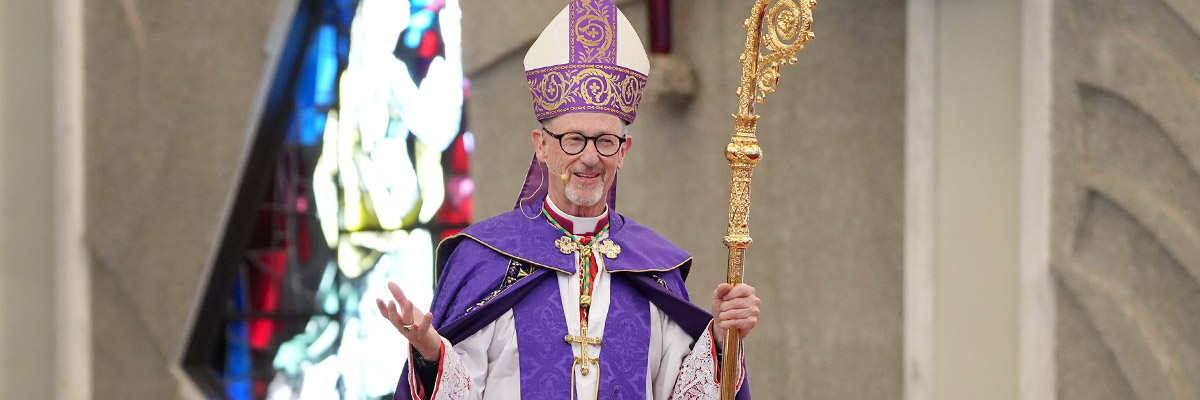
Seriously though, the Red Mass is a very beautiful and rich tradition in the life of the Church. Law is such an essential part of who we are as a people. The blessings the Holy Spirit pours out on lawyers bear fruit for all of us. I am wearing red today, as are the concelebrants of this Mass, to represent the coming of the Holy Spirit at Pentecost. As we recall, the early Church was gathered in the upper room in prayer. Suddenly the Holy Spirit came upon them with a rush of wind and rested upon them as tongues of fire. The Holy Spirit gave them the gift of tongues -- the freedom and courage and wisdom to proclaim the Gospel to the nations, in all the languages of the world.
This is an instructive moment for lawyers. The Lord has given many of you a great facility to speak well, with eloquence and conviction. A gift with words is what sets many young people on the path to a legal career. But the gift of tongues and the gift of facility with language do not exist for the sake of personal advancement or success. The Lord has given you this gift to help build up the Kingdom of God. Use what the Lord has given you to proclaim the Gospel. Our lives have no greater purpose.
After Mass, later on this evening, I’ll be talking with you a bit more about the role of law in our society and how it relates to our cultural identity. I hope you’ll be able to stay for this. But for now, I want to speak with you about two people. The first is St. Vincent de Paul, whose feast we celebrate today. St. Vincent was a French priest who was ordained in the year 1600. At the University of Toulouse he earned a doctorate in theology at the age of 26. After he completed his theological studies, his life really gets interesting. While on a short sea journey, St. Vincent de Paul was captured by pirates. He was sold into slavery in Tunisia. His master promised him freedom if he converted to Islam. Obviously, he did not.
After two years, St. Vincent, by some accounts, converted his master to Christianity and was freed. He returned to France, worked in several parishes and estates, and eventually founded a missionary society, an order of nuns, and a lay movement, all of which still bear his name. St. Vincent’s life was defined by a trust in the providential and merciful love of God. St. Vincent also trusted in the justice of God. That is the point I want to make to you today. When he returned to France from Tunisia, St. Vincent lived with an attorney who accused him of stealing a large sum of money. The accusation was made public and Vincent lost many friends, friends who believed he was a thief. But Vincent trusted in the justice of God. He knew the truth and he knew that truth would win in the end.
God’s justice prevailed. Years later, the real thief confessed. St. Vincent endured slander, distrust, and earthly injustice. But he remained confident that God’s justice would perdure. We should do the same. Today, the Church faces real challenges. For defending our religious liberty, we are sometimes called zealots. For defending traditional marriage, we are called intolerant bigots. For defending the unborn, we are called hateful names. For defending the truth about contraception and sterilization, we are accused of waging a “war on women.”
But we can trust in the justice of God. We defend religious liberty, and marriage, and the unborn because our task is to build up the Kingdom of God. If we wish to be saints in heaven one day, we must be Christ’s presence here on earth today. We must work to protect marriage. We must work to defend freedom of conscience. We must work to establish legal protection for the most vulnerable members of society, our brothers and sisters in the womb. Abortion is the great shame of our national pride. Over a million American children are killed each year for selfish and very often frivolous reasons. Children with genetic defects, like trisomy 18 or 21, are aborted at a rate of nearly 90%. Downs Syndrome kids are disappearing - they are simply going extinct. Women are pressured into making choices that will psychologically scar them for life. Our failure to protect the unborn cripples our capacity to serve the common good in other areas. We cannot really do justice to any American while abortion is legally protected in this country. Many a great leader has said: “a nation's greatness is measured by how it treats its weakest members."
Justice compels us to work for the Kingdom -- and in a special way, to do so within the legal system of our country -- to ensure that our laws respect the dignity of the unborn, the dignity of the person, and the dignity of the family. But we will face opposition in our work. We will face hatred, and persecution, and discouragement. We will all wonder, at some point, whether we will ever see justice prevail. At that point we should remember St. Vincent de Paul. We should be confident in the justice of Jesus Christ.
We wear red today to remember the Holy Spirit’s presence at Pentecost.
But we also wear red today to remember the blood Jesus Christ poured out on the cross. His blood is the victory over death and sin. His blood, poured out for mankind, is the victory of true justice. In this victory, we know, quite simply, that death no longer stings. That goodness overcomes evil. That love conquers fear and hatred. Our task is to spend our efforts to promote the justice of Jesus Christ. We may not see the fruit of our work but we should be steadfast and persevering. And we should trust in the divine justice of our savior. His justice, and not ours, is accomplished in his suffering, death, and resurrection and we commemorate that saving mystery each and every time we come to Mass.
I told you that I wanted to speak to you about two people today. The first was St. Vincent de Paul. The second, of course, is Jesus Christ.
In today’s Gospel reading our Lord is not mentioned. And yet his presence is clear. Jesus had sent his apostles into the world to preach the good news and to heal the sick -- in his name. As they traveled throughout Judea the disciples worked many miracles in the name of Jesus Christ. Today’s reading recounts the reaction of Herod to the reputation of the Apostles. In short, Herod is incredulous. His people are becoming believers in something he cannot understand -- and he must find out more.
The work of the Apostles intrigued Herod. It captivated him. On hearing about the enthusiasm of the Judeans, he felt that he must himself encounter Jesus. Consider this carefully. Jesus is not present in today’s Gospel. But the work of his disciples allows others to encounter him. Our lives must be lived so that others encounter Jesus Christ. In our work, in our communities, and within our families -- we must be the ones who help others to encounter the Lord. We must confidently proclaim what is true. We must live according to the Gospel. We must speak with our hearts of the heart of Jesus.
The great challenges our nation faces will not be overcome solely by legal battles. Law reflects culture. Law reflects the values and goals of the people it governs. If we want our law to reflect the Gospel -- we must win souls for Christ. It’s as simple as that. The world must encounter Jesus Christ when it encounters us. We must be the presence of Christ to the world. This depends on our commitment to prayer, to the sacraments, to a life of charity. The world looks not only to teachers, but, more importantly, to witnesses. The credibility of our message depends upon our love. If we are not reflections of the love of Jesus Christ, we will not effectively proclaim the Gospel. We will not transform culture.
But—if we carry ourselves as Christians, if like the Apostles we live the Gospel; we can build up the Kingdom of God by transforming the culture to Christ.
Let us go forth, like the Apostles, and like St. Vincent de Paul, and trusting in God’s mercy, let us win the world for Christ.
