
Harvard University, Cambridge, Massachusetts - Saint Paul Parish – Catholic Campus Center
Transcript of Lecture
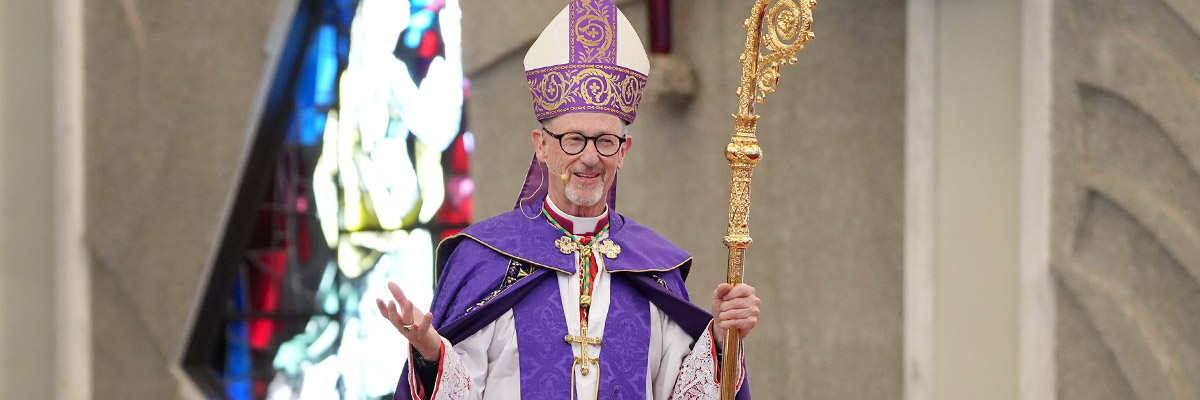
First of all, I would like to thank Fr. Michael Drea for his kind invitation to come to St. Paul’s Parish and the Harvard Catholic Center to celebrate this annual Mass of the Holy Spirit, to bless the new academic year here at Harvard University. I have known Fr. Michael since his days in the seminary and I was very happy to accept his invitation. I will be delivering a lecture this afternoon at 3pm on the great 19th century British convert to the Catholic Church, Blessed John Henry Newman, and I invite all of you to return for the lecture if you can.
I come to you from Denver, Colorado, the mile-high city (as we call it) where I have been serving as auxiliary bishop for the past four years – until Friday! The day before yesterday on the Feast of the Exultation of the Cross, our Holy Father, Pope Benedict XVI named me the new Bishop of Lincoln, Nebraska.
I flew out to Lincoln on Friday for the announcement and so the last 48 hours have been a bit of a whirlwind for me!
The FOCUS missionaries at the University of Nebraska came to my press conference and they asked me to give a ‘shout-out’ to their fellow missionaries here at Harvard – greetings from Lincoln!
I will be installed as the 9th Bishop of Lincoln on November 20th so please keep me in your prayers that I be a good shepherd to the people of Lincoln and a holy bishop, a shepherd after the Heart of Jesus, the Good Shepherd.
The readings for this Sunday, the 24th Sunday in Ordinary Time, set before us the paradox of the Christian life and the radical call to holiness: “Whoever wishes to save his life will lose it, but whoever loses his life for my sake and the sake of the gospel will save it.” This is the mystery of the cross and this is the mystery that is the key to happiness in this life and happiness forever in heaven.
“Whoever wishes to save his life will lose it, but whoever loses his life for my sake and the sake of the gospel will save it.” What does our Lord mean by these strange words?
Obviously Peter didn’t understand their meaning because Jesus reprimands him rather harshly: “Get behind me Satan!” Can you imagine how Peter must have felt? “Peter, you are thinking not as God does, but as human beings do.”
In order to understand these words, we must, as St. Paul tells us over and over, “We must put on the mind of God.” We must think as Jesus would think. Then we will understand the radical call to holiness.
If we would follow Jesus and take up our cross, we must empty ourselves and become as nothing, become totally free, and thereby be exalted, lifted up, to divine life, to supernatural life!
What Jesus is saying is this: Whoever would cling to his life, cling to the things of this world, will lose it in the end; but whoever lets go and loses his life in the love of Christ, will find real life, real happiness, real truth.
In some mysterious way we are called to “lose our lives” for the sake of Christ. He tells us that unless we are willing to give up the lives we have, we will never receive the new and everlasting life He offers.
But isn’t this simply what true love is all about. The lover, the one who truly loves, is willing to give up everything for the beloved. He or she is that “pearl of great price” for whom we would sell everything to possess. That hidden treasure found in the field; a treasure that we would spend our life’s saving to buy.
Jesus also puts it another way: “There is no greater love than to lay down one’s life for one’s friend.”
When God tells us we must surrender our lives for His sake, and for the sake of the gospel, He is not making an arbitrary or tyrannical demand! He’s simply telling us the truth about our lives. He really has our best interests at heart, believe it or not. For if we cling to things of this world and live to pursue them, put all our hopes and dreams and future desires on the things of this world, then we will be unable to receive the things of heaven – not because God would deny them to us, but because we would have no room for them in our hearts.
This past summer I made my annual retreat at a place called Littlemore in England, just about 3 miles outside Oxford, another famous university! This is the place where John Henry Newman came when he left the Oxford Chaplaincy and gave up his life as an Anglican Oxford Don and became a Roman Catholic.
After I finished my retreat, I rode a borrowed bicycle into Oxford to have dinner with a group of priest friends at the Oxford oratory, a thriving Catholic student center at Oxford.
Just down the street from St. Aloysius is a famous English pub called The Eagle and the Child, or as it is commonly called “The Bird and the Babe.” This was the pub where every Tuesday afternoon, back in the 1950s, C.S. Lewis, J.R.R. Tolkien, Owen Barfield and Charles Williams would meet for a pint or two, and discuss the books they were writing. They called themselves “The Inklings.” Lewis was authoring the “Chronicles of Narnia,” and many other works of supernatural fiction and Tolkien, of course, was writing his famous trilogy “The Fellowship of the Ring.” Imagine sitting around that table over a pint!
There is a corner booth that marks the spot where they would meet and there is a framed photograph of the four on the wall. And so I stepped in for a pint!
In one of his letters, and this is to my point, C.S. Lewis gives a good illustration of the gospel paradox in today’s Mass, when he compares our situation to that of a man who cannot receive a gift because his hands are already full.
Lewis describes it in this way. Imagine, if you will, someone carrying a full load of packages in both arms. This person is approached by another person who wants to give him a gift; but this new gift is huge in its own right that it would require both arms to receive it. So now the person has to choose between this enormous new gift being offered to him and the armload of parcels he is already carrying. It’s impossible for him to carry both.
Lewis then quotes St. Augustine: “God gives where He finds empty hands. A man whose hands are full of parcels cannot receive a new gift.”
This is what our situation is like – you and me. We have to choose between the life God offers, and the life we make for ourselves by pursuing the things the world tries to convince us we need in order to be happy. But we can’t have both because whichever one we choose will be all consuming.
The life God wants to give us is too vast, too enormous, to be carried along side the life that we will make for ourselves by our own self-centered desires. Are we willing to let go? Are we willing to drop what we have and take a chance with God?
One of Blessed John Paul II’s mantras during his 27-year Pontificate, something he repeated over and over again – was a line from the Second Vatican Council document, the Pastoral Constitution of the Church in the Modern World, Gaudium et Spes, #24.
The truth about man – the Veritas about the human person is this: “It is only Christ who can reveal to us who we really are for man is the only creature on earth whom God willed for Himself – and man can never fully find himself except through a sincere gift of himself.” In other words, it is only in giving ourselves away in love, do we really find ourselves – our true selves.
“Whoever wishes to save his life will lose it, but whoever loses his life for my sake, and for the sake of the gospel will save it.”
By faith we know that things of this present world to which we normally hold so tightly are as nothing compared to what God has prepared for those who love Him.
So let us not be afraid to set aside the things of this world. Let us empty our hands, so that we may receive that infinitely greater gift of new life, which can only be given to the one who comes before God with empty hands.
Let me conclude with the words of Pope Benedict XVI on the day he was installed as Pope:
“Are we not perhaps all afraid in some way? If we let Christ enter fully into our lives, if we open ourselves totally to Him, are we not afraid that He might take something away from us? Are we not perhaps afraid to give up something significant, something unique; something that makes life so beautiful? Do we not then risk ending up diminished and deprived of our freedom? And once again the Pope said: No! If we let Christ into our lives, we lose nothing, nothing, absolutely nothing of what makes life free, beautiful and great. No! Only in this friendship are the doors of life opened wide. Only in this friendship is the great potential of human existence truly revealed. Only in this friendship do we experience beauty and liberation. And so, today, I say to you, dear young people: Do not be afraid of Christ! He takes nothing away, and He gives you everything. When we give ourselves to him, we receive a hundredfold in return. Yes, open, open wide the doors to Christ – and you will find true life. Amen.”
