
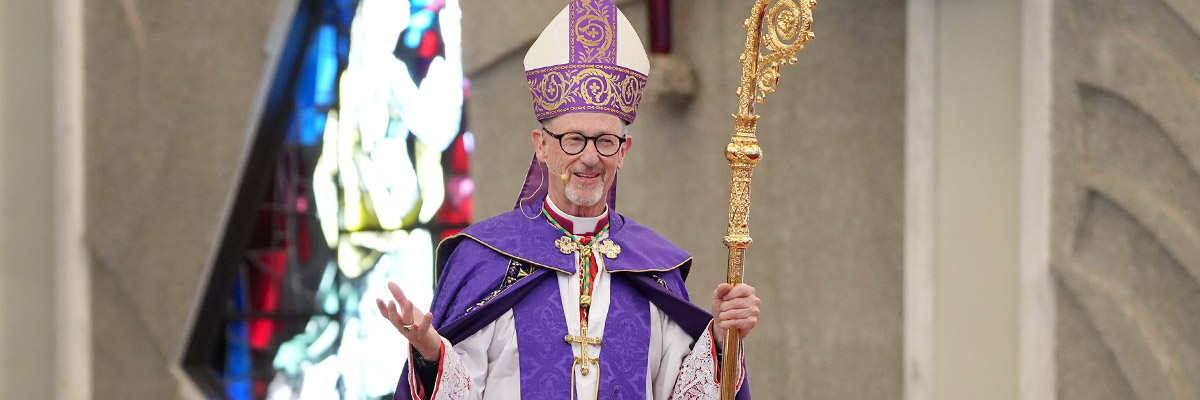
St. Catherine of Siena Catholic Parish in Denver.
Introduction
I would like to first of all thank our Pastor, Fr. Sabastien, Fr. John Gregory and the entire community of Saint Catherine of Siena for organizing this mini-Eucharistic Congress and for inviting me to celebrate the opening Mass and to preach the homily. I say "mini" Eucharistic Congress because we know that the 49th International Eucharistic Congress took place this past June in Quebec, Canada and drew cardinals, bishops (including our own Archbishop Chaput), priests, religious and the lay faithful from all over the world to celebrate the great gift of the Holy Eucharist. The first International Eucharistic Congress took place in Lille, France, in 1881. They are held every four years, kind of like the Olympics, because so much planning is involved. The next International Eucharistic Congress will take place in Dublin, Ireland, in 2012. So mark your calendars!
The purpose of a Eucharistic Congress (both local and international gatherings) is to focus our thoughts and our hearts on the mystery of the altar, and spend time reflecting on the beauty and the meaning of this great gift. The Real Presence of Jesus Christ, body, blood, soul, and divinity in the Holy Eucharist is one of the principal dogmas of our Catholic faith and is therefore of paramount importance as the most precious treasure that Christ has left to His Church as the center of Catholic worship and the source of Christian piety.
In his homily to the people gathered in Quebec this summer, delivered by way of satellite hook up, our Holy Father, Pope Benedict XVI, said these words (which can also be applied to us here this evening at Saint Catherine of Siena's as we begin our Eucharistic Congress:
I sincerely hope that this Congress will serve as an appeal to all the faithful to make a commitment to a renewal of Eucharistic catechesis, so that they themselves will gain a genuine Eucharistic awareness and will in turn teach children and young people to recognize the central mystery of faith and build their lives around it. I urge priests especially to give due honor to the Eucharistic rite, and I ask all the faithful to respect the role of each individual, both priest and lay, in the Eucharistic action. The liturgy does not belong to us: it is the Church's treasure!
Because the Holy Eucharist is the "source and summit" of our Christian and Catholic faith, a Eucharistic Congress gives us the opportunity to delve deeper into the mystery of the Holy Eucharist, and to thank God in appreciation for the great gift of the Holy Eucharist, the gift of Jesus Himself.
Our Holy Father, Pope Benedict XVI, in his first encyclical Deus Caritas Est (God is Love), tells us that every time we gather together to celebrate the Holy Eucharist, the Lord Jesus draws us in to his own act of self-giving love from the cross. "We enter into the very dynamic of his self-giving" (13) the Holy Father writes, and it is from this Eucharistic love of the Sacred Heart of Jesus, "that our definition of love must begin" (12). This is why the Eucharist is at the very center of our faith, the very center of lives, the very center of hearts.
Saint Paul
This evening, because it is a Friday, we are celebrating a votive mass in honor of the Sacred Heart of Jesus. We are taking the readings, however, from the mass of the day, Friday of the 29th week in ordinary time.
In our first reading this evening, Saint Paul is dealing with division among the new Christians at Ephesus. These new Christians thought that they were superior to others, that they had this secret wisdom that no one else had. You can see how a new Christian might be tempted to believe this. I remember when I converted to the Catholic faith when I was 20 years old, I thought I was on top of the world! I wanted everyone to be Catholic! I wanted to convert the world! And I am sure that I was a pretty obnoxious person to be around. New converts can be that way. They think they have found the key to the universe and, in a way, they have! But the new convert must first learn humility in order to be an effective evangelist.
Paul preaches to the Ephesians that it is love and not knowledge that will win souls to Christ. And this love must always show itself in unity. If we profess one Lord, we must be one in heart and mind. We are all baptized into the one body of Christ and therefore we must be united to each other in his body. We have been sealed with the one Spirit. Saint Paul tells the Ephesians, and he tells us, my dear brothers and sisters, to strive "to preserve the unity of the spirit through the bond of peace; one Body and one Spirit, as you were also called to the one hope of your call; one Lord, one faith, one baptism; one God and Father of all, who is over all and through all and in all."
Call to Holiness
This, my friends, is the call to holiness. We are all called to be saints! And God gives us everything we need to become saints! He has given us the Holy Eucharist and all the sacraments; he has given us his own Mother, the Blessed Virgin Mary, and he has given us the Holy Father, the Vicar of Christ on earth, to lead us and guide us along our pilgrim way. And there is a beautiful unity in these three "whites' if you will (or in French, "Les Trois Blancheurs"), that is to say, the white of the Holy Eucharist, the white of the Blessed Virgin Mary and the white of the Holy Father. This is what I would like to preach about this evening: "the three whites", because I have found in my years as a Catholic convert, that these three whites, the white of the Eucharist, the white of the Blessed Virgin Mary, and the white of the Holy Father, have kept me on track in my faith, they have preserved that unity of faith that Saint Paul talks about in his letter to the Ephesians, they have kept me focused on Christ.
The Three Whites
I would like to tell you a story that happened to me when I lived in Rome. I lived in worked in Rome in the Vatican for 10 years from 1996 to 2006. In addition to the work at the Vatican, most of the priests who work in the Roman Curia take on other pastoral duties to supplement our work in the Vatican. I am sure you have heard the famous response attributed to Pope John XXIII when he was once asked "how many priests work in the Vatican?" He answered: "about half".
A good number of priests in the Vatican also serve as chaplains for convents or teach at the universities or have some other pastoral outlet in addition to their work at the Vatican. During my time in Rome I served 6 years as campus chaplain for the University of Dallas Rome program and I also taught for two years for the Christendom College Rome program - both of which were wonderful pastoral outlets for me, especially since I love working with college students.
During the summertime, when the college students were away, I would sometimes celebrate Sunday Mass at the United States Naval base in Gaeta, to help fill in for the Catholic chaplain. Gaeta is located about an hour and a half south of Rome, just north of the Bay of Naples.
During that first August I was in Rome, I had volunteered to fill in several weekends for Sunday Mass at the US naval base in Gaeta. On one of those occasions, I was driving back to Rome after Sunday mass on a clear sunny summer morning and as I approached the city of Rome from the south, I saw the papal palace in Castel Gandolfo off in the distance to the east, nestled in the Alban Hills. I remembered that the Holy Father, Pope John Paul II at the time, was actually staying in Castel Gandolfo during this time as his summer residence. I knew that if I made a slight deviation to the east, I could make it up there in time for the Sunday Noon Angelus. The Angelus at Castel Gandolfo in the summertime is always a nice event since the crowds are much smaller there and the setting is much more informal and intimate.
Well, I made it in time for the Angelus and as I was heading out of town on my way back into Rome on the Via Appia, I noticed two nuns hitch-hiking on the side of the road! Now how can a priest pass up two nuns hitch-hiking! So I pulled over and one of the sisters leaned in the window and said "Father, are you going into Rome?" I said: "yes sister" and then she replied, with a heavy French accent: "then you will take us to our convent no?" Her question was definitely more of a declarative statement than a request: "you will take us to our convent, no?"
After they got into the car, the sister in the front seat turned to me and asked: "Father, are you a holy priest?" I replied by saying: "Well sister, I try to be a holy priest, I want to be a holy priest". And then she said: "if you want to be a holy priest you must live the "three whites" (les trois blancheurs, as we say in French)". I then said: "okay sister, I give up, what are the "three whites?" She responded by saying: "the 'three whites' are the white of the Eucharist, the white of the Blessed Mother and the white of the Holy Father". She went on to explain to me how the three whites keep us united in our Catholic faith and help us to grow in holiness.
She then went on to talk the whole time as we made our way down the Via Appia into the city of Rome - so much so that I really had no opportunity to get a word in edgewise. Then all of sudden she blurted out: "stop the car, stop the car - this is our convent - let us out". After I pulled over and let the good sisters out, the one sister leaned her head back in the window and said once again: "now don't forget the three whites" and as she did, she slapped a miraculous medal into my hand.
I never saw those sisters again during my years in Rome but I have never forgotten her message of the "three whites". It is a simple message and perhaps a very general and generic message but when you reflect upon the centrality of the "three whites" and the part they play in our lives as Catholics, I think you will agree that these are the three very important aspects of our faith. They really identify us as Catholic Christians. And, like the good sister said, they sanctify us and make us holy.
1) The white of the Holy Eucharist:
Perhaps it would be good to look very briefly at the basic Catholic teaching on the Holy Eucharist as it is found in the Catechism of the Catholic Church. The catechism begins its beautiful article on the sacrament of the Eucharist (1323) with these words:
"At the Last Supper, on the night he was betrayed, our Savior instituted the Eucharistic sacrifice of his Body and Blood. This he did in order to perpetuate the sacrifice of the cross throughout the ages until he should come again, and so to entrust to his beloved Spouse, the Church, a memorial of his death and resurrection: a sacrament of love, a sign of unity, a bond of charity, a Paschal banquet 'in which Christ is consumed, the mind is filled with grace, and a pledge of future glory is given to us'".
To me this is one of the best definitions of the Holy Eucharist we can find. It says it all. The Mass is the continuation in space and time of the saving work of God in the world, the daily perpetuation of the passion, death and resurrection - the Paschal Mystery of our Lord and Savior Jesus Christ, until he comes in glory.
Any reflection on the Holy Eucharist, should always begin with origins of the Holy Eucharist, that is, it should begin with a reflection on Holy Thursday and the Last Supper. For it was within the context of the Last Supper, the Passover meal, the night before He was crucified, that Christ simultaneously instituted both the sacrament of the Holy Eucharist and the sacrament of Holy Orders, the priesthood.
The Synoptic gospels of Matthew, Mark and Luke, all include a narrative account of the Institution of the Holy Eucharist. Saint Paul even includes an account of the Institution narrative in his first letter to the Corinthians (1 Cor 11:23-26).
I always wondered why Saint John left this important narrative completely out of his account of the Last Supper. Instead of recounted the words of institution, Saint John inserted what has come to be known as the "Farewell Discourse" of Jesus and the "High Priestly Prayer" of Jesus in chapters 13-17 of his gospel.
Saint John begins his account of the event like all the rest with the Passover meal in the Upper Room in chapter 13. But instead of giving us the actual words of institution, Saint John chooses to launch into a very profound reflection on charity and our love of God and neighbor in the context of the Holy Eucharist.
Saint John, under the inspiration of the Holy Spirit, has chosen instead to reveal the depth of Jesus' love for us in giving us the Holy Eucharist and to reveal how, in the Holy Eucharist, we are called to live out this radical love in our own lives by laying down our lives for our brothers and sisters.
Pope Benedict XVI, in a homily at an ordination mass a few years ago called the Eucharist "the of school gift of self". I think this is one of the keys to understanding Pope Benedict's theology the Holy Eucharist.
Saint John begins that 13th chapter of his gospel with the beautiful account of Jesus washing the feet of the disciples, a physical gesture of humility and pastoral charity which the Church's reenacts each year in the Liturgy of Holy Thursday.
After Jesus has completed washing the feet of his apostles, he proclaims in verse 34 and 35: "I give you a new commandment: love one another (pause) as I have loved you, so you are to love one another. If there is this love among you, then everyone will know that you are my disciples".
"Love one another as I have loved you". This is the new commandment. This is the new standard of love. What kind of love is this? It is as self-sacrificing kind of love in view of the cross. This was something totally new. Jesus would go on to say "there is no greater love than to lay down one's life for one's friend". These kinds of words had never been spoken before, until then.
So moved by this radical challenge, Peter shouts out "I will lay down my life for you".
Peter gets it!
The good shepherd lays down his life for his sheep. But like so often with Peter (and this is why I love Peter so much) he just blurts out what is on his heart and he doesn't really comprehend the full ramifications of what he is saying. The Lord then, rather embarrassingly for Peter, has to challenge him in front of all the others because the Lord knows that Peter is weak and impetuous.
Our Lord says to Peter "Will you really lay down your life for me? In very truth I tell you, before the cock crows you will have denied me three times". Poor Peter.
But in the end, after Peter has been humbled by reality and strengthened by his own three-fold profession of love before the Resurrected Lord on the shores of Galilee, he has his moment to prove to the Lord once and for all, that he is up to the task, that he is ready to love as Jesus loved. He does indeed lay down his life in martyrdom for the Lord.
This new commandment to "love as I have loved" was given by our Lord in the context of the institution of the Holy Eucharist during the Passover meal. In order to demonstrate this love and pastoral charity to which the Lord calls each one of us, he interrupted the meal and went around to each one of his apostles and washed their feet. This gesture would serve as a sign or symbol of laying down one's life in pastoral charity for one's friend, of serving one another in love, of tending to one another's needs. It was a preview of what he would do from the Cross on Calvary the very next day.
The mystery of the Cross is at the center of our lives and the mystery of the Cross is at the center of the Holy Eucharist. One glance at a crucifix reminds us of this radical kind of love that Christ demonstrated.
Without the Holy Eucharist, we simply cannot live.
Catherine Dougherty, the foundress of the Madonna House movement, had a strong and profound love for the Holy Eucharist. Catherine grew up in a small Russian village during the era of the Soviet Union. She tells of the story when she was a little girl and how one Sunday during the celebration of the Mass, the Soviet soldiers entered their parish church and shot and killed the pastor as he was standing at the altar offering the Mass.
Catherine remembers that the community from that day forward would gather each Sunday in the church at the usual time for Mass, and would recite together the prayers of the Mass. When they would come to the words of consecration there would be silence. The people would pause, and not recite the words of consecration, knowing that only priest could make these words efficacious. After a few moments they would resume the prayers of the Mass to the conclusion.
Catherine remembers that during those silent moments, hearing her mother quietly sobbing. She was shedding tears knowing that because there was no priest that Christ and his Real Presence in the Holy Eucharist was absent, even though the whole community was gathered together in prayer. There was a real void a "real absence".
Catherine said that many years passed by before they were able to have a priest come again and celebrate Mass, but the community kept gathering in the church every Sunday to pray and ask God to send them a priest. This experience helped to shape Catherine's appreciation for the Holy Eucharist and the priesthood.
I am reminded of the words of Cardinal George Pell, the Archbishop of Sydney (Australia), at his installation homily in 2003. He was speaking about the need for vocations to the priesthood and he put it like this: "without the Eucharist there is no Church and without the priest, there is no Eucharist." So please pray for priests and for vocations to the priesthood. I was at a seminary Board meeting on Thursday for our archdiocesan seminary, Saint John Vianney, and we have 74 men studying for the archdiocese of Denver. They are not all studying here in Denver but they are all studying for the archdiocese. But we need more, so you young men out there, or if you know of young men whom you think might make good priests, please consider the seminary and come and see me!
So the "white" of the Eucharist is our first "white" and is at the very heart of who we are as Catholics and defines the love to which we are called. It is the source of our unity and love as Christians and it binds us together in the one Body of Christ.
The Holy Eucharist, more than anything else, is the way Jesus reminds us to love one another, "as I have loved you". The Eucharistic sacrifice, the Mass, is an entrance, if you will, into the Paschal Mystery: the passion, death and resurrection of Christ. It makes present in time and space the saving work of God in the world. It renews, each time the Mass is offered, the redemptive act of love of Jesus from the Cross. And each one of us must be deeply grounded in the Eucharist, deeply grounded in the "white" of the Eucharist.
2) The white of the Blessed Mother
Because the "three whites" are at the center of our faith and they are the distinctively Catholic in nature, they are also the teachings that Protestants and other non-Catholics find most difficult to accept when they are considering the Catholic Church. This is another reason why, it seems to me, that the "three whites", more than anything else, identify us as Catholics. This is what makes us different from other preachers of the gospel. The "three whites" identify us as Catholics.
Interestingly enough, I had no problem with the "three whites" in my journey to the Catholic Church. Once they were explained to me by the priest who gave me instruction classes it all made perfect sense to me. I was pretty much a pushover in my conversion.
But one thing I remember very clearly and distinctly was falling in love with the Blessed Virgin Mary. Once it was explained to me that Mary was the Mother of Jesus and she was chosen by God to be the one woman among all women, to be the God-bearer, the Theotokos. And with her consent to the message from the Angel Gabriel, the Holy Spirit came down upon her and she conceived the Second Person of the Trinity, the Son of God, in order to provide God with a human nature, it all made perfect sense to me. And, she is also the Mother of the Eucharist because she is the Mother of Jesus.
I thought to myself: of course Mary should hold a special place of distinction in our faith. I thought, of course we should honor her and have special devotions to her and pray to her because she is the mother of Jesus, the Mother of God, the Mother of the Church. And I thought, of course Mary still exercised her maternal privileges even now in heaven for she still is the Mother of Jesus.
So I was convinced from the get-go that the Catholic Church had it all right about Mary. And not only did the Catholic teaching and doctrine on Mary make sense to me, like I said before, I fell in love with Mary the woman. She became my mother. She became a new love in my life that I never knew before. I fell head over heals in love with the Blessed Virgin Mary.
The last recorded words of Mary in Sacred Scripture are taken from the story of the wedding feast of Cana in John 2:5, the story of the first public miracle of Jesus. Those last recorded words of Mary were addressed to the waiters when she said to them (and to us): "do whatever he tells you". Mary appears again, of course, in the scriptures throughout the life of Jesus and she is there at the crucifixion and at the Resurrection, Ascension and Pentecost but she is silent on those occasions, she is a silent witness to all of the mysteries of our faith.
I think these last words from the wedding feast of Cana are very significant. Mary's whole life was marked by the virtue of obedience. She was obedient to her parents, Saints Joachim and Anne as a young child. She was obedient to the prescriptions of the law according to her Jewish faith as she was growing up. She was obedient to the Angel Gabriel when he spoke to her at the Annunciation and informed her of the designs God had for her life. And she was obedient to Christ from the cross when He entrusted her to His beloved disciple's care.
Growing up as a Protestant, I know the place of Mary in the Christian faith can sometimes be problematic for those of other faith traditions. Protestants tend to look at Catholic devotion to Mary as somehow taking away from Jesus, as if she were in competition with her son for our affection and devotion. This couldn't be farther from the reality. Mary was always pointing away from herself and directing out attention and obedience to her Son: "do whatever He tells you".
Obedience to the will of God is the key to happiness in this life and will determine our happiness in the life to come. Each one of us said "yes" to God when we heard the call to the priesthood with the same spirit of trust, faith and obedience that Mary modeled with her first "fiat". She continues to guide us still, along our path of obedience to God's will - especially in times of difficulty, confusion and loneliness. Mary continues to whisper into our ears each day "do whatever He tells you". She is the model of faith. She is the Mother of the one High Priest Jesus Christ and, therefore the Mother of all priests. And she is the "First Disciple".
As the second of the "three whites", we must be close to Mary in our prayer, our affections and our devotions. Mary is the unique passageway to the mysteries of her Son. As Saint Louis Marie de Montfort writes, "there can be no excess in devotion to Mary". Yes there can be excesses by way of false devotion to Mary but there can be no excesses in true devotion to Mary. As we grow in our affection and devotion to Mary through meditation on the mysteries of the Rosary, through her intercessory prayer, and through her example of humility, trust and confidence, we interiorize Christ and become who we were created to be.
George Weigel, the author of the definitive biography of JPII: Witness to Hope, wrote another marvelous little book entitled Letters to a Young Catholic. In treating the subject of a Christian vocation, Weigel very beautifully illustrates that Mary is the key to our ability to say "yes" to a calling from God. He applies this to every authentic vocation from God.
Weigel writes: "Mary is the first disciple of the Son she bore and nursed and raised. Because all Christians are grafted onto Christ in baptism, Mary is the mother of the Church, the mystical body of Christ extended in history. Through Mary's fiat, we glimpse one of the primary lessens of discipleship, a lesson which takes a lifetime to learn: we are not in charge of our lives - God is in charge of our lives! To know this is to be liberated in the truest sense of human freedom. To know this is to be set free from the restlessness that besets every human heart in every age" (57).
We need Mary's maternal love. We need her maternal protection. We need her maternal consolation and strength. And she helps to reveal to us, mystery of her Son and the mystery of the Holy Eucharist.
3) The white of the Holy Father
Finally, the third of our "three whites" is the white of the Holy Father. The first time I ever encountered our late Holy Father, Pope John Paul II, of happy memory, was in Des Moines, Iowa in October of 1979. Some of you may have been at that Mass or remember the occasion. It was his very first visit to the United States as Pope and was within the first year of his pontificate. The Mass was held outdoors at the Living History Farms, just outside of Des Moines and just so happened to be the 4th of October, the Feast of Saint Francis of Assisi. It was harvest time and the autumn rural setting was absolutely spectacular.
Everyone was anxious to see this new pope so hundreds of thousands of people traveled from all around the mid-west to attend this Mass. I hadn't been a Catholic very long at the time - not even five years. I remember traveling up to Des Moines the day before with a bunch of my friends from college and getting up at 3am the next day in order to get a good spot in the field. The day had been overcast all morning long but, as it so often happened with John Paul II, when the Holy Father's helicopter descended from the sky, the clouds parted and the sun came out.
Providentially for me, there was a woman in a wheel chair seated in front of our group along with some elderly people. Someone in the group leaned back and asked us younger bucks if someone could wheel this lady who was suffering from cancer up to the front section where a place had been designated for the sick. It was a pretty long distance to the front where the altar was located. I am not sure how pure my motives were but I quickly volunteered knowing that this lady was my ticket to the front row so I wheeled her up to the front and remained with her the duration of the Mass.
Shortly after the Holy Father made his dramatic descent from the heavens, he appeared up on the altar flanked by hundreds of bishops and perhaps a thousand priests. I will never forget seeing this new, young, manly and dynamic pope, all vested in white, leading his congregation of some 300,000 souls, in the prayers of the Mass. After the Mass was over he came down off the altar and came right over to the section where the sick were located and he blessed everyone.
I remember well that it was during that Mass and in particular, when he came so close to us, that the thought that maybe God was calling me to be a priest first entered my mind. I think up until that point, I had this crazy notion in the back of my mind that somehow converts were not allowed to become priests.
But seeing the Holy Father, the Successor of Saint Peter and Vicar of Christ on earth, surrounded by his brother bishops, the successors of the apostles, and joined by his brother priests, those chosen collaborators who were laboring in the Lord's vineyard, I knew for the first time that I wanted to be part of this team. I wanted to be on his side. I wanted to be a soldier in his army as he would lead the Church on earth into the Third Millennium. The Lord only knows how many vocations were inspired by the example of discipleship lived out in the 58 years, five months and one day of the luminous and world-transforming priestly ministry that Karol Wojtyla, Pope John Paul II.
But I know that in my own life and in my own vocation to the priesthood, the "white" of this Holy Father had a profound influence on my decision to enter the seminary and eventually to seek Holy Orders. By January of 1980, just three months later, I was driving off to the seminary to begin my first semester of college seminary.
The Holy Father has always been an anchor for me in my priesthood. Today, amid the storm and strife of conflicting and competing personal opinions, amid the discordant voices that confuse and confound so many, one voice still rings out clearly and convincingly, and that is the voice of Peter.
He continues to be the sign of unity in the Body of Christ. Guided by the Holy Spirit, he guards, safeguards and explains the faith to us in each new generation.
Let me conclude the third of our "three whites" - the white of the Holy Father - with one last quote from Pope Benedict. This was the conclusion of the Wednesday General Audience catechesis from June 7, 2006, from Saint Peter's square.
Pope Benedict is making reference to the first Council of Jerusalem from the 15th chapter of the Book of Acts where Peter carries out an executive function and exercises his petrine authority in the midst of the assembly by witnessing to the authentic faith.
Pope Benedict then makes a very interesting shift and quotes that passage from Saint Luke's gospel chapter 22:31 from the Last Supper (which I quoted earlier) where Christ entrusts to Peter the ministry of confirming his brothers in the faith. He points to this passage as a sign of the primacy of Peter. Pope Benedict shows how the Church, which is born from the paschal memorial celebrated in the Holy Eucharist, has entrusted to Peter as part of his office of primacy, the ministry of unity in the Body of Christ.
Let me conclude with the words of Pope Benedict which are quite remarkable. I think they reveal not only the brilliance and depth of our Holy Father as a theologian par excellence, but, more importantly, his humility and his deep faith and his desire for full communion with our separated brothers and sisters.
"The context of the primacy of Peter in the Last Supper, at the moment of the institution of the Eucharist, the Lord's Pasch, also indicates the ultimate meaning of this primacy: For all times, Peter must be the custodian of the communion with Christ, he must guide in the communion with Christ so that the net will not tear but sustain the great universal communion. Only together can we be with Christ who is Lord of all. (never this me and Jesus thing) Peter's responsibility thus consists of guaranteeing the communion with Christ with the charity of Christ, guiding the realization of this charity in everyday life. Let us pray so that the primacy of Peter, entrusted to poor human beings, may always be exercised in this original sense desired by the Lord, so that it will be increasingly recognized in its true meaning by brothers who are still not in communion with us".
Conclusion
In conclusion, I hope I have been able to show how the unity of our Catholic faith, the unity that Saint Paul speaks about in our first reading to the Ephesians, is deepened and made strong in our unity with the "three whites" - the white of the Holy Eucharist, the white of the Blessed Mother and the white of the Holy Father - as the three pillars, if you will, that sustain and direct our lives as Catholics and as Christians. I hope this has been an opportunity, perhaps, to renew our own faith and devotion in the "three whites".
Like the good advice given to me by the hitch-hiking French nuns, I firmly believe that the "three whites" can be the path of holiness for each one of us as we grow deeper and deeper in union with them. As Catholics and as Christians, I really believe that our identity with the "three whites" and our continual return to them in the course of our daily lives, can lead us deeper into the mystery of the Sacred Heart of Jesus, the mystery of God's love for us.
In the Book of Ecclesiastes chapter 4 verse 12, we hear these words: "And though a man might prevail against one who is alone, two will withstand him. A three-ply cord is not easily broken".
Indeed, the three-ply cord of the Eucharist, the Blessed Mother and the Holy Father is not easily broken. The three together provide strength, identity, and confidence in our Lord Jesus Christ, and together keep us grounded in the love of his Most Sacred Heart.
-
Youth Protection +
-
Evangelization & Catechesis +
-
Catholic Schools +
-
Youth Ministry +
-
Family Life & Discipleship +
-
News & Media +
-
Directory, Maps & Mass Times +
-
Diocese Home +
