
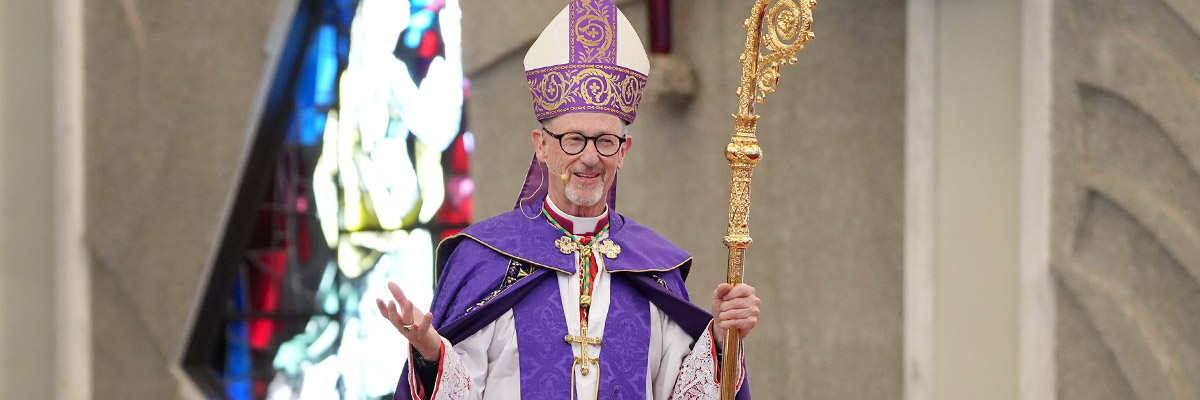
Cathedral Basilica of the Immaculate Conception, Denver, CO
(Matthew 7:21-27)
Today's gospel is taken from the 7th chapter of St. Matthew and forms the conclusion of Jesus' famous "Sermon on the Mount." This sermon, which Jesus preached to the multitudes from the grassy hills along the northern banks of the Sea of Galilee, began, as you will recall, with the Beatitudes. Our Lord now concludes his sermon with a plea to take to heart what he has said and make it your own, as a "wise man who built his house upon the rock."
In fact, in the very last sentence of this chapter, which is left out of today's gospel, St. Matthew writes: "And when Jesus finished these sayings, the crowds were astonished at his teaching, for he taught them as one who had authority, and not as their scribes".
Jesus is calling those around him and he is calling us today, to live out his words with authenticity, to make them our own, to make them real. To not simply to "talk the talk" – but to "walk the walk". For Jesus tells us today: "Not everyone who says to me, ‘Lord, Lord,' will enter the kingdom of heaven, but only the one who does the will of my Father in heaven" (Mt. 1:21).
The pharisees and the scribes could certainly "talk the talk". They were the experts in religion, they were experts in the law. But they did not teach with authority. They were not authentic teachers because their lives were not consistent with what they were teaching. In other words, they hypocrites. They didn't "walk the walk" as it were. And people saw through their hypocrisy. The scribes and pharisees said one thing but did another. They spoke out of both sides of their mouths. They didn't listen to the law with their own hearts. They didn't "make it their own".
"Faith comes through hearing", the gospel teaches us. We must first listen to the Word in order to understand how to live it in our lives. "Everyone who listens to these words of mine and acts on them..."
We might ask ourselves, what does "teaching with authority" really mean? Why were the words of Jesus so authoritative? Does it automatically come with the office - with the office of a scribe or pharisee, or with the office of bishop, the office of being a parent, the office of being a teacher? All of these roles are certainly roles of authority, but does the person in the office automatically speak with authority?
Well in some sense, the answer is yes. The office itself does hold a kind of inherent authority – the office of a bishop, a parent, a teacher, a lawyer, etc. But we all know that this authority can be abused or compromised, if the one exercising the office is not authentic, is not true to the word, is not speaking with authenticity and true conviction.
Parents know this well. Children have a sort of sixth sense for hypocrisy and when parents are not being consistent and authentic in their teaching and the disciplining of their children, they lose a big portion of their authority. They lose the respect of their children.
They still have the right and duty to apply the law, but their teaching will not be received with the same receptivity as it could and should have. There will be credibility gap in the minds of the children.
Author Jim Collins, in his New York Times best selling book: Good to Great, analyzes the most successful corporations in America over the past 25 years. In his research he discovered that the one common trait among all the CEOs of these highly successful corporations was their humility and their ability to listen to those around them.
We have to listen. How many times have you parents heard your children say: "but mom, dad, you're not listening to me!" They know when we are not listening. They know when we don't hear them or don't care to hear them. Sure, it is hard to truly listen but we can't afford not to listen.
Saint Paul reminds us in today's second reading to the Romans that we are not saved by the law, we are not saved by rules and regulations, important as they may be. Saint Paul writes: "Brothers and sisters: Now the righteousness of God has been manifested apart from the law, though testified to by the law and the prophets, the righteousness of God through faith in Jesus Christ for all who believe" (Rom 3:21).
This does not mean that the law is not important. Jesus, himself, tells us earlier in the Sermon on the Mount, that he has not come to condemn the law, but rather to fulfill the law: "Do not think that I have come to abolish the law and the prophets; I have come not to abolish them but to fulfill them. For truly, I say to you till heaven and earth pass away, not an iota, not a dot, will pass from the law until all is accomplished" (Mt. 5:17-18).
Jesus, of course, is speaking about the law of Love, which is the fulfillment of all the other laws. It is that movement of the heart that urges us to "to love as he loved", to lay down our lives for our friends, for our children, for our spouses, for our country.
To teach with authority means that one has assimilated this law of Christ into their own heart. It means that we are convinced of the truth of Christ and his Church. It means that we abide by the teachings of Christ so as to become living, authentic witnesses of his teaching. Anything short of this is hypocrisy.
This is why it is so troubling when public figures in any field take positions that are contrary to Catholic convictions about the sanctity of human life, and then claim to be good Catholics. There's a huge disconnect here, and it causes great confusion for the many honest Catholics who are sincerely trying to live their faith.
The Catholic Church has been faithful to the teachings of Jesus Christ down through the centuries, upholding these truths, correcting errors, admonishing false teachers, and remaining faithful to the sacred deposit of the faith. And "when the rain fell, the floods came, and the winds blew and buffeted the house" the Church did not collapse.
We can be sure that the teachings of Jesus and his Catholic Church are true. They are guaranteed like that house which was built on solid rock.
But we must always speak the truth with love. Sometimes we don't want to hear the truth. But sometimes we need to hear the truth and be humble enough to change our position when discover that we are not in harmony with the received teachings of the Catholic Church.
Our Holy Father, Pope Benedict XVI, spoke with authority when he visited our country last month. And people listened to him, both Catholics and non-Catholics - because he was transparent and authentic. He spoke the truth with love, and he was sincere and utterly convinced of the truth he was speaking.
Everyone likes to speak with authority. We all want people to believe us and believe in what we say. We want to convince people that what we are saying is true. I think this is part of human nature to want to live in the truth and to want others to live and believe in the truth.
Let us always listen to the teachings of Christ and his Church, and let us act on these teachings in our lives. May we be like that wise man in the gospel who built his house on rock, on the rock of Peter. And when the rain fall and the floods come and the winds blow, as they surely will, the house will not collapse because it will have been built on solid rock.
-
Youth Protection +
-
Evangelization & Catechesis +
-
Catholic Schools +
-
Youth Ministry +
-
Family Life & Discipleship +
-
News & Media +
-
Directory, Maps & Mass Times +
-
Diocese Home +
