
Midnight Mass, December 25, 2013
Cathedral of the Risen Christ
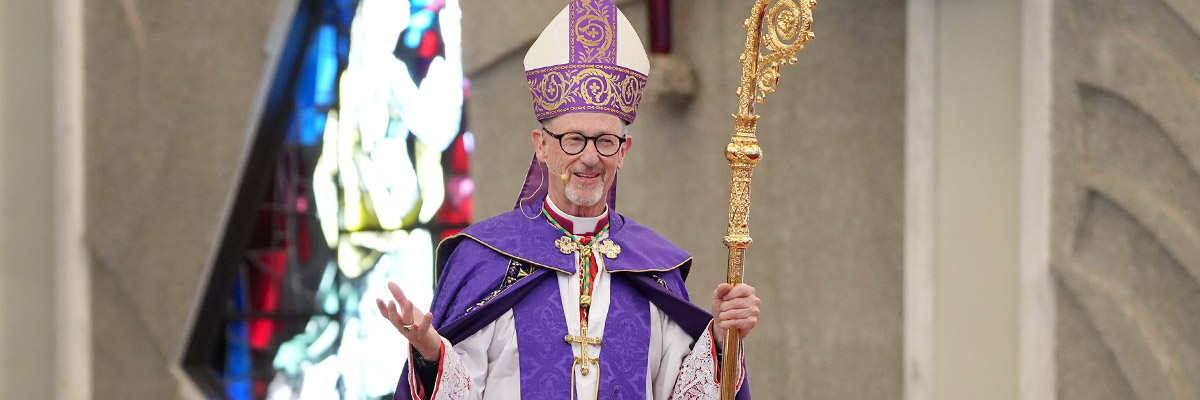
Most Rev. James D. Conley
My dear brothers and sisters in Christ,
Tonight we celebrate the Incarnation of Jesus Christ, the Son of God.
Tonight we celebrate the reality that God has become a man, in order to redeem us from our sins, and to invite us to a life of joy, of peace, and of eternal happiness with the Blessed Trinity.
Tonight, on Christmas night, at this Mass, we remember and we give thanks, that God came into the world to have real, lasting, intimate relationship with each one of us.
This past week, Pope Francis reminded us that: “the birth of Jesus is not a fairytale! It is the story of a real event, which occurred in Bethlehem two thousand years ago.” Our Holy Father goes on to say that: “faith allows us to recognize in the Child born to the Virgin Mary, the true Son of God, who did not show Himself to us in strength, in power, but in the weakness and fragility of a newborn.”
And “Christmas” he tells us, “…is the encounter with Jesus Christ himself.”
As we all know, this is Pope Francis’ first Christmas as our Supreme Pontiff. Who would have thought last Christmas at this time that Pope Benedict would soon step down from the papacy and the Church would elect a new pope. This has been an historic year for the Church.
I saw some film footage today of Pope Francis making a visit to the residence of Pope Benedict in the Vatican, to bring Christmas greetings to his beloved predecessor. It was a touching scene. They embraced each other at the door, they prayed together in the chapel and then spent some quiet time together. It was remarkable to watch – and rare moment.
“From the humble grotto of Bethlehem,” Pope Benedict XVI spoke last Christmas, “the eternal Son of God, who became a tiny Child, addresses each one of us: he calls us, invites us to be reborn in him so that, with him, we may live eternally in communion with the Most Holy Trinity.”
Christmas is the powerful promise that we can truly know God—in the sacraments, in his sacred word and in the communion of the Church, as a real person, who desires a real, intimate, personal and eternal relationship with us.
Tonight, dear brothers and sisters, I invite each of you into the mystery of Christmas, and into the mystery of life in Jesus Christ.
In the Gospel tonight, Saint Luke tells us that Christ’s birth is announced to shepherds working in a field. The shepherds were poor men, doing a difficult and lonely job. They were preparing for a long night: counting sheep, driving away wolves, fighting sleep perhaps. They were poor men, working quietly, waiting for daybreak.
There is a reason the shepherds were chosen to be the first to hear the proclamation of the Gospel. Blessed John Henry Newman says that the “shepherds were chosen on account of their lowliness to be the first to hear of the Lord’s nativity.” Newman said that, “the Almighty wanted to show…that God had chosen the poor in this world to be heirs of His kingdom, and so to do honor to their lot.”
Shepherds were chosen, suggested Newman, because “in God’s sight greatness is less acceptable than obscurity.”
The angel comes to the shepherds to point to our common poverty, and our common need. We all need something that only Christ can provide.
We’re all poor in some way. We are sinners. And we are all dependent on God’s mercy and goodness, even for our very existence. None of us can will ourselves into being. None us can get ourselves to heaven. Our very lives are a gift and we depend upon almighty God for every breath we take and any good we might achieve.
But we will not truly encounter Jesus Christ if we are proud, or vain, or self important. We can’t. Because our pride will keep us from seeing the greatness of a small, poor, infant redeemer. Our pride will blind us from accepting a God who comes to earth as a child, a God who lives in itinerancy, and a God who dies in disgrace.
We will not see the triumph of the resurrection, and the promise of eternity, if we cannot accept that we are among those who most need Christ’s mercy.
We will not know Jesus Christ if we measure greatness by influence, or wealth, or success. Why? Because, as we see so clearly in tonight’s gospel, the Holy Family enjoyed none of those things. The Son of God was born into the world surrounded by simplicity, poverty and silence. And he did so in order to “lift up the lowly.” In order to make all of us—poor souls, and sinners—the heirs of his eternal Kingdom. In order to make all things new again.
I pray that each one of us will encounter Christ this Christmas in a new way. And I pray that each of us will see ourselves among the poor shepherds. God loves us in our simplicity, in our brokenness, and in our poverty. In fact, this is when we are most attractive to God – in our need. When we accept our need for his love—our inadequacy, our poverty—we will hear the proclamation of great joy. We will hear the angels singing “Glory to God in the highest and on earth peace to those on whom his favor rests.”
When the angels came to the shepherds at Bethlehem, they came in the silence of the night. The shepherds were hard at work. They were watching their sheep: alert for the dangers of the night. But in their work, they were focused and quiet. They were not distracted by iPhones, or television, or cable news.
And so they heard God’s Word.
If we want to hear the Word of God, proclaimed, we need to listen quietly.
When I was young, I spent about a year in a Benedictine monastery in the southwest of France. The village of Fontgombault is a beautiful place that sits along a river, where a monastery has stood for most of the last thousand years. I travelled there right after college and not long after I had become a Catholic, because I thought Christ might be calling me to become a monk.
I learned a lot about how to pray at Fontgombault. Mostly I learned how to listen for the Lord. I learned that prayer happens in sacred worship, and in the chapel, but it also happens as we go through the work of our lives. I learned that the Lord often speaks to us at unexpected times. I learned the importance of silence.
Monks work hard. At Fontgombault, the monks farm and produce their own wine, and they can be quite busy. But they are also attentive to the Lord. They’ve cultivated the virtue of silence. St. Benedict of Norcia, the father of western monasticism, writes in his famous Rule on monastic life that “the disciple's part is to be silent and to listen.”
The shepherds of Bethlehem were silent and listening. While they went through their daily work, they were alert and attentive. They chased away threats to tranquility and silence: the wolves at the gate threatening their peace. And so God’s glory was revealed to them.
This Christmas, let us try to quiet ourselves. Let us turn away from distractions, let us chase away the temptations of Satan who always tries to keep us distracted and unsettled. In our daily lives, let’s listen for the Lord. Let’s hear his glory proclaimed.
Last week, Pope Francis said that “silence is really the ‘cloud’ that covers the mystery of our relationship with the Lord… where there is no silence in our lives, the mystery is lost, it goes away. Guard the mystery with silence!”
I’m blessed, and called, to be the chief shepherd of this diocese. I’m called to chase away the distractions that keep us from hearing God’s glory. I’m called to guard the mystery of our faith. But so are you. In your homes, and in your daily lives, you are called to cultivate the tranquility and interior silence, in which the proclamation of the Lord might be manifest.
Christmas—the Incarnation of Jesus Christ—is the beginning of the Christian mystery. Because Christ becomes a man, born in the manger at Bethlehem, he is able to overcome all sin, all death. Because Christ is born in a humble stable, we can live forever in the peace, and joy, of the Most Blessed Trinity.
