
Opening Mass, Year for Consecrated Life; Solemnity of Christ the King
Cathedral of the Risen Christ, Lincoln
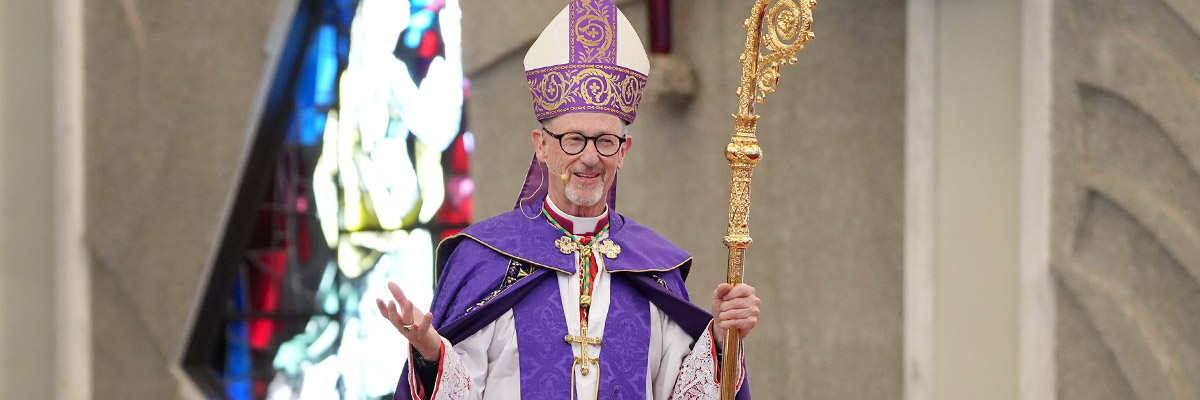
Bishop James Conley; October 26, 2014
Photos from the Mass and reception are available at the Register's photo gallery.
Bishop Bruskewitz, Father Coulter and Father Doty, our two Vicars for Religious, Msgr. Tucker, my dear brother priests, dear consecrated women, dear brothers and sisters in Christ,
I am grateful to be with you today to inaugurate a special Year of Consecrated Life and to celebrate the great Solemnity of Christ the King!
It is such a joy for me to look out today and to see so many consecrated brides of Christ, women who have dedicated their entire lives to Christ and His Catholic Church. What bishop would not be filled with joy and deep gratitude to God for the gift of your “yes” to Him, -- to look out and to see what I see today!
And I include, of course, our dear cloistered nuns and sisters, the Carmelites of the Monastery of Jesus, Mary and Joseph in Valparaiso, where Bishop Bruskewitz just this morning presided over a solemn veiling of a newly professed nun, and the Sister Servants of the Holy Spirit of Perpetual Adoration known to all as the Pink Sisters.
Lest we forget the men, I also want to recognize the Priestly Fraternity of Saint Peter, as Society of Apostolic Life for men, who staff Saint Francis Chapel here in Lincoln, and who staff and run Our Lady of Guadalupe in Denton, the North American seminary for the Fraternity.
I also want to congratulate the School Sisters of Christ the King, on this their patronal feast day. Normally the bishop celebrates a special Mass to mark this day, so I am grateful for their willingness to share this feast day with all the sisters of our diocese. I understand you had a special day of recollection yesterday.
I also want to congratulate in anticipation Sr. Rosaria and the Congregation of Missionary Sisters of the Blessed Virgin Mary, Queen of Mercy, who will celebrate the 60th anniversary of the founding of their congregation next November, 2015.
I also want to congratulate the Marian Sisters of the Diocese of Lincoln who are celebrating the 60th anniversary of their foundation here in the Diocese of Lincoln.
Pope Francis announced this special year dedicated to consecrated life to mark the 50th anniversary of the Second Vatican Council’s decree on religious life entitled: Perfectae Caritatis, as well as the 50th anniversary of Lumen Gentium, the Council’s Dogmatic Consitution on the Church. The purpose of this yearlong celebration, according to a Vatican statement, is to “make a grateful remembrance of the recent past” while embracing “the future with hope.” And we here in Lincoln, have a reason to be hopeful with the springtime of vocations we have experienced among our communities of religious women.
As you know, the Year of Consecrated Life officially begins next weekend, November 29 and 30, with the First Sunday of Advent and concludes on February 2, 2016, the Feast of the Presentation and the World Day of Consecrated Life.
And so with our upcoming civil holiday of Thanksgiving, we give thanks today for the gift of religious consecration in the life of the Church and, in a particular way, in the life of the Diocese of Lincoln.
--------------
As many of you know, the Solemnity of Christ the King was instituted in the universal calendar of the Church by Pope Pius XI in 1925, in the magnificent encyclical Quas primas. This solemnity was originally established on the last Sunday in the month of October, the Sunday closest to the Solemnity of All Saints. The solemnity was moved to the last Sunday of the liturgical year, with the establishment of the new liturgical calendar after the Second Vatican Council. As we read from the Book of Revelation in the Office of Readings for today’s solemnity, it is fitting to celebrate this feast at this point of the liturgical year in order to honor Christ the King, who is the Alpha and the Omega, the beginning and end of all things.
When Pius XI surveyed the world in 1925, he saw that believers—that the Church herself—should be prepared for a looming battle with the forces of secularism. Of course, the Holy Father was right – and in so many ways, prophetic.
Consider the world of 1925. The First World War had come and gone. Old structures and empires and allegiances had fallen. The world was changing. And Pius XI saw a gathering of storm clouds on the horizon of history. In the power vacuum of world leadership, secular, humanistic socialism was having a moment of triumph.
In France, anti-Catholic governing parties made practicing the faith virtually impossible. In the East, the Soviet Union had been formally declared three years earlier. In Latin America, Christians resisting anti-clerical secularist socialism faced martyrdom, particularly in the country of our closest neighbor, Mexico. And on the Iberian Peninsula, socialism had become the fuse in a powder keg waiting to explode with the impending Spanish Civil War.
In the decades to follow 1925, in every corner of Europe, of America, of Africa and China, secularizing forces would make the world less hospitable to the Gospel, and to the proclamation of Christ and of His Kingdom.
At their heart, the forces looming in 1925, were the forces of radical self-determination—of profound disregard for the obedience due to God. The danger of socialism is the rejection of natural human rights in favor of pragmatic consequentialism. The Enlightenment materialism, popular across Europe, adamantly rejected any sense of natural law, or justice, or virtue. And in many places, the motivation of corrupt dictatorships was far simpler—a basic unwillingness to allow the concepts of justice and morality to stand in the way of personal profiteering.
In response to these forces, Pius XI realized that world needed to be reminded of what it means to be obedient to God, to recognize the sovereignty of the divine over the human.
In Quas primas he wrote that “when once men recognize, both in private and in public life, that Christ is King, society will at last receive the great blessings of real liberty, well-ordered discipline, peace and harmony.”
In 1925, the world needed real liberty, well-ordered discipline, peace, and harmony. And so the world needed Christ the King.
It goes without saying that the modern world today needs real liberty, well-ordered discipline, peace, and harmony. We are living in a time largely devoid of authority, and mostly devoid of joyful obedience.
Absent the idea of obedience, the very idea of liberty has been turned on its head. Liberty is no longer freedom to choose the good. Liberty has become the idea that every choice should be called good—except, of course, the choices of Christian men and women. That’s the supreme irony in our culture wars today.
In 1992, the Supreme Court decision Planned Parenthood vs Casey had this to say about the notion of liberty: “Personal choices are central to the notion of liberty . . .central to the liberty protected by the 14th Amendment. At the heart of liberty is the right to define one’s own concept of existence, of meaning, of the universe, and of the mystery of human life.”
Absent the idea of obedience to something higher, something greater than ourselves, the very idea of liberty is turned on its head.
Discipline and obedience, therefore, have become, for us, evil words—a triumphalist imposition on the free choice of others.
Peace and harmony are reduced to “tolerance.” They are reduced to the idea that evil should be permitted, and even celebrated, in the name of “diversity.” Diversity and tolerance, in the end, trump everything.
Absent authority, and absent obedience, the world is quickly subject to the dictatorship of relativism. Christ the King alone defeats that evil dictatorship.
Today, we have a deeper need for the restoration of peace, of harmony, of ordered life—and of obedience—than perhaps ever before.
We have a deep need for Christ the King. As Pius XI said, “Oh, what happiness would be ours if all men, individuals, families, and nations, would but let themselves be governed by Christ!”
But we cannot expect Christ to reign in the world if the world does not know Christ. And we cannot expect that the world will come to obey Christ the King because of what I preach from this ambo. The world is looking for more than good teaching. The world is looking for witnesses! The world is looking for witnesses to the meaningful, joyful, fruitful obedience to the Kingship of Jesus Christ.
In short, dear religious sisters, the world is looking for the witness of your life. In today’s world, you profess vows of contradiction. Very few understand voluntary poverty. Even fewer understand voluntary chastity. But, perhaps, the most challenging idea for the modern world to understand is why intelligent, independent, competent women would profess a vow of obedience.
You know that obedience, though sometimes trying, is liberating. You know that in abandoning your own will, you are, as the Second Vatican Council says, “united permanently and securely to God’s salvific will.” And you know that there is security and freedom in obedience.
To quote again from Perfectae caritatis, you, dear sisters, know that “religious obedience, far from lessening the dignity of the human person, leads it to maturity by extending the freedom of the sons of God.”
Does the world know how liberating obedience to Christ the King can be? Does your life reflect that liberty? In the Year of Consecrated Life, the liberty of poverty, of chastity, and of obedience is seen as an antidote to the confusion of the modern world. Dear sisters, I pray that you will ask yourselves whether the world sees the witness of your lives of consecration.
Today, the Gospel portrays the judgment of Christ the King. In the fullness of time, the King of Kings, Jesus Christ, will separate the sheep from the goats. Those sheep Christ calls to himself will be those who have fed the hungry, who have welcomed the stranger, clothed the naked, nursed the sick, and visited the imprisoned. Those sheep Christ calls to himself will be those who have poured out their lives in love and in obedience to the reign of Christ the King in their hearts.
Pouring out your lives in love is the witness of fruitful and joyful obedience to Christ the King. Small things—small acts of selfless charity—may seem like nothing to you. But they are witnesses to the love of Jesus Christ. They are witnesses to the liberation of obedience. And they are witnesses to the reign of Christ the King in your hearts.
Your solidarity with the poor, your charity to the unloved, your joy in the company of the lost—these things witness to the reign of Christ the King. They witness to the goodness God’s love. And to your sisters, to those with whom you live in community, your humble, uncomplaining, and joyful obedience will do the same thing.
Christ will establish his reign one heart at a time—one soul at a time, one family at a time, one community at a time. You, dear consecrated women, are the emissaries of Christ the King. Lumen gentium calls you to “give splendid and striking testimony that the world cannot be transformed and offered to God without the spirit of the beatitudes.”
In this Year of Consecrated Life, may you be worthy emissaries of Christ the King. May you witness to the freedom of obedience to Christ’s leadership. May you serve Christ in the poor, the hungry, the naked, and the ill. And may you witness, in small acts of great love, to the greater love of Christ our Everlasting King.
