
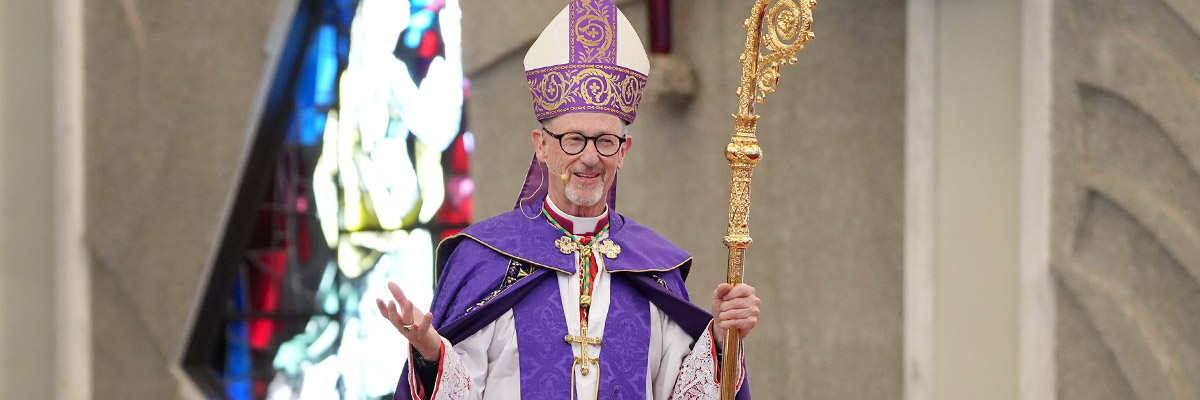
Midnight Mass, December 25, 2014
Cathedral of the Risen Christ
Most Rev. James D. Conley
Msgr. Tucker, my brother priests, deacons, seminarians, our beloved religious sisters, dear friends in Christ,
Blessings and peace to all of you tonight and welcome to the Cathedral of the Risen Christ! I’m very grateful to be here with you as we come together in vigil to celebrate the nativity of our Lord and Savior Jesus Christ.
In a special way, I’d like to welcome the members of the Cathedral parish, those of you who worship in this parish regularly. It is always a grace for me to celebrate Mass here with Msgr. Tucker, your pastor, and with all of you at the Mother Church of the Diocese of Lincoln. The cathedral community is a very special one, and I am so glad that all of you are here tonight.
I also want to welcome those of you who are not from the Cathedral parish, who may be visiting from out of town or joining us for the first time. Thank you for being here. Christmas is a time that seems to be joy-filled for everyone, and I pray that our joy at Christmas might be a source of joy for you.
I also want to welcome those of you who might be from other faith traditions who ordinarily worship in other Christian communities. The Catholic tradition of the midnight Mass is very ancient and tonight, we join Christians from all around the world who gather in the middle of the night who celebrate in anticipation the birth of our Savior. Jesus prayed that all of us who are Christians might be one—and that the world might see him in the witness of our unity. Your presence, here tonight, is an expression of Christ’s longing for unity.
In a particular way I want to welcome those of you who are Catholics, but who may not attend Mass each Sunday and who may have come back to the practice of your Catholic faith during these graced days of advent. We made an effort in the media to extend a “welcome home” to Catholics who might have been away from the sacramental practice of their faith, by expanding the times for the opportunity for confession. I had the privilege of hearing confessions myself here at the Cathedral. Christmas is a time of tremendous grace and conversion.
A friend of mine said to me recently that a practicing Catholic is one who is a work in progress. None of us have reached perfection. That’s why we are still practicing! We are all pilgrims along the way. None of us live the teachings of the Church as fully as we could, and that all of us, at times, have doubts and question and frustrations that we are unable to answer. I think that’s true. God is inviting each of us to a deeper relationship with him, to deeper love and union with him, and he is calling us to a greater love our friends and neighbors.
Dear friends, we are glad that you are here and, when you are not here, you are missed. You are a part of the body of Christ, and without you, the body is weaker than it might be. You have something unique and something important to offer to the life of our Church. So I am very glad that you are here, and I pray that you will continue to join us at Mass every Sunday as we all journey together in this great Catholic adventure of faith.
********
The Gospel of Saint Luke, that we just heard proclaimed tonight by our deacon, tells a simple and familiar story:
A poor man, a common laborer, led his family on foot to the town of Bethlehem in Judea, far from their home in Nazareth, in order to comply with a government census. His wife was nine months pregnant. She was due to give birth any day. When they arrived, they found nowhere to stay. No inn. No hotel. No friend to welcome them. So they searched out and found lodging in a nearby stable. There she gave birth to a son. The child was laid in a manger.
But what was unique about the birth of this child was the fact that he did not have a human father and that his mother was a virgin. For the child born tonight was the son of God, the Word made flesh, the second person of the Blessed Trinity.
That is the story we celebrate at Holy Mass tonight. And it is a true story, not a fairy tale or ancient myth. It is an event that was recorded in history by secular historians. It is the story that St. Luke tells us that angels celebrated on the night of the child’s birth. It is the story that prophets foretold, and angels proclaimed, and shepherds and kings celebrated.
The story of this poor child’s birth has made martyrs, and moved civilizations, and changed lives.
When you go home tonight, you will put your children to bed – unless they already fall asleep in the car! In the morning they’ll wake up to stockings, and presents, and laughter. Later on you’ll feast with your friends and family. All of us will be singing, and giving thanks, and wishing one another well. We will be, in a word, rejoicing.
*********
So what are we celebrating at Christmas? What is the meaning of this story? Why does Christmas matter?
Christmas matters because we need a savior. Each one of us needs a savior. Each family needs a savior. Our world needs a savior.
In modern American culture, it is difficult to accept the idea that we need a savior.
We live in an age of incredible achievement. The technological advances of the past fifty years are unmatched by any other period in human history. We can communicate, and travel, and work in ways that would have been unimaginable 100 years ago. Advances in medicine mean that we live longer and healthier lives. Advances in agricultural science mean that more people can be fed through the fruit of our work than ever before. It is not implausible to think that in the next fifty years, we might cure cancer—in fact, at this moment, almost no technological achievement seems beyond our grasp.
And to Americans, success very often feels like our destiny. When Alexis de Tocqueville came from France to study the United States in 1831, he observed that the optimism and industry of Americans makes nearly any achievement seem very possible, and very ordinary.
We are culturally conditioned to believe that we can become anything, can achieve anything, and can conquer anything—that the only boundaries are the limits of our imaginations.
But whatever we achieve, there are certain truths we simply cannot avoid.
Each one of us is mortal. Each one of us will die. Every single person who has preceded us in life has died. We also know that each of us struggles with the challenge of goodness—that in our hearts, we wrestle with fears and anxieties, with selfishness, and with greed. And we know that across the world, people are afflicted with profound human suffering—that those who suffer loss, and mourning, and poverty, and injustice are everywhere.
Whether we look into the injustice of the world, or into the corners of our own hearts, it is obvious that we face realities that no technological solution can solve—we face the realities of sin.
We all hunger for justice, for freedom, and for love. We work for those things so zealously that they seem fundamental to our very humanity. It is fundamentally human to long for peace, to long to love and be loved. It is fundamentally human to long to live forever.
But no matter what we invent, humanity alone is incapable of achieving real justice, real freedom, or real love. And no matter how we innovate, we cannot escape the confines of our mortality.
Sin—manifested in suffering, in chaos, in selfishness, and in death, cannot be overcome by our hard work or innovation. Sin stands in the way of all we hope to achieve.
This is why we need a savior. Only a savior, God himself, can eradicate the power of sin.
We need a savior to be freed from sin. We need a savior to become the human being God created us to be.
**********
The child who was born in Bethlehem 2000 years ago was not like any other child. The child who was born—Jesus Christ—was God himself, born into humanity, in order to draw every human soul into the life of God.
Jesus Christ is the savior we’re made for.
We hear very often, from Christians and non-Christians, that God is love. Love is a kind of relationship. Love means revealing ourselves and giving ourselves and sharing ourselves with other people. Love only exists between people. We can only say that God is love because God is not one person; God is three—the Father, the Son, and the Holy Spirit.
The Blessed Trinity of God is a family of love, which exists outside of time and space, in a way that we simply cannot imagine or comprehend. In the Blessed Trinity, love is dynamic, and exciting, and powerful. It is the eternal experience of perfect satisfaction in relationship with other people.
At Christmas, a member of this Blessed Trinity entered the world as a human being—a baby. He lived as we do, and died, as we do, and then rose from the dead. He did not sin, but he suffered death because of sin. Christ is divine, and in death, he conquered sin.
By sharing our frailty, our weakness, our mortality, and then by redeeming it in the resurrection, Christ undid the power of sin. He made it possible for each of us to share in the eternal life of God.
The birth of Jesus Christ means that every single person—through Jesus Christ—can share in the love and friendship of God. Every single person is supremely loveable to the eyes of God.
God’s love means that death need not destroy us. It means that sin need not enslave us. The love of God—in Jesus Christ—means that injustice, and loneliness, and poverty, and suffering can be overcome, as we are formed and shaped by the perfect love of the Trinity itself.
We rejoice on Christmas because the birth of Jesus Christ can save us from every kind of evil, and bring to fruition every longing of our hearts.
We rejoice because in every heart, and every family, and every community, Jesus Christ can build a civilization set free by love.
***********
To celebrate Christmas, tonight we celebrate the Holy Sacrifice of the Mass. In the Mass, Christ is made present to us, as he was made present in Bethlehem. As at Bethlehem, Christ appears in the Mass in a hidden way, in the appearance of bread and wine—small, simple, unobtrusive, undetected.
The mystery of the Holy Mass is that we are made present to the sacrifice of Christ on the Cross.
Christ was born in Bethlehem, died on Calvary, and arose on Easter morning so that all humanity could have eternal life. In love, Christ made himself a sacrifice for us.
The Eucharist is the Body of Christ, made present in order to make us one with Christ, sharers in the divine life of Christ. In the Eucharist, Christ enters our lives and our hearts, and sets us free from the burdens of sin.
If you are new to the Cathedral, you will notice tonight that I am celebrating Holy Mass in an unusual way. I am celebrating the Mass with you, standing in front of the altar, as we pray and offer the sacrifice together. The Mass has been celebrated this way since ancient times. It is a reminder that Christ will return, and that we must be waiting for him, and watching for him.
Christ will return in glory to the world. The Scriptures promise that Christ will come as light from the east. We stand and face the crucifix together, and the Eucharist together, and—symbolically—we face east together, in order to watch for the return of Jesus Christ. In the Mass, we remember that he will return to us in glory.
We also stand together, facing the altar, to remember that each one us is called and invited to unite our lives to the life, death, and resurrection of Jesus Christ—and to share in his eternal life. When I celebrate Holy Mass, each of us is called to fully, freely, and consciously offer our lives, in union with Christ, for the salvation of the world.
Christ offers his body, his blood, his soul, and his divinity for the salvation of all the world. In the Mass, we receive that sacrifice. And we offer our lives as a sacrifice, in union with Christ, and in participation of the self-giving love of the Blessed Trinity.
When I offer the sacrifice of the Holy Mass, tonight, please join me by praying silently that Christ’s love will consume you—and that through him your life, like his, will bring the world into eternal life. Please join me, when I offer the sacrifice of the Mass, in praying that God will use our lives to bring salvation—through Christ—to the world.
************
At Christmas, we celebrate the birth of Jesus Christ. In him, we celebrate the birth of true freedom, of true justice, of true peace, and of everlasting joy. May we be set free from sin. May we know real love, and real peace. And may each of us, in the Body of Christ, live eternally in the love of God.
