
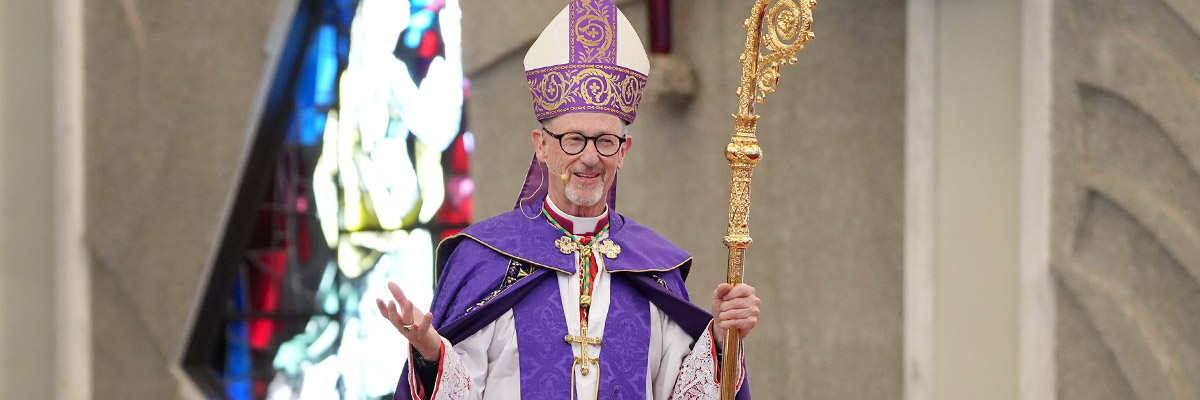
Homily for Administrators’ Day Mass
Our Lady of Good Counsel Retreat House in Waverly
March 12, 2014
Most Rev. James D. Conley
Monsignor Perkinton, Sister Collette, the Staff at the Diocesan School Office, my brother priests, dear religious sisters, Catholic school administrators, greetings to all of you on this annual spring Administrators’ Day. I remember celebrating Holy Mass with you last August on the Feast of Saint Augustine when you last met as a group, and I am grateful to be with you again, and I am grateful to God for your leadership, your service, and your deep love and dedication to the beauty and purpose of Catholic education.
The Mass we celebrate today is the Mass for Wednesday of the first full week of Lent. The readings for today’s Mass remind us of a central theme for this season of Lent, and that is the call to conversion.
In the Gospel, Jesus points to the conversion and repentance of the Ninevites through the preaching of Jonah in the Old Testament as an indictment to the “present” generation. If the wicked, pagan, and despised people of Nineveh are capable of conversion (a people that the Jews looked upon as non-believers, as pagans) and they turned away from their wicked ways, then how much more should you—“you evil generation, who are always seeking and asking for a sign”--how much more should you convert and turn to the Lord when “there is something far greater than Jonah here.”
Alas, even something far greater than the wisdomof Solomon is here - namely, the fullness of God’s revelation in the person of Jesus Christ, the Son of God. And the Lord declares emphatically: “No greater sign will be given.” In fact, no greater sign exists than the revelation of his Son in the Lord Jesus Christ.
When we think about the beauty and purpose of Catholic education, we always have to go back to the source of why we exist, to the fundamental reality of our vocation as baptized Christians—to know, love, and serve Jesus Christ, our Lord and Savior in this world and to be happy with him forever in the next.
The Second Vatican Council’s declaration on Catholic education, Gravissimum Educationis(no.2) puts it like this:
Catholic education “has as its principal purpose this goal: that the baptized, while they are gradually introduced the knowledge of the mystery of salvation, become ever more aware of the gift of Faith they have received, and that they learn in addition how to worship God the Father in spirit and truth (cf. John 4:23) especially in liturgical action, and be conformed in their personal lives according to the new man created in justice and holiness of truth (Eph. 4:22-24); also that they develop into perfect manhood, to the mature measure of the fullness of Christ (cf. Eph. 4:13) and strive for the growth of the Mystical Body; moreover, that aware of their calling, they learn not only how to bear witness to the hope that is in them (cf. Peter 3:15) but also how to help in the Christian formation of the world that takes place when natural powers viewed in the full consideration of man redeemed by Christ contribute to the good of the whole society.”
That is the purpose of Catholic education! To form disciples of Jesus Christ—to form people who know Christ, who follow Christ, and who make him known to others.
The goal of Catholic education is not excellence in education, as important as that may be. It is not equipping students to have productive and successful careers, as valuable as that may be. The goal and purpose of Catholic education is to form disciples of Jesus Christ. So, as administrators, as those charged with the important responsibility of overseeing our Catholic schools, we have to ask the question: “Are we succeeding in our goal?” “Do our students know Jesus, follow him, and share him with others? In our zeal for academic excellence, do we obscure or minimize the evangelical purpose of our schools? Do we really strive to form students to be educated disciples of Jesus Christ?”
And not only is this the purpose and goal of Catholic education, but it is also the beautyof education. I have been speaking a lot lately about the role of beauty in the New Evangelization, and the importance of beauty in the way we live our lives. Beauty attracts souls. Beauty attracts hearts. Beauty captures imaginations.
We must “lead with beauty” if we want to win the hearts and minds of our students. Our schools must be beautiful places to learn if we want our students to fall in love with learning, if we want them to embrace the lifelong adventure of discipleship! That is why I have been promoting the Catholic Textbook Project, which is a beautiful history textbook series that presents history from a Catholic perspective in attractive, user friendly, beautiful textbooks.
Saint Augustine, looking back on his youth and the years he squandered in dissolute living, searching for the next best thing, said it best when he lamented, “Late have I loved you, O beauty ever ancient, and ever new.” In other words, “You were right in front of me all along, Lord, but I could not see.”
“You seek a sign,” Jesus says today in the Gospel. “But no sign will be given.” In other words, “You have it already.” I think of this often in relation to education, particularly in regard to the current controversy over the implementation of the Common Core Standards Initiative.
It is not that common goals, standards and outcomes are the problem—we need to call our students to excellence and the highest achievement, and we should be all about that in our schools. The troubling thing about the Common Core Initiative is that the ultimate goal seems to be to create a generation of college and career ready students who can compete effectively in the global economy. Is that what education is supposed to be about? It seems to me to be an overly pragmatic and utilitarian approach to education.
Whereas the Catholic philosophy of education, from the very beginning of our medieval schools of Oxford and Salamanca and Paris, is the integral formation of the whole person, “which includes the development of all the human faculties of the students, together with the preparation for professional life, formation of ethical and social awareness, becoming aware of the transcendental and religious education.” (Vatican II) In other words, what we call a liberal education - liberal in the true sense of the word, in the sense of being liberated from the error of darkness and being truly free to walk in the light.
The liberally educated person, is the person who knows his mind and exercises virtue, who participates thoughtfully and virtuously as a member of civil society, someone who seeks the true, the good and the beautiful in his own pursuit of happiness and in his contribution to the common good of others. We know this and we have been at this for a millennium. There is no need to reinvent the wheel. We have all of the common goals and standards and the desired outcomes, if we would only look.
Let me conclude by returning to beauty once again, and the important role that beauty plays in our schools and in our efforts toward the New Evangelization. As an aside . . . I am going to speak about this tomorrow night at an event called FOCUS Create at the UNL Student Union. Tomorrow marks the first anniversary of the election of Pope Francis. Who would have thought that this new pope would have caused such a stir! He appeared on the cover of Time magazine, Rolling Stonemagazine, everywhere you look you see his face.
Of the many themes of his young pontificate, the theme of beauty keeps coming up. Not only in his words, but more in his actions, gestures, his smile, and his style. In his first Apostolic Exhortation, Evangelii Gaudium, “The Gospel of Joy,” I think my favorite paragraph is number 167. In this section, he speaks about the way of beauty, the “via pulchritudinis.” He speaks about it in the context of catechesis, in teaching the faith.
Let me conclude with Pope Francis:
“Every form of catechesis would do well to attend to the “way of beauty” (via pulchritudinis). Proclaiming Christ means showing that to believe in and to follow him is not only something right and true, but also something beautiful, capable of filling life with new splendor and profound joy, even in the midst of difficulties. Every expression of true beauty can thus be acknowledged as a path leading to an encounter with the Lord Jesus. This has nothing to do with fostering an aesthetic relativism which would downplay the inseparable bond between truth, goodness and beauty, but rather a renewed esteem for beauty as a means of touching the human heart and enabling the truth and goodness of the Risen Christ to radiate within it. If, as Saint Augustine says, we love only that which is beautiful, the incarnate Son, as the revelation of infinite beauty, is supremely lovable and draws us to himself with bonds of love. So a formation in the via pulchritudinisought to be part of our effort to pass on the faith. Each particular Church should encourage the use of the arts in evangelization, building on the treasures of the past but also drawing upon the wide variety of contemporary expressions so as to transmit the faith in a new ‘language of parables’.”
May our lives as administrators, as teachers, as formators; may our discipleship, our teaching, be the way of beauty—drawing others to the truth, goodness, and beauty of the Blessed Trinity.
