
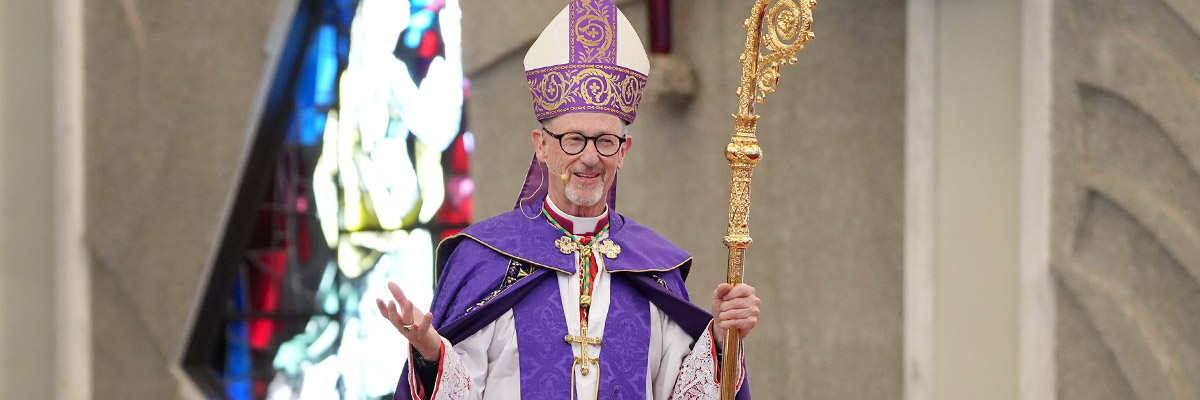
Palm Sunday of Our Lord’s Passion
Cathedral of the Risen Christ
March 29, 2015
Bishop James Conley
Monsignor Tucker, my dear brother priests, dear friends in Christ,
Today, with our celebration of Palm Sunday, we begin Holy Week, the holiest week of the liturgical year. On Thursday we begin the Sacred Triduum, the “holy three days.” We begin with the Mass of the Lord’s Supper on Thursday evening, followed on Friday with the Liturgy of the Passion and Death of the Lord, the Easter Vigil on Saturday evening and finally the celebration of the Resurrection of the Lord on Easter Sunday. These are the high holy days of our Catholic and Christian religion. These are the mysteries of our faith.
Today’s celebration is a supreme paradox. Jesus entered the city of Jerusalem like a king—like the Messiah that Israel had awaited for generations. He rode into Jerusalem on a donkey, fulfilling long-awaited prophecies. And as he traveled, people spread their cloaks upon the ground. Pope Benedict XVI says that as Jesus traveled, “a tremor of Messianic hope spread through the crowd, causing many of them to ask: this Jesus, going ahead of us towards Jerusalem, could he be the Messiah, the new David? And as he was about to enter the Holy City, had the moment come when God would finally restore the Kingdom?”
At beginning of Holy Mass today, we recalled those who welcomed Jesus to Jerusalem with fervor, hope, and great expectation. We remember those who celebrated and rejoiced, shouting to Christ and spreading palm branches on the road. These men and women were the disciples of Jesus, and those who had been impacted by their hope, and by their joy.
At the time of Jesus, devout Jews were expecting a triumphant Messiah, one who could never be defeated, one who would destroy all evils, even foreign political domination, and who would establish the glorious earthly kingdom of the Messiah with the capital at Jerusalem.
We sometimes imagine that all of Jerusalem turned up to celebrate Jesus on the road into the holy city. But to many people in Jerusalem, the crowd celebrating Jesus might have seemed ridiculous. The Roman Empire ruled Jerusalem. The Jewish people were political vassals. The crowd was celebrating a king with no army, no wealth, and apparently no power. To many people, it must have seemed impossible to imagine Jesus as the hope for Israel’s glory.
The cynical must have dismissed the crowd of disciples. The pragmatic must have figured that Jesus was insane. Even in the moment of Christ’s triumphant entry into Jerusalem, many people probably felt that the believers were pitiable, stupid, or dangerous.
In fact, even as Jesus entered the city in triumph, his crucifixion was being quietly plotted.
Our situation is no different today.
We are the disciples of Jesus, who celebrate the true freedom of redemption and eternal life. We rejoice in the Christ who “comes in the name of the Lord.”
Today, for us, we celebrate a king who many believe is powerless. We rejoice for a savior who is often dismissed and ridiculed. In the eyes of the powerful, the followers of Jesus Christ often seem foolish, and pitiable. As in Jerusalem, there are those today who wish to silence the Gospel of Jesus Christ, who object to Christians speaking out in the public square, who want to silence the voice of the Church in society.
Cynicism, pity, or rejection should not dampen our enthusiasm. Our Christian hope is in eternal salvation. We rejoice because Christ has conquered sin and death. In some ways, our culture grows ever less accepting of Jesus Christ. But we know that Christ is the way, the truth, and the life. And Palm Sunday reminds us to proclaim the Gospel with joy and enthusiasm—as witnesses to the truth, to the mercy, and to the power of Christ our King.
Even when the world doubts, it is easy to follow the Gospel in the company of our fellow believers, as the disciples did when Christ entered Jerusalem. The companionship of the Church gives energy, enthusiasm, and hope to the faithful followers of Christ.
Faithfulness is much more difficult in quiet moments of temptation. Money and power and the ways of the world quietly tempt us to betray Christ, as they tempted Judas Iscariot. Fear and embarrassment tempt us to abandon Christ, as they tempted Peter.
But the meaning of Christ’s death is that we needn’t be controlled by our temptations. We are never alone with our fears. Christ is with us. Christ, the powerful King of Kings, is with us in the quiet moments of temptation, giving us the grace to choose goodness. Christ suffered the agony of torture and crucifixion so that we might be made holy through his grace.
Each of us knows the temptations that Judas and Peter faced. Those are the moments when the grace of Jesus Christ is the most meaningful. Temptation is the moment in which Christ’s grace can be most manifested in our lives. By the cross, Christ can save us from every moment of temptation.
--
No matter what the world thinks, Jesus Christ is our King. His goodness and power are limitless.
His love is limitless also. His love drove him to Jerusalem. His love drove him to be beaten, and tortured, and crucified. The love of Christ our King conquers death and sin. And he is with us, in every moment of temptation, strengthening us to become his disciples, to follow after him, and to proclaim the Gospel.
Let us take to heart the words from an ancient homily on this day from the 8th century. St. Andrew of Crete wrote:
So let us spread before his feet, not garments or soulless olive (or palm) branches, which delight the eye for a few hours and then wither, but ourselves, clothed with his grace, or rather, clothed completely in him. We who have been baptized into Christ must ourselves be the garments that we spread before him. Now that the crimson stains of our sins have been washed away in the saving waters of baptism and we have become white as pure wool, let us present the conqueror of death, not with mere branches of palms, but with the real rewards of his victory. Let our souls take the place of welcoming branches as we join today in the children’s holy song: Blessed is he who comes in the name of the Lord. Blessed is the king of Israel.
