
Easter Vigil
Cathedral of the Risen Christ
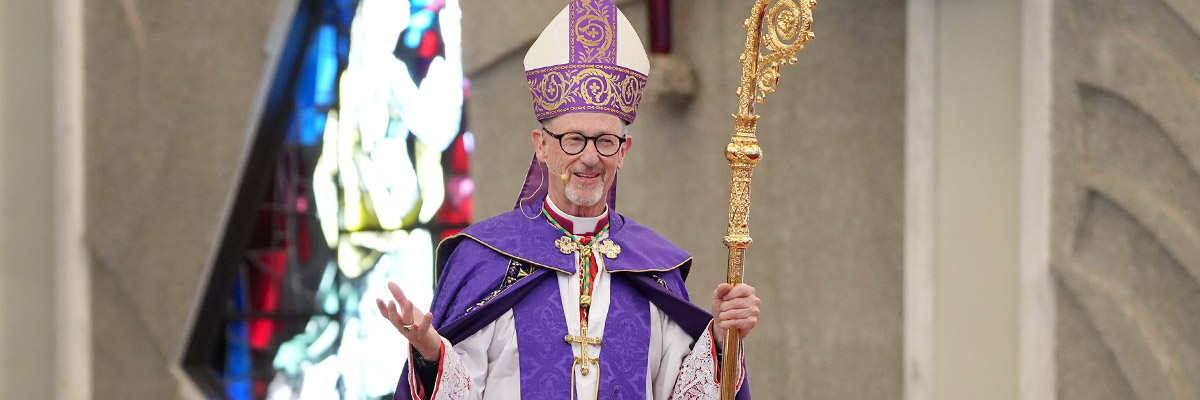
Bishop James Conley
April 4, 2015
Bishop Bruskewitz, Msgr. Tucker, my dear brother priests, deacons, seminarians, consecrated sisters, dear friends in Christ,
Tonight we are gathered together in vigil, to anticipate the resurrection of the Lord. And we are gathered together in the night. The word vigil comes from the Latin vigilia that means “wakefulness” – keeping watch through the night, anticipating a great event.
On Holy Saturday we contemplate Christ’s rest in the tomb. We have spent this day reflecting on the burial of Christ. All is quiet on this Sabbath day. The world is still.
On Thursday evening we commemorated the Last Supper of the Lord, where he instituted the great gift of the Priesthood and the Holy Eucharist, the night before he died.
Yesterday we commemorated his Passion and his death on the Cross.
And today we contemplate Christ’s rest in the tomb. This morning we gathered here at the Cathedral with our seminarians for a Tenebrae service, where we chanted the psalms of Matins and Lauds, and listened to the haunting Lamentations of the Prophet Jeremiah. Tenebraeis the Latin word for “shadows” or “darkness.”
From the Office of Matins we heard these words from an ancient homily on Holy Saturday.
Something strange is happening – there is a great silence on earth today, a great silence and stillness. The whole earth keeps silence because the King is asleep. The earth trembled and is still because God has fallen asleep in the flesh and he has raised up all who have slept, ever since the world began. God has died in the flesh and hell trembles with fear.
It is interesting to note that Easter’s date is always determined by the moon! It is always the Sunday following the first full moon after the spring equinox (March 21). This year, Easter and Passover coincide. And last night was the first full moon, the “Paschal Moon” as our Jewish brothers and sisters call it. And if you rose earlier enough this morning and went outside, you would have seen a full lunar eclipse, where the earth blocked the light of the sun perfectly. In our age of artificial lighting, it is good that we have a link to our forebears who relied on the moon both for light in the night and for a way of keeping track of time.
So it was, in the early hours of the morning, on that first Easter Vigil, when the Sabbath was over, as the light was beginning to rise in the east, that the three women made their way to the tomb of Jesus, bringing spices so that they might anoint his body.
These women were His disciples. They believed he was the chosen one, the Son of Man whom prophets had foretold. They believed that Jesus was the one their nation had awaited since God had formed them from the family of Abraham.
The women came to the tomb of the Messiah. They came to the tomb to anoint the one God had promised would set them free, bring them peace, and make them a light to the nations.
As the sun was rising, the women made their way to Christ’s tomb, to anoint his body with oils. But they didn’t find Christ’s body. They found a young man, clothed in white, waiting, almost as if to deliver a message to them.
At the tomb of Jesus, an angel told two women the truth, a truth that has forever transformed the world: “Do not be amazed! You seek Jesus of Nazareth, the crucified. He has been raised; he is not here… He is going before you to Galilee; there you will see him, as he told you.”
Jesus Christ has been raised from the dead. That truth changes everything about the world.
In the Scripture, he traveled to Galilee, to meet his disciples in the place where his ministry began, the place where everyone knew him. Pope Francis says that Christ went to Galilee to show that everything can be made new through Christ’s resurrection.
We are all sinners in need of redemption, each one of us. Our sin separates us from God. Our sin leads to death. But because Christ is resurrected from the dead, we can be free from our sins. In the waters of baptism, we can have new life. In the mercy of confession, we can have forgiveness. And in the Eucharist, we can take and eat Christ’s resurrected body, and share in his eternal life in heaven.
In a few moments, we welcome new Christians into the Church through the Sacraments of Initiation: through baptism, confirmation and Holy Eucharist. Tonight, tens of thousands of new Christians will come into the Church – all over the world. As a convert to the Catholic Church myself, it is always a joy for me to receive new Catholics into Holy Mother Church.
And for all of us, we have the opportunity to renew our own baptisms, to renew our own promises we made at baptism, to renounce Satan and the darkness of sin in our lives, and to proclaim Christ, who is the light of the world.
Because of the resurrection, we can move from the darkness of our lives into the light of God’s own life. Through the resurrection, we can feast at the heavenly banquet of God.
Everything can be made new in the resurrection.
The question, for each one of us, is whether we will accept the merciful love of God. Whether we will follow after Christ as his disciples. Whether the resurrection will change our lives because we believe it, and because we cling closely to the resurrected glory of Jesus Christ.
No matter our sinfulness, the resurrection can set us free. No matter our fear, the resurrection can bring us peace. No matter our lack of faith, the resurrection can give us faith, hope and love.
The resurrection can bring us the relationship with Jesus Christ that gives meaning to our lives, in this world, and the next.
The only appropriate response to Christ’s resurrection is wonder. The only fitting attitude is joy. The only appropriate virtue is gratitude.
Christ gave himself on a cross, to conquer once and for all death and sin. Because of that, our lives can be made anew, to live eternally with him. Let us rejoice together, and let us follow after Jesus Christ as he makes us new creatures in him.
