
Mass of Dedication and Consecration of Saint Thomas Aquinas - Newman Center
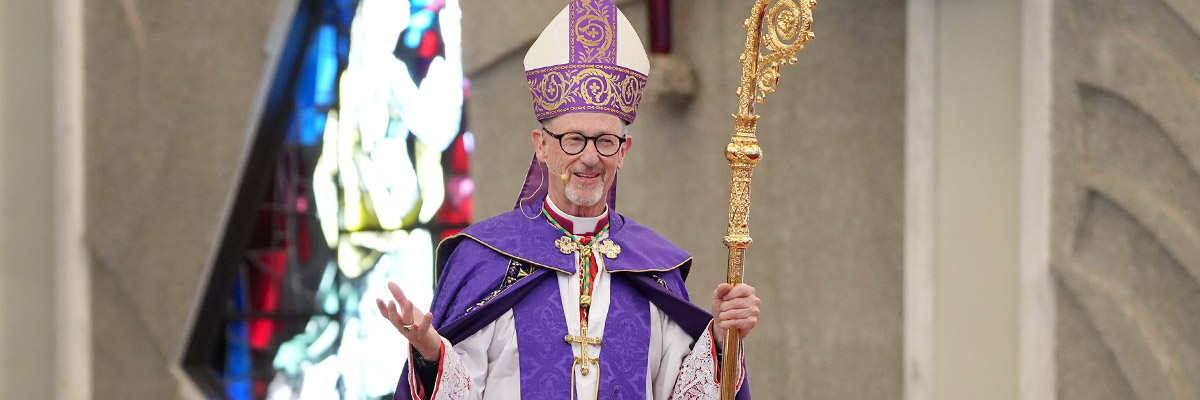
Bishop James D. Conley
University of Nebraska-Lincoln
April 12, 2015
Divine Mercy Sunday
Archbishop Lucas, our Metropolitan Provincial Archbishop of Omaha, Bishop Bruskewitz; Father Matya and Father Holdren; and the Newman Center staff, my dear brother priests and religious; seminarians, artisans and benefactors, dear students, dear friends in Christ.
It is with great joy and gratitude in our hearts, that we gather together this afternoon on Divine Mercy Sunday, at the hour of mercy, to celebrate this Holy Mass of dedication and consecration for Saint Thomas Aquinas Church and Newman Center here on the campus of the University of Nebraska.
The dedication and consecration of a church is an ancient rite in the Church that goes back deep into the Old Testament, when the people of Israel set aside a sacred space destined solely and permanently for the worship of God.
When the temple was rebuilt after the Babylonian captivity in the time of Ezra and Nehemiah, as we heard in our first reading, the people wept for joy when they heard the word of God and the book of the law proclaimed once again in the holy temple. And then Ezra and Nehemiah exhorted all the people: “Today is holy to the Lord your God. Do not lament, do not weep…” but rejoice in the Lord who is our strength. Today, my brothers and sisters, let us truly rejoice in the Lord who is our strength.
Two years ago, this space was a hole in the ground. The old Newman Center and Church, with all its memories and history had been razed, and construction began on this new Church and center.
Like many of you, I would drive by this location and watch as the new building went up. First the foundations were poured and the wells were dug, and then metal beams were put in place. Then walls were poured and the roof took shape. Last summer, on a blistering hot day in June, I blessed the four magnificent bronze bells, which were then lifted into the bell tower. Bricks were laid, then the interior walls went up, and paint, and pews. An organ was hoisted to the choir loft. Artisans from around the world came to install beautiful stenciling, woodwork, statues, and paintings. And then, of course, the magnificent stained glass window and the round transept window arrived, crossing the sea from Munich, Germany, in five wooden crates. All artisans of beauty, coming together from around the world to share in a common goal and passion -- to create something beautiful for God - a tapestry of finely woven beauty, all for the glory of God.
In just two years, a hole in the ground has become a beautiful Church, suitable for the sacred worship of God. A temple of God, built of living stones, where the Father can be worshipped in spirit and in truth, a special sign of the pilgrim Church on earth, able to reflect the divine worship of heaven. A sacred place where the community can come to hear the word of God, to pray together, to celebrate and receive the sacraments, and to grow in holiness and grace.
This Church was built by providence and the grace of God. The Lord worked through the leadership of Bishop Bruskewitz and Fr. Matya, of Jude Werner, and of Kevin Clark and his many collaborators and associates. God worked through the generosity of so many generous benefactors who are with us today seated in this Church. The Lord worked through men and women who poured the concrete, built the scaffolding, painted and plastered, and labored – all with a common goal and a common purpose, to create something beautiful for God. To create a place where university students can come and experience the mercy and love of God!
It is truly providential that we dedicate and consecrate this new church on Divine Mercy Sunday – the Octave day of the Resurrection of the Lord. Last evening in Rome, from Saint Peter’s Basilica, Pope Francis announced an extraordinary jubilee Year of Mercy, through a special Bull of Indiction entitled: “Misericordiae Vultus” – a title taken from the first sentence of this new document: “Jesus Christ is the face of the Father’s mercy.”
Divine mercy has been a central theme of pontificate of Pope Francis. He sees the mercy of God as the call to conversion and discipleship; the foundation for transformation and renewal in the Church, a journey that begins with spiritual conversion. His own episcopal motto is taken from the Gospel scene of the call of St. Matthew, when the Lord looked at Matthew the tax collector with mercy, and called him to be an apostle.
When young people enter this new church, they will be reminded of our common baptism, the day we were set free from original sin and became children of the light.
When the students enter the central nave of this church and kneel down to pray, their eyes are immediately drawn up to the image of Christ in the Heavenly Court, seated on the throne of Divine Mercy. The image of Jesus Christ and the love of his Most Sacred Heart, flowing like streams of water and grace, to refresh, and cleanse and transform our lives. And they see God, the Father looking over all of us with his love and protection.
And through the ongoing conversion of our lives through the sacrament of confession, we continually experience the mercy of God who calls us to deeper communion with Him, in the life of the Blessed Trinity and in the Holy Eucharist. We worship as a Church of sinners, set free by the mercy of God.
This Church is, and must always be, a Church of mercy.
Pope Francis reminds us: “we need to constantly contemplate the mystery of mercy. It is a wellspring of joy, serenity, and peace. Our salvation depends upon it.”
The gospel for today, for Divine Mercy Sunday, is a story, specific to Saint John’s gospel. It is a scene that takes place one week after the Resurrection in which the apostle Thomas, inexplicably absent from the group on the day of the resurrection, at last encounters the Risen Lord.
In a very real way, Thomas represents all of us who want to believe in God’s mercy. He represents the college student who is searching for something more, something true, and good and beautiful. He represents those who are not sure if God is real, who wonder if they can be loved, who want to believe, but who doubt that God can really love them. Thomas represents all who sincerely seek the answers to those perennial questions about life and love; about meaning and purpose; about heaven and hell; about time and eternity.
Through his divine and tender mercy, Jesus invites Thomas to feel and examine his wounds; to see that he is real; to know that it’s all true! And Thomas responds with his simple, yet deeply profound act of faith, “my Lord and my God!”
And then Jesus proclaims, thinking in the future of you and thinking of me, “Blessed are those who have not seen, yet still believe.”
I would like to believe brothers and sisters, that somehow, in this sacred place, we might get a glimpse of what Thomas saw and felt on that first Octave of Easter. It is true, as Saint John reminds us, that we believe without seeing, but in this sacred place, we see a remarkable testimony to Jesus Christ, our Lord. We get a glimpse into, what Blessed John Henry Newman refers to as “that invisible world that is more real to me than the world I can see.”
Today, on this Octave day of Easter—the Feast of Divine Mercy—this church also speaks resoundingly to the legacy of Pope St. John Paul II, who is featured prominently in the stained glass window behind me.
Two weeks ago, the Church remembered the tenth anniversary of Pope St. John Paul II’s death. In a very real way, we dedicate and consecrate this church in the shadow of Pope St. John Paul II, the pope of our generation. Not only does his figure literally overshadowing us in the stained glass window, but this new church also reflects the hallmarks of Pope St. John Paul II’s pontificate, the call to be missionary disciples of the Lord and his mercy, the universal call to holiness, and the grace, power, and beauty of the Most Holy Eucharist.
Pope St. John Paul II died late on a Saturday evening in 2005, on the vigil of the Second Sunday of Easter—Divine Mercy Sunday. The Holy Father loved this feast. In fact, it was on the occasion of the canonization of Saint Faustina, a polish mystic and messenger of divine mercy, who is also featured in the stained glass window, that John Paul proclaimed the feast of Divine Mercy for the universal Church.
On the day of his death, Pope St. John Paul II penned his final message to the world, to be read the next day on Divine Mercy Sunday. In that message, Pope St. John Paul II said that, “the Risen Lord offers his love that pardons, reconciles and reopens hearts to love. It is a love that converts hearts and gives peace. How much the world needs to understand and accept Divine Mercy!”
It was especially important to Pope St. John Paul II that young people know the mercy of God. The Holy Father knew that young men and women, transformed by God’s mercy, would build strong Catholic families, and strong Catholic cultures. From the time he was ordained a priest, he spent time with young people—especially university students—teaching them, hiking and kayaking with them, and offering them God’s mercy through the sacrament of penance. As the pope, John Paul II invited young people from around the world to pray together, to worship together, and to avail themselves of God’s mercy.
Young people, especially—the students for whom this church is built—hunger for the mercy of God. Our vocation is to be conduits of God’s mercy—to be merciful ourselves, helping our brothers and sisters, especially young people, to reject evil, and to choose goodness. Mercy is mediated in the sacraments. It is also mediated in friendship, and generosity, and joy – longtime hallmarks of the life and community of this Newman Center.
John Paul wrote that the Church in modern world must offer a “ heartfelt appeal…to mercy, which humanity and the modern world need so much.” Proclaiming Divine Mercy, and mediating mercy, is the mission of the Church. And this Church must mediate mercy in the grace of holy sacraments, holy catechesis, and holy discipleship.
Through the Newman Institute for Catholic Thought and Culture, students can make a real and lasting contribution to our culture and to the intellectual life of our community, rediscovering the wisdom and treasures of our rich Catholic heritage.
My brothers and sisters, I firmly believe that through God’s mercy, this church and center can form students to become the saints of this university, and this community, and this generation.
In fact, this church is a witness to the universal vocation of holiness. Each one of us is called to be a saint. God calls us to be the saints of this generation, in order to know him and serve him, and in order to transform the world.
In the jubilee year 2000, in Rome, John Paul invited millions of young people to be saints. “Dear young people,” he told “may it be your ambition to be holy, as He is holy… do not be afraid to be the saints of the new millennium! Be contemplative, love prayer; be coherent with your faith and generous in the service of your brothers and sisters, be active members of the Church and builders of peace.”
Saints are ordinary men and women made holy through God’s mercy. As Blessed Mother Teresa of Calcutta would often say, “God does not call the sanctified, he sanctifies those who are called.” Their lives are configured to the truth, beauty, and goodness of the Most Holy Trinity. The witness of the saints is present in every part of this Church.
Behind me, in this stained glass, are ordinary men and women who were made holy through God’s mercy. St. John Paul II stands above my shoulder. With him stand St. Thomas Aquinas, St. Joseph and the Blessed Virgin Mary, St. Albert, St. Therese, Bl. Pier Giorgio, St. Raphael, Bl. John Henry Newman, St. John, St. Margaret Mary, St Faustina, St. Maria Goretti, and St. Michael.
These saints lived different vocations, in different times, in different circumstances. Together they point to an enduring truth—in Jesus Christ, holiness is possible. And holiness can transform the world.
The pendantives, the beautiful triangular images of St. Longinus, St. Veronica, St. Andrew, and St. Helena, remind us of the men and women present at Christ’s crucifixion—and those who carried the faith to the world. Statues of these saints “hold up” the dome in St. Peter’s Basilica. Their presence unites us to the Church of Peter—the Church of our Vicar of Christ on earth, the Holy Father.
You can’t see every saint from where you’re sitting. In fact, I can’t either—but when you walk forward for Holy Communion, and when you return to your seat, keep your eyes open, and look up, for we are all truly citizens of heaven and we are called to join the communion of saints.
And the Queen of that heavenly court is, of course, the Blessed Virgin Mary, who, in this church, has her own chapel. This unique “Lady Chapel” has been designated for our students to use for personal prayer and adoration and contemplation, to grow in deeper communion with the Blessed Trinity, under the mantle of the Queen of Heaven.
In a few moments we will pray the litany of the saints. Pray that our students will be unafraid to be saints. Pray that they will believe that holiness is possible. And pray that their holiness—and yours—will transform the world.
In a few moments, I’ll consecrate this building, to set it aside for holy and sacred worship. I’ll invoke the presence of the Holy Spirit in this sacred space. In the altar, I will place holy relics of the saints of God—St. Balbina, an early martyr who was converted by touching the chains of St. Peter and gave her life for Christ, and St. Thomas Aquinas, a doctor of the Church and patron saint of this Newman Center. On this altar, we will offer the Holy Eucharist with the intercession of our holy forebears.
Through God’s mercy, the altar of this Church can join us to the communion of saints. The whole communion of saints is present in the Holy Sacrifice of the Mass, the heavenly court of the Lord. And in the Eucharist, every grace that we need for holiness is present in the body and blood of Jesus Christ.
But more than beauty and splendor, this church will be alive because the Eucharist will be at its center. Mercy will radiate because the Eucharist is at the center. Students will become holy because the Eucharist is at the center.
Pope St. John Paul II was a fervent disciple of the Most Holy Eucharist. He called the Blessed Sacrament “the heart of the mystery of the Church.” This Church, thanks be to God, reflects the depth of this mystery. John Paul said that sacred architecture, sacred music, and sacred worship itself must reflect a “clear understanding of the mystery” of the mercy of God.
Holy lives must reflect the mystery as well. John Paul wrote that “Every commitment to holiness, every activity aimed at carrying out the Church’s mission, every work of pastoral planning, must draw the strength it needs from the Eucharistic mystery and in turn be directed to that mystery as its culmination. In the Eucharist we have Jesus.”
In this Church, we will soon have Jesus present in the Eucharist. Because we have Jesus, we will have life in this Church. May that life, rich in mercy, transform the lives of our students in holiness. And may that holiness transform the world, through the everlasting Divine Mercy of Jesus Christ.
