
Installation of Acolytes
St. Charles Borromeo Seminary
Memorial Mass of St. Athanasius
May 2, 2015
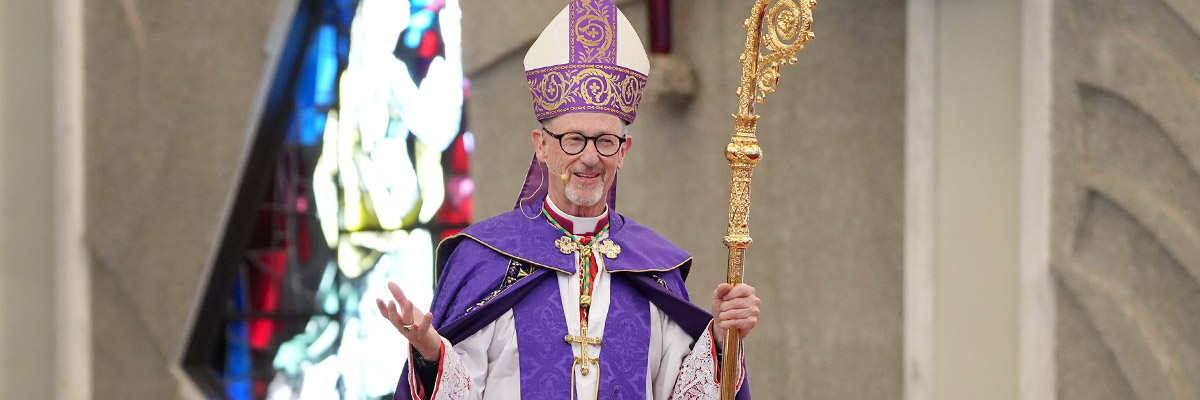
Bishop James Conley
Bishop Senior, brother priests and deacons, seminary faculty and staff, beloved seminarians, dear friends in Christ,
It is a great joy and an honor to celebrate Holy Mass with you today here at Saint Charles Borromeo Seminary in the Chapel of Saint Martin of Tours and seated in the chair where a saint once sat – Saint John Neumann!
I’m very grateful that you have invited me to be here with you, especially for the installation of 13 new acolytes. I have been praying for you men—praying that your installation will be a source of grace to you, as you continue to prepare for ordination and pastoral ministry as priests of Jesus Christ.
Today is the feast of St. Athanasius the Great, the holy bishop of Alexandria, who battled the Arian heresy for 45 years while he served Christ as a bishop.
Of his 45 years as bishop, Athanasius spent 17 in exile. It is hard for those of us who are called to the episcopate to feel sorry for ourselves when we consider the hardships of heroic bishops like Athanasius!
Saint Athanasius’ life spanned nearly three quarters of the fourth century, a time in the history of the Church when the Arians held sway in the imperial courts of Rome, and persecuted faithful bishops like Athanasius. He fled from threats of arrest, and violence, and even death. He trekked through deserts and was chased by armies and emperors. He hid with hermits and monks, and even once took refuge in his family tomb.
Athanasius was persecuted and exiled simply because he was faithful to the words of Christ in today’s Gospel. “Whoever has seen me has seen the Father… Believe me that I am in the Father and the Father is in me.” When Christ explained the unity of the Father and Son, Athanasius believed it. When the Arians denied the Trinity, Athanasius knew that they denied the Gospel.
Many years ago, when I was a seminarian, I remember cramming with my classmates in order to get straight in my head the distinction between all the complex heresies of the early Church. I had index cards for Arianism, Apollonarianism, and Nestorianism. On test day, I prayed that I might remember how to distinguish between monophysites and monothelites.
But Arianism was not an academic interest for Athanasius. Neither was orthodoxy. Authentic, faithful Christian doctrine mattered to him, as it should matter to us. In some instances, it meant life or death. And Athanasius defended orthodoxy because he cared for the salvation of every soul.
The great Athanasius knew that the deepest meaning of the Christian life is the grace of theosis – the divinization, the transformation by grace of the human soul. He understood and believed the profound Christian truth—that because Christ became incarnate as a man, we can be drawn into the inner life of the Trinity itself. The Arians undermined the divinity of Jesus Christ. And Athanasius knew that if Christ were not fully divine, one with the Father and the Holy Spirit, we could never expect deep and eternal unity with God. And he was willing to sacrifice everything for this truth.
In 2007, Pope Benedict XVI wrote that, “the fundamental idea of Athanasius’ entire theological battle was precisely that God is accessible.” The Holy Father said Athanasius battled heresy because “it is through our communion with Christ that we can truly be united to God.”
Athanasius was not martyred. But he gave his life—his intellect, his imagination, his will, and his liberty—in order to lead souls to eternal communion with Jesus Christ.
My dear sons in Christ; there is no better cause for which to spend your life than the cause of Jesus Christ. There is nothing more noble, more beautiful, or more true than to spend your lives leading souls to eternal salvation. There is no life more satisfying than one poured out to reveal the merciful love of God the Father.
------------
In a few moments, I will install several of you as acolytes. As you become acolytes, you will be called more deeply to reveal Christ to his beloved children. In the words of Holy Mother Church in the Rite of Institution of Acolytes: “You should seek to understand the deep spiritual meaning of what you do, so that you may offer yourselves daily to God as spiritual sacrifices acceptable to him through Jesus Christ.”
And so today, as you become acolytes, you are called to imitate the courage, zeal, and fortitude of St. Athanasius. I would like to suggest three ways in which you might imitate the holy life of St. Athanasius.
The first suggestion is that you be serious about your formation as missionary disciples of Jesus Christ. In today’s Gospel, Christ tells his disciples that if they know him, they will know the Father. “Have I been with you for so long a time and you still do know me, Philip? Whoever has seen me has seen the Father.”
Dear sons, commit yourselves to know Jesus Christ, and thus, to know the Father. Commit yourselves to become men of prayer. Be faithful to the breviary, the rosary, and the Eucharist. Spend your time before the Blessed Sacrament adoring the person of Jesus Christ.
Take your studies seriously—use your minds to know the Incarnate Word of God. Your intellects, your wills, your hearts, and even your imaginations—these are gifts the Lord gives you to know him more intimately.
In Evangelii Gaudium, Pope Francis writes that, “all of us are called to mature in our work as evangelizers. We want to have better training, a deepening love and a clearer witness to the Gospel. In this sense, we ought to let others be constantly evangelizing us.” Christ has given you the opportunity, here, at St. Charles Borromeo, to be evangelized, and transformed, by the richness of your priestly formation.
Dear sons, build the habits that will draw you more deeply into the heart of Jesus Christ, habits of prayer, study and ongoing formation that will sustain you for the rest of your lives. If you wish to bring souls to Christ, do all that you can to know him more deeply.
------------
My second suggestion is that you imitate the prophetic courage of St. Athanasius. Athanasius faced real persecution because he told the truth. We must be willing to face persecution as well. We must believe that the truths of our faith can transform lives, and we must be unwavering in proclaiming the truth. And we must expect persecution, particularly as our culture loses its last Christian vestiges and the atmosphere for Christians becomes more and more toxic.
In today’s first reading from the Acts of the Apostles, Paul and Barnabus tell Israel that the Lord made them to be light, to be an “instrument of salvation to the whole world.” The vocation of Israel is our vocation. We must be instruments of Christ’s salvation. Proclaim the truth, joyfully, clearly, and charitably. Build friendships that draw souls in to deeper relationships with Christ and his Church. We must be unflinching prophets—revealing the lies of the evil one, and the truths of Jesus Christ.
At times, I suspect, Athanasius might have been tempted to despair. In his fourth exile, or his fifth, he might have believed that the Arians might just win the day. And we can identify with that feeling. As the “dictatorship of relativism” grabs deeper hold on our culture, we might be tempted to believe that the cause of Christ will see no victory.
The evil one tempts us to cower from prophetic witness. He tempts us to despair in the face of great evil. Blessed John Henry Newman, for whom Saint Athanasius, among all of the great fathers of the Church, was his closest spiritual mentor, understood well the nature of conflict and controversy in the Church. Newman taught that we must remember that the Church has always faced great evil, and that the cause of Christ will endure until the last days. He writes, “[do not] be anxious, at the troubles which encompass us. They have ever been; they ever shall be; they are our portion.”
The psalmist writes that, “the waves of the sea are mighty, and rage horribly; but yet the Lord, who dwells on high, is mightier.”
As disciples of Jesus Christ, we must be prophetic witnesses to truth, trusting in a God who is mightier than the raging and mighty seas.
------------
My third suggestion is that you become faithful servants of the most sacred liturgy we celebrate today. As acolytes, your ministry is to draw souls more deeply into the profound mystery of the Holy Sacrifice of the Mass. In 1973, Pope Paul VI said that acolytes must “strive to grasp the inner spiritual meaning” of every act of sacred worship. You must not only grasp that meaning, you must reveal it in the solemnity, the reverence, and the fidelity with which you undertake this sacred ministry.
Pope Francis says that, “the Church evangelizes and is herself evangelized through the beauty of the liturgy…the source of her renewed self-giving.” Your ministry, as acolytes, is to evangelize through your service at the sacred altar. Be transformed in sacred worship, and seek to witness that transformation.
In the Eucharist is the Body and Blood of Jesus Christ, the Incarnate Word, who draws us into communion with the Trinity. St. Athanasius poured out his life that Christ might be known. In the sacred liturgy, pour out yourselves in fidelity, that Christ might be revealed in sacred beauty.
-------------
This past Sunday, Good Shepherd Sunday, Pope Francis ordained 19 men to the priesthood in Saint Peter’s Basilica. In his homily he instructed the new priests with these words: “Consider that by exercising the ministry of Holy Doctrine, you will share in the mission of Christ, the only Master. Dispense the word of God to everyone, which you yourselves received with joy. Read and mediate assiduously on the Word of the Lord.” Then paraphrasing the Rite of Ordination the Holy Father exhorted the new priests to “believe what you read, teach what you learnt in faith, and live what you teach.”
He also added, as he is wont to do, a zinger! Make sure your sermons “are not boring; that your own homilies reach people’s hearts because they come from your heart, because what you are saying is truly what you have in your heart!”
My dear sons, as acolytes, you will serve the sacred liturgy, and thus serve Christ, and His Church. Be zealous disciples. Be courageous, compelling, and charitable as you witness to truth. Reveal the beauty of the sacred liturgy, and be transformed in the Incarnate Word of God, present to us in the Sacrament of the Most Holy Eucharist.
And finally, on this First Saturday of the month of May, her month, always place yourselves under the mantle of the Blessed Virgin Mary. She is our life, our sweetness and our hope.
Mary, Mother of the Church and Mother of Priests, pray for us!
