
Ordination of Priests
Cathedral of the Risen Christ
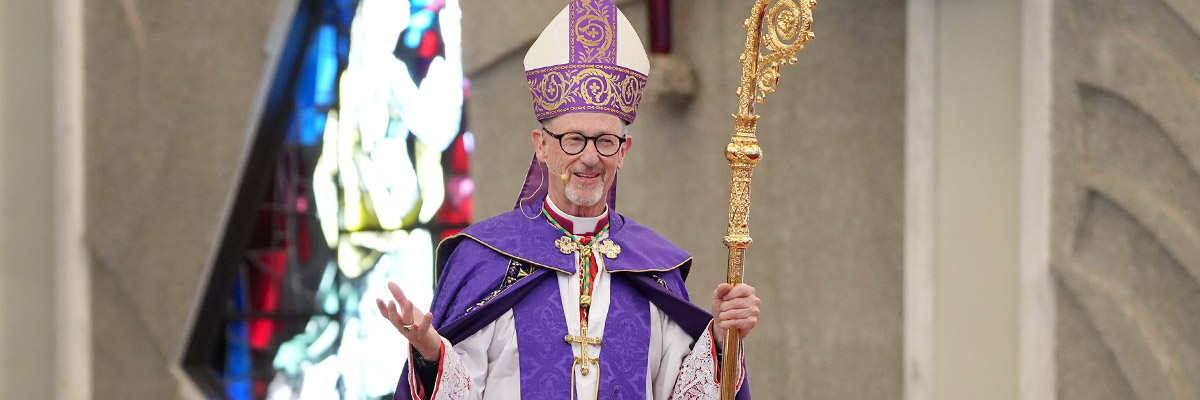
Bishop James D. Conley
May 23, 2015
Bishop Bruskewitz, Bishop Senior, Fr. Matya and Father Eickhoff, my dear brother priests and deacons, faculty members and formators from Saint Charles Borromeo Seminary in Philadelphia and Mount Saint Mary’s Seminary in Emmitsburg, Maryland, newly ordained deacons and priests, beloved seminarians, classmates of our ordinandi and seminarians from around the country, religious sisters, consecrated brides of Christ, parents and family members of our eight ordinandi, my dear brothers and sisters in Christ, welcome one and all.
On the Eve of the Solemnity of Pentecost, what a privilege and a grace for all of us to be together here in the Cathedral of the Risen Christ, to celebrate the ordination of 8 men to the sacred priesthood of Jesus Christ.
This is indeed a joyous occasion. Today’s ordination is a testament to the Providence of God calling these young men to the vocation of sacred ministry. It is a testament to families who formed these young men in the faith. It is a testament to our Catholic schools; to the good work of the Newman Center at the University of Nebraska, to St. Gregory the Great Seminary, and to the seminaries of St. Charles Borromeo and Mount St. Mary’s, where these men were prepared for Holy Orders.
Today’s ordination is a testament to the good work of pastors who invited young men to consider the priesthood. It is a testament to the witness of holy marriages, holy religious, and holy priests. Today’s ordination is a testament to the ministry of my predecessor, Bishop Fabian Bruskewitz, whose courage, and leadership, and holiness is borne out in the fruit of this diocese.
Thank you, parents, pastors, teachers, formators. Thank you, Bishop Bruskewitz. Vocations are a witness to a fruitful and holy community of believers—thank you, to each of you, for building up the Body of Christ here in the Diocese of Lincoln.
At the same time that we celebrate with deep gratitude our blessedness, the Church in the United States faces certain sobering realities. Last week, a massive, seven-year study on religious life in America reported that the practice of Catholicism is declining, in serious and disturbing ways, in our country. The Pew Forum reports that Americans who identify as Christians has declined by 8% in the past seven years. That 23% of Americans report having no religion at all!
The Pew study found that Americans who identify as Catholic has declined by 3 million since 2007. And that for every person who enters the Catholic Church by baptism or the RCIA, six people stop identifying as Catholics. Among your generation, dear sons, this trend is particularly evident—more than 1/3 of those born between 1981 and 1996 claim no religious identity at all. 7% of adult Americans now identify as atheists or agnostics, a number that has doubled since 2007.
Christian Smith is a sociologist who teaches at the University of Notre Dame. He has conducted extensive research on the religious beliefs of young Americans from every major faith group. And he has concluded that even among young Americans who are regularly committed to religious faith, the majority tend to disregard doctrinal and dogmatic teachings in favor of a very nebulous belief in an impersonal God, and a kind of relativistic moralism. Smith calls this belief “Moralistic Therapuetic Deism”—the pervasive belief that God only wants people to be nice, and fair, and tolerant of others. And God will only intervene in their lives at moments of crisis or need. This belief is all too commonplace among young people, and it is very dangerous.
We are facing a trend of profound secularism in America, where it is becoming increasingly difficult for Christians to live their faith in a public way.
But, at the same time, sociological data reports that Catholic parishes and movements committed to an enthusiastic proclamation of authentic truth—real truth, goodness, and beauty—are thriving. We all seek high and clear expectations, and we desire the truth that holiness requires real and costly commitment. In 2005, at the beginning of his Pontificate, Pope Benedict XVI remarked that, “we were not created for an easy life, but for great things.”
The call to greatness is compelling. The 8 men who will be ordained today are evidence of that. And this is not only true here in the diocese of Lincoln, but this is evident across our country. If all the men who are currently in theology, including these eight today, persevere to ordination, in the next four years, God willing, I will ordain 26 men to the priesthood. In that same time period, we will have four retirements for net gain of 22 priests. This is one of the reasons I have released two priests this year to serve outside the diocese in the important work of seminary formation and college campus missionary work.
The total number of ordinations to the priesthood this year is up over 25% nationwide. The ordination class of 2015 will number 595, the highest number of ordinations to the priesthood in American since 1975 and 118 more ordinations than last year. Obviously, God is raising up young men and calling them to be priests of Jesus Christ, to face the new challenges of our hyper secular age and proclaim a New Evangelization.
Dear sons, the challenge of your priesthood will be to proclaim the Gospel to a nation that is increasingly less convicted by the Gospel. A world without faith is a world that lacks love, order, justice, and joy. The challenge of your priesthood is to bring Jesus Christ to souls longing for his love.
Dear sons, I believe the key to your ministry in the years ahead is mercy.
Pope St. John Paul II—the modern saint of divine mercy—wrote that the Church’s mission is to offer a “heartfelt appeal…to mercy, which humanity and the modern world need so much.”
On the day before he died, John Paul wrote that, “the Risen Lord offers his love that pardons, reconciles and reopens hearts to love. It is a love that converts hearts and gives peace. How much the world needs to understand and accept Divine Mercy!”
Divine mercy converts hearts. Divine mercy heals wounded and broken lives. Divine mercy gives the peace the world needs. Divine mercy offers love, and unity, and joy to a world that is in great pain and confusion.
Dear sons, today you are ordained to bring souls into communion with Jesus Christ and his Catholic Church. Today, you are ordained so that your lives might mediate mercy to the entire world.
In April, Pope Francis announced a Jubilee Year of Mercy, with a Bull of Indiction entitled Misericordae Vultus – “the face of mercy.” This Year of Mercy will begin on the Solemnity of the Immaculate Conception, December 8 and end on the Solemnity of Christ the King on November 22. If you have not already read this beautiful document, I now assign it to you as homework before you report to your new assignments on June 15! Pope Francis begins with a concept that is beautiful, extraordinary, and essential to your priesthood.
The Holy Father writes very simply that, “Jesus Christ is the face of the Father’s mercy.”
Dear sons, when you become priests, you stand in persona Christi. You stand in the place of Christ for the sake of the salvation of souls.
Dear sons, in your priesthood, you must become the face of the Father’s mercy.
--
Shortly after Jesus began his ministry, he entered the town of Capernaum. People came to hear him proclaim the Gospel. They surrounded him, and thronged outside the house where he was staying. Some believers brought a paralyzed man to him. They lowered him to Jesus through the roof.
Christ looked at the suffering of this man, and proclaimed that his sins were forgiven. The Pharisees accused Jesus of blasphemy. To reveal his divine power, Christ told the man to rise and walk.
There is no greater suffering than the suffering of sin. Christ saw this, and forgave the sins of the suffering man. Today, you are given the grace and the power to forgive sins in the name of Jesus Christ. Proclaim sin honestly, and know the deep suffering sin causes in people’s lives. Call the world to turn from sin, and to pursue holiness.
With conviction, and humility, and generosity, forgive the sins of those who seek the love of God.
Become the face of the Father’s mercy.
--
Sometime later, Jesus retreated into the mountains to pray. The poor and the sick followed him. St. Matthew says that Christ’s “heart was moved with pity for them, and he cured their sick.”
Today, you are given the grace to anoint the sick—to make present the consolation and healing of Jesus Christ, the Divine Physician, to those who need it. You are given the grace to bring strength to the suffering, and peace to the dying. You are called to invite the suffering to offer their pain for the salvation of the world.
Be moved with pity, dear sons, for those who suffer. Be moved with compassion. Be moved in solidarity. In the name of Jesus, bring healing to those in pain.
Become the face of the Father’s mercy.
--
Jesus preached the Gospel to the 5,000 who came to hear him on a hillside at the Sea of Galilee. They were hungry, and only five loaves and two fishes could be found. Matthew says that Christ took the food, and “looking up to heaven, he said the blessing, broke the loaves, and gave them to the disciples, who in turn gave them to the crowds. They all ate and were satisfied.”
Christ feeds the world with the heavenly gift of himself—the most Holy Eucharist.
Today, in your priestly ordination, you are given the grace and power to bring the Most Holy Eucharist into the world. Today, you are ordained so that you can look to heaven, bless the bread, break it, and distribute the Bread of Life.
Feed the hungry with the Eucharistic bread that satisfies the deepest kinds of hunger, the longings of the soul.
Become the face of the Father’s mercy.
--
Pope Francis reminds us that we priests “are faithful servants of God’s mercy.” In the sacramental life, be faithful, committed, and generous servants of God’s mercy. In the proclamation of the Word, be faithful servants of God’s mercy. As evangelists, and teachers, and shepherds, be faithful servants of God’s mercy.
Mercy does not mitigate justice. Mercy does not absolve truth. Those who counterpose the mercy of God and the commandments of God and his Church misunderstand both mercy and the truth of the Gospel. Mercy enables us to start out again. It does not enable us to stop where we are, comfortable in a sense of being accepted as we are. Mercy calls us to greatness, to the heights of God’s love.
Mercy mediates the grace that makes justice possible, that makes truth knowable. Mercy mediates the grace that makes holiness possible.
Dear sons, we live in a world in desperate need of saints. Call the world to holiness. Be prophets of holiness. Mediate mercy so that the world will know the love of God, and be transformed in holiness.
Today, in San Salvador the capital city of El Salvador, hundreds of thousands of Catholics will fill the streets to celebrate the beatification of Archbishop Oscar Romero. In March of 1980, just 35 years ago this past March, the archbishop was shot and killed while celebrating the Holy Sacrifice of the Mass. He was a staunch defender of the poor and proclaimed the mercy of God. Today he will be proclaimed Blessed Oscar Romero. I will be presiding at a Mass this afternoon at Cristo Rey parish in thanksgiving for this martyr of mercy.
Pope Francis offers the prayer in his Bull of Indiction: “May the message of mercy reach everyone, and may no one be indifferent to the call to experience mercy.”
May your priesthood convey mercy, and soften hearts indifferent to God’s call.
As priests, remain disciples of Jesus Christ. Spend time before the Blessed Sacrament.
Be loving sons of the Blessed Virgin Mary, the mother of mercy. Misericordiae Vultus says that, “No one has penetrated the profound mystery of the incarnation like Mary. Her entire life was patterned after the presence of mercy made flesh. The Mother of the Crucified and Risen One has entered the sanctuary of divine mercy because she participated intimately in the mystery of His love.”
Nourish your intellectual life—as St. Paul says, “be transformed, by the renewal of your mind.” Remain in holy friendship with one another, so that, “as iron sharpens iron,” you might sharpen one another. Confess your sins. Pray for hope, for humility, and for joy.
Today you embark on the mission of proclaiming Christ in a world that does not always hear him, and does not always know him. This mission is the challenge of a lifetime. It is the adventure of a lifetime. You have the prayers of this Church. You have the support of me, and of your brother priests. You have the grace of your sacred ordination.
Become the face of the Father’s mercy, dear sons. Become the face of Jesus Christ.
