
Midnight Mass
Cathedral of the Risen Christ
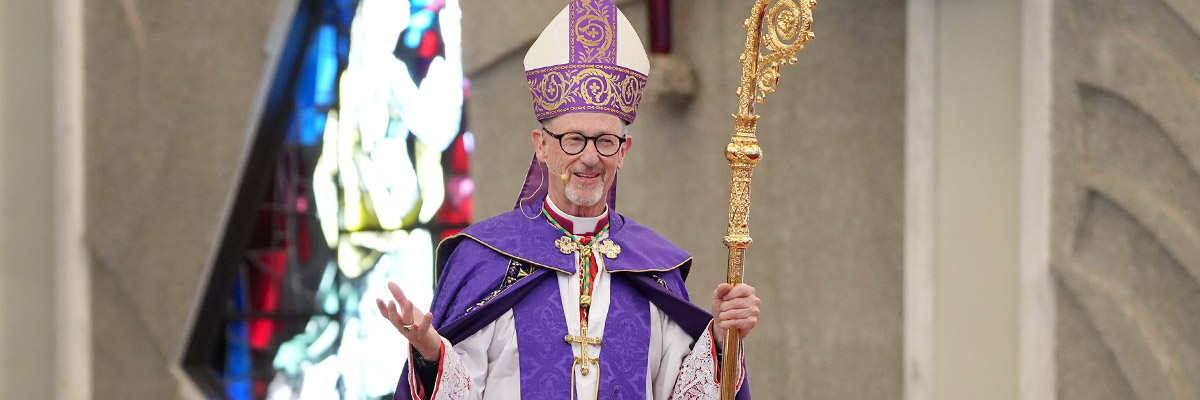
Most Rev. James D. Conley
December 25, 2015
Blessings and peace to all of you tonight and welcome to the Cathedral of the Risen Christ! I’m very grateful to be here with you as we come together in vigil, in the still of the night, to celebrate the nativity of our Lord and Savior Jesus Christ, the gift of mercy from the Father.
Concelebrating this midnight Mass with me this evening is Msgr. Robert Tucker, Pastor of the Cathedral, along with the resident priests of the Cathedral. I am also happy to welcome home Fr. Jay Buhman, national chaplain for FOCUS, presently serving at FOCUS headquarters in Colorado, Fr. Joseph Tatro, a priest of the Diocese of Wichita and an old friend of mine, he is in residence at the Newman Center, and serving a year internship with Catholic Social Services as he completes his doctorate in clinical psychology at the Institute for Psychological Sciences in Arlington, VA.
In a particularly way I would like to welcome the members of the Cathedral parish, those of you who call this parish home and who worship here regularly. It is always a grace for me to celebrate Mass here with Msgr. Tucker, your pastor, and with all of you at the Mother Church of the Diocese of Lincoln. The cathedral community is a very special one, and I am so glad so many of you are here tonight.
I also want to welcome those of you who are not from the Cathedral parish, who may be visiting from out of town or joining us for the first time. Thank you for being here.
I also want to welcome those of you who might be from other Christian denominations, who ordinarily worship in other Christian communities. Tonight, we join Christians from all around the world who gather in the middle of the night to celebrate in anticipation the birth of our Savior. Tonight, we especially remember our unity with Christians across the Middle East, who gather to celebrate Christmas, even as they face the threat of martyrdom and persecution. They are living witnesses to the profound kind of discipleship to which God calls each one of us. And they remind us of the poverty and uncertainty into which Jesus Christ was born, in a small stable, far from his family’s home.
In a particular way I want to welcome those of you who are Catholics, but who may not attend Mass each Sunday or who may have come back to the practice of your Catholic faith by making a good confession during these graced days of advent. Welcome home.
We are glad that you are here and, when you are not here, you are missed. You are a part of the body of Christ, and the Church loves you because you are a child of God. You have something unique and something important to offer to the life of our Church. None of us are perfect. We all come before the Lord wounded and in need of his divine mercy. Each one of us has doubts. Many of us experience times of spiritual uncertainty. But in the community of the Church, we seek the truth together, as imperfect sinners, each one of us, graced by God. I pray, sincerely, that you will continue to join us at Mass every Sunday, and that you will feel welcome here. And if there is anything that might make it easier for you to worship in this Christian community, please speak with the priests of the Cathedral parish anytime.
And, of course, we are grateful for an unexpected “white Christmas” this year. Msgr. Thorburn, my VG and chaplain to the Carmelite Nuns in Valparaiso, just mentioned to the nuns yesterday that it sure would be nice if we could have a white Christmas. Well the good sisters didn’t waste any time and took that intention to prayer and here we are! We can never underestimate to power of those nun’s prayers!
--
Brothers and sisters, we are gathered tonight for the holy celebration of Christmas. Christmas is the celebration of the Incarnation of Jesus Christ, the Word of God, made flesh in the form of a tender child and born of a Virgin. The wonder of Christmas is simply this: that all men have sinned, and we all fall short of the glory of God. But God desires us to share in his eternal life forever. God became man, born of the Virgin Mary this night, in order to suffer, to die, and to conquer death by rising from the dead, so that we can share in his life—through baptism, and through the reception of the Most Holy Eucharist.
The message of Christmas is that God became a man like us—truly, a fellow human being just like us in all things but sin—who suffered and died, and yet who rose again—all so that we would not be bound by death. All so that we might live eternally, sharing in the inner life of God.
We read tonight from the letter of St. Paul to Titus, the true message of Christmas: “The grace of God has appeared, saving all…Jesus Christ [who] gave himself for us to deliver us from all lawlessness.”
The grace of God appears in the world in the person of Jesus Christ. And because God’s grace is manifested in the world, we can truly be free from the chaos and disorder of sin. We can have hope that we can become holy. Because Christ has come, our lives can be lived anew. Because God is with us, in the person of Jesus Christ, we can live in “blessed hope” of eternal life with God, instead of in the agony and loneliness of doubt.
God has come to us tonight, as a human being, as a small child born into poverty, because he loves us. He comes to us as an act of mercy from God. And that is the central message of Christmas: that we have not earned the Incarnation of Jesus Christ. God has come to us—God is with us—because of his own act of mercy, undeserved, unmerited and unearned.
If Christmas is to really mean anything in our lives—if, indeed, the Incarnation is to bear fruit in our lives, we must accept that Christmas is an act of profound mercy—unbounded and unmerited love—given solely because God desires to share eternity with us.
We Americans are a very independent people. We are accustomed to “paying our own way,” and to “earning our own keep.” Our independence is in the very fabric of our culture. The stories and legends of America are the stories of those who pull themselves up by their bootstraps—rugged cowboys and pioneers, or self-starting business leaders, or maverick political leaders. From the beginning, our American culture has praised those who earn success by their own hard work and initiative.
But we cannot earn eternal life by our own hard work and initiative. We cannot “pull ourselves up by our bootstraps” to heaven. We cannot earn our way to heaven without God’s mercy. We cannot be free from sin without a savior. We need mercy. We need Jesus Christ, who is the living, present, incarnate face of God, the Father of all mercy.
The message of Christmas is that our only true happiness—eternal happiness—depends on the mercy of God. Our peace and our hope depend on the mercy of God. And God’s mercy is made manifest at Christmas in a wondrous and beautiful way, through a child, through the innocence and helplessness of a baby.
Christmas is an invitation to us to receive God’s mercy anew!
We receive God’s mercy first and foremost in the sacramental life of the Church. Beginning with our baptism, God pours his divine into us through the cleansing waters of baptism.
In the sacrament of the Holy Eucharist, when we receive the body, blood, soul, and divinity of Christ, the Lord fees, sustains and strengthens us for daily battles and struggles of life.
And in the sacrament of penance, in confession, the Lord sets us free from our sins, and orients us to the grace of eternal life. He lifts us out of the muck of our lives and sets us on a new path, a path to future glory.
If we wish for the grace of Christmas to be meaningful in our lives, we must regularly seek the mercy of God, in and through the sacraments of the Church, which transform us in ways that we cannot transform ourselves. God’s mercy frees us in ways that we cannot free ourselves. God’s mercy conveys to us peace, joy, and hope that we cannot hope to attain by any other means.
--
But if we wish for God’s mercy to bear fruit in our lives, we must cooperate with mercy. Christmas—and indeed the Incarnation of Jesus—is a call to mediate the mercy we receive to the world; to become missionaries of mercy, if you will, to those around us. It is true that our salvation depends on receiving God’s mercy. But our salvation also depends on pouring out God’s mercy to the world, of sharing his mercy with others, through forgiveness and healing.
The Gospel of St. Luke reminds us tonight today, that God raises up men and women who cooperate in God’s merciful love to the world. St. Joseph followed the call of the Lord, to take his beloved betrothed, even when she is mysteriously pregnant, and to care for her as she gives birth in poverty in a strange place.
And the Blessed Mother herself followed the call of the Lord to bear the Son of God—to give birth to a son who would eventually suffer and die before her eyes for the salvation of the world. The Blessed Mother mediates the mercy of God to every human heart. And we are called to do the very same thing.
The responsorial Psalm tells us to “Announce his salvation, day after day. Tell his glory among the nations; among all peoples, his wondrous deeds.” This is the call of the Christian life. We’re called to proclaim the salvation of God, the “wondrous deed” of God, and to give witness to it.
This year, in the Church’s jubilee Year of Mercy, we’re called to reveal God’s salvation through the corporal works of mercy—through the charity of feeding the hungry, of giving drink to thirsty, of clothing the naked, of visiting the lonely and sick, of sheltering the harborless and homeless.
And we are called to reveal God’s mercy by proclaiming the spiritual works of mercy as well, instructing those who are misinformed about the Catholic Church, to counsel and give hope to those who are doubtful, to admonish those who are caught up in sin, to bear wrongs patiently instead of demanding redress or revenge, to forgive offenses willingly, to comfort the afflicted and to pray for the living and the dead. We can and must do all of these things if we want to reveal God’s mercy to the world. We are called to witness to God’s love in us, God being with us in the person of Jesus Christ, by the ways in which we love the world.
Brothers and sisters, this Christmas we are called in particularly way by our Holy Father, Pope Francis, to commit anew to those works of mercy. We’re called to commit to being present to those who need our presence, in concrete ways; to identify those whom we know who will only know the Lord because of our love. These people could be our grandparents, or parents, or neighbors, or classmates, or colleagues. The Lord desires to reach every human heart—and, quite sincerely, it may be that only our merciful love will reach those in our lives.
So let us ask ourselves, do we give generously to the needs of the poor, without counting the cost? Do we open our homes and our lives to those who are longing for true friendship? Do we invite those we love to pray with us, and worship with us, and to live in the light of truth? Do we form authentically Catholic communities, and share them with those who suffer? Do we witness to the faith with joyful, infectious enthusiasm? Christmas is the call to live so that we might reveal Christ and his mercy to the world.
St. Joseph was a poor workman from a small town. The Blessed Mother was a young girl. They were not powerful, or famous, or educated. They were, in the eyes of the world, insignificant.
The Father chose the insignificant for the most profound act of his mercy. If, for a moment, we believe that we are unworthy, or incapable, or not called to be mediators of the mercy of God, we need only look to the Holy Family, who revealed God’s mercy to the entire world in a stable, in the middle of the night, in a poor and obscure village, through the birth of a tiny child who was born to save the world.
At Christmas, God becomes man to unite us to God, and free us from sin. If we seek the mercy of God, and mediate that mercy others, we will become channels of God’s love—by which all might know, proclaim and rejoice in the unbounded love of Jesus Christ, our newborn King.
May God bless you and your families as you celebrate the Incarnation of Jesus Christ, our Lord and Savior.
