
Easter Vigil 2016
Cathedral of the Risen Christ
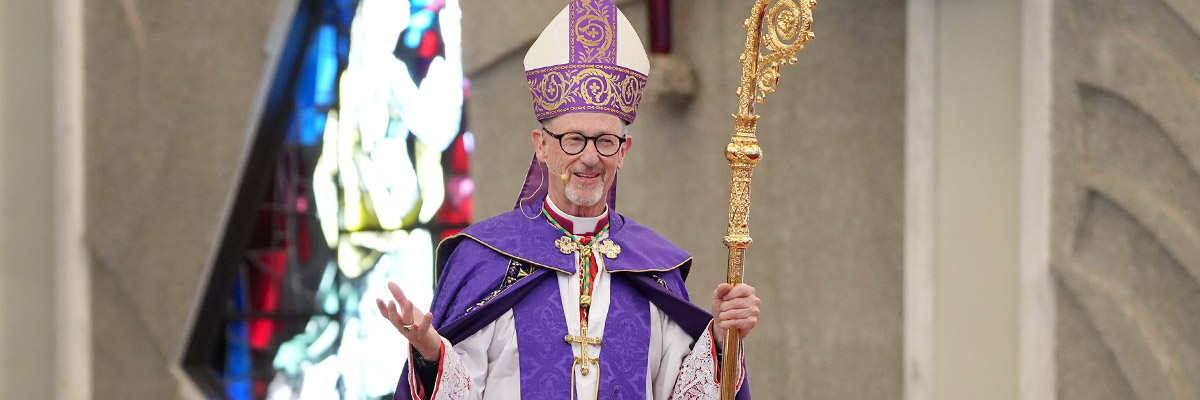
Bishop James D. Conley
March 26, 2016
Bishop Bruskewitz, Msgr. Tucker, my brother priests, deacons, beloved seminarians, consecrated religious, dear catechumens and candidates, those who will be received into the Catholic Church tonight, dear brothers and sisters in Christ!
Welcome, each one of you, to the Easter Vigil, the greatest and most solemn of all the Church’s celebrations in the liturgical year. For tonight, in anticipation, we celebrate the Resurrection of the Lord from the dead, that “most sacred night” as we just heard in the chanted Easter Proclamation, the ancient Exultet, “in which our Lord Jesus Christ passed over from death to life.”
This solemnity is also the patronal feast day of our diocesan Cathedral, the Cathedral of the Risen Christ.
In a particular way, I would like to welcome our 4 catechumens who, in a few moments, will be baptized in the waters of everlasting life; as well as our 12 candidates who will be received into the full communion of the Catholic Church through their Profession of Faith and the Sacraments of Confirmation and Holy Eucharist.
As a Catholic convert myself, I always look forward with joy each year to the Easter Vigil. Well over a hundred thousand new Catholics will be received into the Church tonight at Easter Vigils across the country. There are 69.5 million Catholics in the US, comprising about 22% of the population.
For those of us who are already Catholic, we unite our prayers in solidarity with our new converts, as we renew our own baptismal promises and our profession of faith.
In every liturgical celebration, but particularly in the Easter Vigil, the mystical Body of Christ comes together for the glorification of almighty God and the sanctification of all of her members. Through word and sacrament, sign and symbol, through gesture and song, through light and darkness, the Church, who is the Bride of Christ, celebrates the high and holy mysteries of our own redemption and salvation.
It has been a true joy celebrating the Easter Triduum, these holy three days, with all of you, particularly with our three transitional deacons and our beloved seminarians. As Msgr. Seiker reminded us at the Mass of the Last Supper, which began the Sacred Triduum, these liturgical ceremonies are like one continuous celebration that culminates tonight with the Easter Vigil. I recognize that many of you have been with us each night. God bless you.
In our sequence of readings this evening from sacred scripture, beginning with the Book of Genesis and creation of the world, through the tragic fall of man and the call of the Prophets to return to God, we have heard the epic story—a true and epic story—of God’s plan and promise to redeem the world from sin and death in the Incarnation of a Messiah. We heard the story of thousands of years of salvation history, by which God formed a people to know him, to follow him, and to prepare for the coming of his son. We heard the story of God’s promise to send his Son among us, for the salvation of the world.
Those apostles, who ran to the tomb on that first Easter morning after hearing from the faithful women that the tomb was empty, would have known this story far better than we do. In fact, they would have lived and prayed this story! The Scriptural readings we’ve just heard would have been committed to their memory. They believed that God’s promise had been fulfilled in Jesus Christ; that the prophecies and promises of the Old Testament were realized in the Incarnation of Jesus of Nazareth.
The apostles knew that Jesus was the long-awaited Messiah. We might have expected, therefore, that when he died, they would be awaiting his resurrection. After all, Christ had told them, time and time again, that he would conquer death, “that the Son of Man must be handed over to sinners and be crucified, and rise on the third day.” We might have expected that they would have faith.
But when the resurrection was proclaimed, the apostles found it impossible to believe; they thought it was “nonsense.”
In tonight’s Gospel, the women of Galilee journeyed to Christ’s tomb, to anoint his body with oils and perfumes. When they arrived, they discovered that he was gone. Angels appeared, and announced that Christ had risen. He had conquered death! He had opened the door to eternal life. He had fulfilled the deepest meaning of the Lord’s promise.
The women of Galilee ran to the apostles, and told them what happened. But the apostles would not believe what they had heard. They thought it was nonsense. The women could only encourage the apostles to see for themselves. Like the apostles themselves; they could only say “come and see!”
Dear brothers and sisters, tonight in this holy vigil, we proclaim that Jesus Christ was both fully God and fully man. We proclaim that he lived, died, and then rose again. And we proclaim that his resurrection is more than a historical fact: we proclaim that the resurrection of Jesus Christ can transform our lives, and unite us forever with God.
Rational people might have trouble believing what we proclaim. It may seem like “nonsense” to most of the world. Science tells us that life does not end and then begin again. Our experience also tells us the same. Easter makes a claim that seems impossible to accept: Christ died, Christ rose again, and Christ’s Resurrection gives us new life. We can understand why the apostles might have doubted this claim. And we can understand why the women of Galilee told the apostles to see for themselves.
The claim of the resurrection challenges us. St. Peter only believed in the Resurrection when he saw the empty tomb. St. Thomas had to put his fingers in the wounds of Christ in order to believe that he had risen from the dead.
In the first century, St. Ignatius of Antioch said that, “Christianity is not the work of persuasion, but of real power.”
Today, dear brother and sisters, the call of Easter is the call of the women of Galilee: “come and see” the power of the Resurrection.
This Easter, the Lord invites us to see the power of the Resurrection. As Pope Benedict XVI once said, “the Risen One does not show himself in a great public spectacle before the Masses.” Instead, the power of the Resurrection is seen in the ordinary lives of believers.
The power of the Resurrection is not only the power of a historical fact. The power of the Resurrection is a power that is alive today. And the Lord invites us to see and experience the power of his Resurrection.
“Come and see” the power of the Resurrection in the lives of ordinary believers, transformed in holiness, who have hope, and joy, and real authentic love in their lives, through Jesus Christ. Come and see the power of the Resurrection in the life of the Church, in those who have been healed through Christ, in those who have experienced the power of God’s mercy.
Come and see the power of the Resurrection in the lives of the saints: two thousand years of disciples who discovered the meaning and purpose of their lives in the power of Jesus Christ. Come and see the power of the Resurrection in those who have given their very lives for Jesus Christ, particularly the martyrs of the Middle Eastern Christian genocide recently recognized by our government.
Come and see the power of the Resurrection in the power of the Church’s sacraments: in the transformation that comes through the sacrament of penance and Eucharist. Come and see the power of the Resurrection in the truth of the Gospel, and the truth and beauty of the Church’s teachings.
Come and see the power of the Resurrection by following Jesus Christ, more openly and more intentionally, by living as Christ calls us to live, and by experiencing the meaning and power of Christ’s life, death, and Resurrection.
The Gospel is more than a conclusion, or a proposal, or a historical fact. The Gospel is a living fact—a living person—Jesus of Nazareth. Christ invites us to new life in Him—to know our deepest purpose and meaning through his resurrection. He is Risen, dear brothers and sisters. Come and see the power of his Resurrection!
