
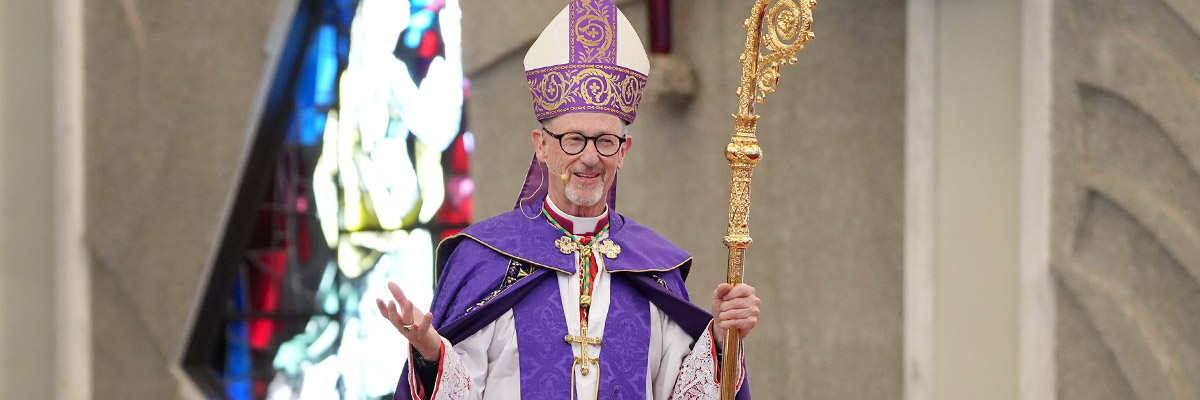
Christmas Midnight Mass 2016
Cathedral of the Risen Chris
Bishop James Conley
December 25, 2016
Dear brothers and sisters in Christ,
On behalf of Msgr. Robert Tucker, and the priests and people of this parish, we welcome you to the Cathedral of the Risen Christ. May the peace of the Christ-child fill your hearts with joy, as we celebrate the birth of the Messiah at this midnight Mass.
Some of you, I suspect, are visiting family members or friends and perhaps have traveled from afar. Some of you, maybe, just couldn’t sleep and decided to come to Mass at midnight! Some of you may have been away from the Church or are from other faith traditions.
Christmas is a gift from God for each one of us. Wherever we are on the journey of faith, the Christ-child welcomes us and comes into our lives to give us peace, hope and joy.
The midnight Mass is one of the most ancient liturgies in the Catholic Church. It dates back to the very early centuries of Christianity, when the faithful would travel by foot or by donkey, in the middle of the night, to the local church or chapel, to anticipate the birth of Jesus by celebrating Mass, Christ’s Mass – the Mass of the Nativity of the Lord.
The liturgy this evening began with a reading from the Roman Martyrology, the announcement of the Solemnity of the Nativity of the Lord. This was chanted tonight by a native son of the Cathedral parish, Deacon Tim Danick, who will be ordained a priest, please God, in less than six months here in this cathedral.
I am always moved when I hear this proclamation because it reminds us of the historical fact of the birth of Jesus. So many people think the birth of Jesus is a beautiful story, but they doubt its authenticity. They think of the Christmas story as as kind of myth or even a fairy tale, not a real event in history.
But the proclamation of the Nativity of the Lord that we just heard is taken from an ancient text that is drawn from both sacred scripture and non-Christian historical sources. And the purpose of the text is to remind us that the birth of Jesus is rooted in history and is located in space and in time.
Pope Benedict, in volume one of Jesus of Nazareth, the “Infancy Narratives,” drives home this point in a beautiful way. He writes this: “It was not with the timelessness of myth that Jesus came to be born among us. He belongs to a time that can be precisely dated and a geographical area that is precisely defined: here the universal and the concrete converge. It was in him that the Logos, the creative logic behind all things, entered the world. The eternal Logos became man: the context of place and time is part of this. Faith attaches itself to this concrete reality…”
And so we are not dealing with mere myth or a fairy tale in what we celebrate tonight, we recognize and honor a real event that forever changed the course of history. And the fact that we are celebrating its anniversary tonight, 2000 years later, is a testament to its authenticity.
Christmas is a gift for each one of us, for those who believe and those who do not believe, because Christmas is the incarnation of love itself. The gift of God, at Christmas, is inexhaustible, unlimited, unselfish love.
God has given us that love through his son, and he calls us to join him in the mission of transforming the world, and transforming every human heart, by love. Each one of us is absolutely beloved by God. And each one of us, because of Christ’s coming into the world, can love our families, our friends, and, indeed, the entire world, with the love of God himself.
When Christ came into the world, on that first holy night, he came in poverty. The Gospel of Luke tells us that he was born in a stable, a barn, and laid to sleep in a feeding trough. The Lord chose this humble place for his entrance into the world. And Pope Benedict says that the birthplace of Jesus “points towards the reversal of values found in the figure of Jesus Christ and his message. From the moment of his birth, he belongs outside the realm of what is important and powerful in worldly terms.”
Christ was born into poverty because he came for all people. He came for the broken, he came for the lost, he came for the poor, he came for the unimportant. He came for the sinful. Christ came for all of us because, to God, every single human being is his beloved child. God the Father created each one of us lovingly, and we were born into the world so that we would know his love, and spend eternity with him.
Sin exists. Death exists. Evil and chaos exist. We know this too well. But God’s love is capable of setting us free from the power that sin, and death, and evil can have on our lives. To set us free, God surrenders himself to us.
He becomes a human being like us, he dies on a cross, but unlike any other person, Jesus Christ is raised from the dead. And because he was a human like us, we can share in his freedom. Because Christ came into the world, we can become the best possible versions of ourselves: we can become holy, like he is holy.
This is not just a pious platitude. The history of Christianity is the story of men and women who have been set free by Christ, and who have then lived extraordinary and incredible lives. No matter our situation, no matter how hopeless it seems, God wants to transform us in freedom. And to make that possible—because he loves us—he gives himself to us.
In a special way, God continues to give us himself through his Church, and through the sacraments. In baptism, we are adopted into Christ’s own life, grafted, if you will, into the family of God. In confirmation, we are given the power of the Holy Spirit. In confession, we are given his mercy. And in the Eucharist, we are given the presence of Jesus Christ himself, who enters our hearts, and makes them anew: pure, true, and free, like the heart of the newborn Jesus, who was born today in that manger.
The Eucharist unites us with the sacrifice of Christ’s life on the cross, and with his resurrection. We do not simply receive the Eucharist—instead, through it, we are drawn up into the drama of Christ’s sacrifice for our eternal freedom.
Pope Benedict XVI says that through the Eucharist, “we enter into the very dynamic of his self-giving.” This means that, because we are united with his sacrifice on the cross, we can be united with his victory over death. But it also means that through the Eucharist, we become a part of Christ’s mission of love to the world. Pope Benedict says that in the Eucharist, “God's own agape”—his merciful and transformative love—“comes to us bodily, in order to continue his work in us and through us.”
In a Christmas homily over 1500 years ago, St. Augustine put it like this: “Beloved, our Lord Jesus Christ, the eternal creator of all things, today became our Savior by being born of a mother, in a humble stable. Of his own will he was born for us today, in time, so that he could lead us to his Father’s eternity. God became so that we might become like God. The Lord of angels became man today, so that man could eat the bread of angels, the Holy Eucharist.”
The Eucharist, God’s physical gift of himself to us, is meant to be the pinnacle of our lives. Pope Benedict says that receiving the Eucharist “includes the reality both of being loved and of loving others in turn. A Eucharist which does not pass over into the concrete practice of love is intrinsically fragmented.”
God’s love is deeply personal. God becomes close to us in the Incarnation. Pope Francis says that Christ becomes “little, near, and real,” when he is born in the manger, and when he is present to us in the Eucharist. And because Christ loves us in humility—little, near, and real—he calls us to love in the same way. To love in humility, in littleness, by making others first and taking the last place. To love in nearness, to be in solidarity with those we know: to take our family members, and friends, and co-workers by the hand. To be truly present with those who are close to us. To love in reality and in authenticity: by helping, in concrete ways, to carry the crosses of those who are struggling.
That is what it means for us to love as God loves. To share in Christ’s self-gift means that we work to set people free for holiness. We enter the messiness, the difficulty, the challenges of other people’s lives, and help them to live as God calls them—to walk in truth, and light, and freedom.
Because Christ became one of us, a human being, at Christmas, we can reveal Christ to other people through our love.
Loving as God loves, is the highest goal to which we can strive. Loving God as he loves us, and loving other people as God loves, is the highest experience of what it means to be a human being. It is what we are made for. And Christmas—the Incarnation of Jesus Christ—sets us free to love. God definitively enters into the world as a child in his mother’s arms, so that he might pour forth that divine love by giving himself as food for our souls. This is the “good news of great joy.”
God is calling each one of us to encounter him, and know his love, and to love him, and the world, through the Eucharist. He is calling us to be transformed by his love. This Christmas, let us rejoice. And let us together, ask God to reveal his love to us, and to transform us, through the gift of himself, in his presence in the manger, and in the gift of himself in the Holy Eucharist.
God’s gift, to each one of us this Christmas, is the incredible gift of his love. Merry Christmas.
