
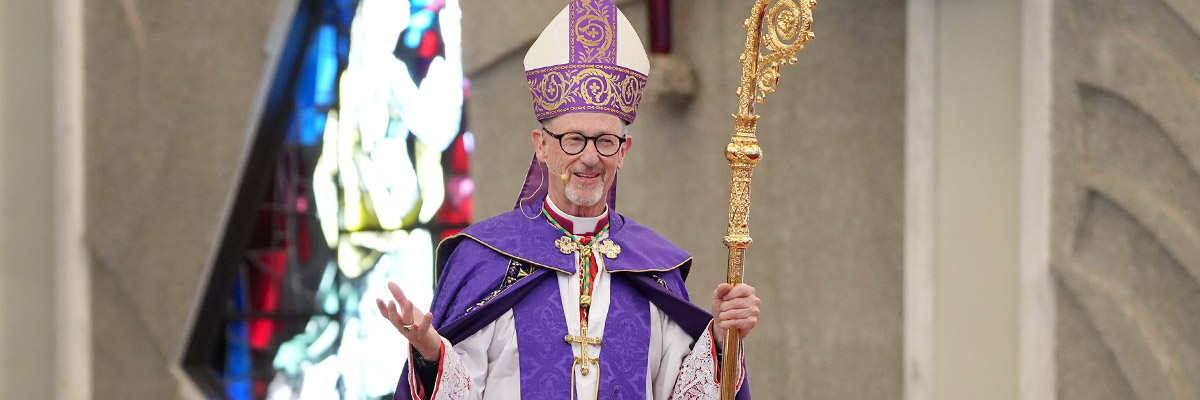
Deacon Ordination Mass 2017
Cathedral of the Risen Christ
May 26, 2017
Bishop James D. Conley
Bishop Bruskewitz, Bishop Senior, Bishop-elect Shlesinger, my brother priests, deacons and seminarians, representatives from the faculties of Mount St. Mary’s Seminary in Emmitsburg, Maryland and St. Charles Borromeo Seminary in Philadelphia, Pennsylvania, my dear religious sisters, beloved diaconal candidates and your families, dear friends in Christ.
“I consecrate myself for them,” says the Lord, “so that they also may be consecrated in truth.”
Tonight, as we gather to offer the Holy Sacrifice of the Mass, and witness the consecration of two young men to the sacred order of the diaconate, we give thanks to almighty God for his goodness to us and to his Holy Catholic Church.
Tonight, my dear brothers and sons, you enter the ministry of sacred orders, instituted by Jesus Christ himself as a sacrament. Tonight, you enter the clerical state. Tonight, you will make a commitment to remain celibate for the rest of your lives, as a sign of your dedication to Christ the Lord for the sake of the Kingdom of Heaven, in the service of God and man. Tonight, you will make a promise of respect and obedience to me, your bishop, and to my successors. Tonight, you will be configured to Christ in a new and unique way, through the laying on of hands. Tonight, the sacrament of Holy Orders will mark you with an indelible imprint or character that cannot be removed which will configure you to Christ, who made himself “deacon” or servant of all (CCC #1579).
The Catechism of the Catholic Church teaches that deacons assist the Church “in the celebration of the divine mysteries, above all the Eucharist, in the distribution of Holy Communion… in the proclamation of the Gospel and preaching…and in dedicating themselves to the various ministries of charity.”
The deacon is ordained to be a servant, just as Jesus Christ was a servant. In the Book of Acts, we just heard that the first deacons were chosen, and ordained, to serve the widows of the early Church who were being neglected. They were chosen to extend the servant ministry of Christ himself, who came not to be served, but to serve.
Dear sons, you are not ordained to take the first place, but the last. You are not ordained to be great, but to be small. You are not ordained because of what you can give, but because of what Christ can give through you.
You are ordained to become servants, unified in a beautiful and particular way with Christ, the Suffering Servant. The prophet Isaiah tells us that the Suffering Servants was like a sheep led to the slaughter, who opened not his mouth. He was pierced for our sins; crushed for our iniquities. He bore the punishment that makes us whole. By his wounds, we were healed.
The love of Christ the servant, culminates in Calvary, his death on the Cross, the gift of himself to atone for our sins.
In the celebration of the Holy Eucharist, we are mystically present to the self-gift of the Suffering Servant. In fact, in Holy Mass, we offer ourselves in unity with Christ to the Father, in atonement for sins, and for the redemption of the world. And because you will now be configured to Christ for charity, the Mass must be the source of your diaconal identity. Here, at the Mass, you are unified in communion with the Lord, and, thereby, unified in communion, and in charity, with the Church—with those whom you are called to serve.
Pope Benedict XVI said that that in the Eucharist, “God’s own agape, [his love and his friendship], comes to us bodily, in order to continue his work in us and through us… ‘Worship’ itself, Eucharistic communion, includes the reality both of being loved and of loving others in turn. A Eucharist which does not pass over into the concrete practice of love, is intrinsically fragmented.”
This, dear sons, must be the basis for your identity as deacons. Your diaconate must be intensely Eucharistic, if it is to be a living unity with Christ the Servant, expressed in charity.
To be formed for “the concrete practice of love” by the Eucharistic sacrifice of the Mass, your prayer lives must also be Eucharistic. To be true deacon-servants, you must contemplate the face of Christ in the Eucharist, in his presence in adoration of the Blessed Sacrament, in silent and contemplative union with the Crucified Lord.
In the Christian life, intimacy with the Lord precedes action. In the Gospel, the Lord makes clear that being consecrated—set apart, made holy—allows the world to know and encounter Jesus Christ through his witnesses. In your ordination, you are consecrated to Christ, and set apart, in a special way, for his service. But only in a loving relationship of prayer, with the heart of the Lord, will your consecration deepen, and thus, your ministry of charity reveal Christ to the world. You must see those you serve as Christ sees them—indeed, as Christ himself—if you are to reveal Christ to them. And that depends on silent contemplative union with the face of Christ in the Eucharist, the sacrament of divine friendship.
Saint Mother Teresa of Calcutta said it this way: in the world, there is an “inseparable twofold presence of Jesus, in the Bread of Life and in the ‘distressing disguise of the poorest of the poor.’”
As deacons, you are called to serve Christ in the “distressing disguise of the poor.” This means that you must first recognize and know him, in silent contemplation, in the mystery of his presence in the Bread of Life.
Tonight, dear sons, you are consecrated to serve the world as the Suffering Servant did. The world will hate you, but you are not of the world, in the same way that he was not of the world. You are consecrated in truth.
Contemplate his face. Contemplate his sacred heart. Contemplate his sacrifice on the cross. Worship him, and give yourselves to him, in the Holy Sacrifice of the Mass. And from there, go forth, in the “concrete practice of love,” serving the world in Christ, and serving Christ in the world.
-
Youth Protection +
-
Evangelization & Catechesis +
-
Catholic Schools +
-
Youth Ministry +
-
Family Life & Discipleship +
-
News & Media +
-
Directory, Maps & Mass Times +
-
Diocese Home +
