

Lincoln man discerning call to the permanent diaconate
Story by Reagan Scott
LINCOLN (SNR) - Those moving to the diocese from other states or parts of Nebraska may have noticed the absence of permanent deacons in their new parishes. The Diocese of Lincoln has not had a formal permanent diaconate program, but Bishop James Conley has recently given permission for a married man to discern the call to the permanent diaconate for the Diocese of Lincoln.
The sacrament of Holy Orders was instituted by Jesus which continues the mission of Christ that was entrusted to the Apostles. Holy orders is an apostolic ministry that includes three degrees: the episcopate, presbyterate, and the diaconate.
The episcopacy contains the fullness of Holy Orders. Priests serve as co-workers of the bishops, and receive their faculties to administer the sacraments from bishops. The word deacon comes from the Greek word “diakonia,” which means service.
The diaconate can be lived out in one of two ways. The first, the “transitional diaconate” is used to refer to seminarians who serve as deacons for one year before being ordained priests. The other avenue, referred to in this article as the “permanent diaconate,” is for those called to live out a life-long vocation as a deacon.
Since the diaconate is part of the sacrament of Holy Orders, all priests are first ordained deacons and are therefore, in a real sense, “permanent deacons” even as priests.
However, the diaconate may also be conferred upon married men. In this article, the phrase “permanent diaconate” is used to refer to those laymen who discern that they are being called to this vocation permanently.
Father Daniel Rayer, the chancellor for the diocese, said the primary function of the diaconate is being of service to the ministry of charity. The secondary function is in the sanctuary.
He said, “At the heart of the diaconate is ministry to the community and ministry to the Church’s work of charity. A deacon is oriented to the ministry of service.”
Father Rayer said that one of the important parts of discernment for the diaconate is figuring out whether there is a need in the community that needs to be met by a minister of service, whether in local hospitals, prisons, or schools—places in which to live out the corporal works of mercy.
In addition, deacons perform particular functions at liturgies.
Deacons are ordained to proclaim the Gospel, so at Masses where a deacon is present, it is that deacon’s role to read the Gospel. The deacon may also preach the homily at the discretion of the parish’s pastor.
As part of the celebration of the Mass, the deacon prepares the chalice for the celebrating priest. While the priest holds the host during the Eucharistic Prayer the deacon holds the chalice.
Father Rayer stressed the fact that acolytes, who serve a very important role in the Mass as servants of the liturgy, are not a part of Holy Orders. Men interested in pursuing installation as acolytes at their parishes may continue to do so.
Other roles and responsibilities that a deacon can take on include performing the Sacrament of Baptism, celebrating wedding and funeral liturgies outside of Mass, taking Communion to the sick, and performing exposition and benediction of the Blessed Sacrament during Adoration.
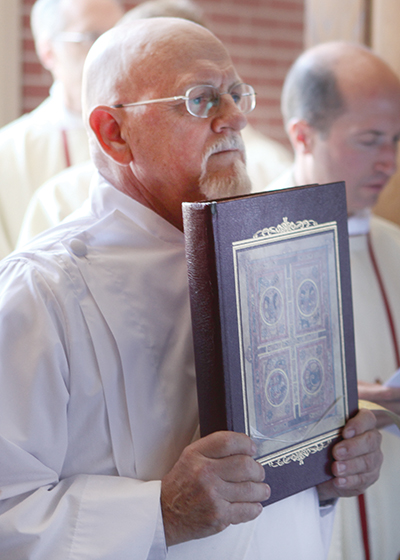 Deacon Stephen Kuchar, a member of St. Patrick Parish in Lincoln, was ordained a deacon in 1983 in the Omaha Archdiocese.
He moved to Lincoln in 1996, but it was another five years before he and Deacon Dick Drueke (who had moved to Lincoln around the same time) were incardinated into the Lincoln Diocese and given faculties to administer sacraments.
Deacon Kuchar worked in prison ministry for three years before applying for chaplaincy at St. Elizabeth Hospital where he served until a few months ago.
He currently assists Father Troy Schweiger at St. Patrick Parish. Father Schweiger said he’s happy to have Deacon Kuchar in the parish, and that he’s well respected by him and the parishioners.
“The priests I’ve worked with truly appreciate having a permanent deacon,” Deacon Kuchar said. “What we can do for the parishes and the people is just wonderful because the priests can’t do it all. I’m so happy that Bishop Conley is sending someone to the diaconate program.”
Dr. Matthew Hecker, the chief administrative officer of the Diocese of Lincoln schools, is the first candidate for the permanent diaconate in the Lincoln Diocese. 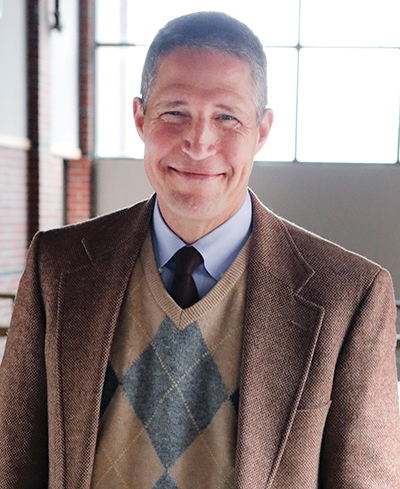
Dr. Hecker is originally from the Archdiocese of Denver, where he had been introduced to the permanent diaconate. The thought of being a deacon had been on his mind and in his prayers since the early 1980s.
Dr. Hecker approached Bishop Conley about this calling when Bishop Conley first moved from Denver to the Lincoln Diocese. Toward the end of 2016, Bishop Conley reached out to Dr. Hecker to see if he was still interested. He was, and he entered formation for the diaconate in 2017.
Dr. Hecker has been going through formation in the Archdiocese of Omaha and is currently in year three of four.
He said, “This is a much more significant journey than I could have imagined. For a lay person… it’s a lot to learn to reconfigure your life to the demands of Holy Orders, spiritually, mentally and socially.”
Dr. Hecker said that learning to navigate this journey has also been in part his wife’s journey as well as they figure out what this opportunity means for them as a family.
Dr. Hecker and Father Michael McCabe, the pastor at St. Joseph Parish in Lincoln (his home parish) have also been working to figure out what this opportunity means for the parish.
Father McCabe said he could see Dr. Hecker leading wake services and rosaries, doing some baptisms, assisting in the parish’s RCIA program and helping with Bible studies.
“We’re excited,” he said. “Dr. Hecker is very prayerful and has a wonderful temperament and we’re really excited for him to be a permanent deacon. Long term he’s going to help serve people in a more thorough way.”
Father McCabe also said Dr. Hecker could be a light for other men in the parish, to help them see if they have a calling to the diaconate.
Father Rayer said that the expansion of the permanent diaconate in the diocese is an ongoing discernment process and that if a man feels in his heart that God might be calling him to the permanent diaconate, to work with his parish priest to determine if there is an authentic call and an authentic need.
“The bishop would then work with that man to determine if the call is authentic,” he said. “Each person is called to holiness and for a man, that might be in the permanent diaconate.”
