

Peoria author presents on famous archbishop at Lincoln parish
By Fr. Gary Coulter
Diocesan Website Manager
Long before cable TV and viral videos, Archbishop Fulton J. Sheen was one of the most recognized faces on American television and is now on the path to sainthood.
In a talk July 23 at St. Joseph Parish in Lincoln, Katie Bagno — a Catholic teacher, catechist and author from Sheen’s home of Peoria, Ill. — discussed the archbishop’s roots, his cultural influence, and the reasons she believes his example is still relevant.
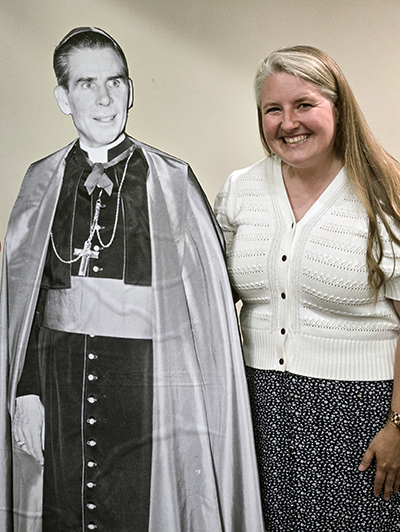
Sheen’s connection to Peoria runs deep, Bagno explained. He attended Cathedral School, served there as an altar boy, and was ordained a priest in the very same building where he is now buried — just 30 feet from the spot where he first laid down his life given to the priesthood.
It’s difficult today, Bagno said, to fully grasp how Sheen was a household name, able to command a television audience and speak directly to American culture with both humor and warmth. Equally hard to measure is the money he raised — and personally gave away — to support the Church’s missionary work abroad.
Bagno highlighted several details about the bishop’s life, such as the fact that Sheen is the only cleric to ever win an Emmy Award, having triumphed over Lucille Ball and “I Love Lucy.”
At the height of his television fame, Sheen received between 15,000 and 25,000 letters a day. And he donated his entire television salary to the Society for the Propagation of the Faith.
So why is Sheen a saint the Church needs today? Why follow in his footsteps? Bagno offered five answers drawn from his life.
A dedication to prayer. Sheen kept a holy hour before the Blessed Sacrament every single day of his priesthood, and he credited that hour of adoration as the source of all his ideas and writings.
A devotion to Our Lady. Sheen celebrated Mass every Saturday in honor of the Blessed Virgin Mary, wove her presence throughout his teaching and books, and dedicated his written works to her. He believed — and taught — that Mary draws people closer to her Son.
The use of media to evangelize. Sheen viewed television and radio not as distractions but as tools for spreading the Gospel, a conviction that drove his pioneering work on the airwaves.
Obedience in suffering. Sheen endured real physical hardship, including open-heart surgery, and spent his later years in relative obscurity, giving retreats for priests. Even so, he offered his trials and once remarked, “God has been easy with me.”
A universal call to holiness. Sheen’s own beginnings were unremarkable — a farm kid, an altar server, an ordinary Catholic family, and educated in Catholic schools. As he put it, “It does not take much time to make us saints, it only takes much love.”
Bagno then outlined the Church’s process for recognizing a new saint. A candidate must first be shown to have lived a life of heroic virtue, earning the title “Venerable.” Beatification then requires a verified miracle attributed to the candidate’s intercession, alongside evidence of popular devotion.
For Sheen, that miracle traces to a family living near Peoria in 2010. A couple had already chosen to name their unborn son after the archbishop when the boy, James Fulton, was born without a heartbeat and not breathing, the result of a knot in his umbilical cord. He went 61 minutes without a pulse or oxygen — after which doctors expected severe brain and organ damage. A year later the boy showed no damage at all.
For those interested in learning more from Sheen’s own writing, Bagno recommends several of his best-known works: “Treasure in Clay” (autobiography), “Life of Christ,” “The World’s First Love,” “Victory Over Vice,” and “The Way of the Cross.”
Bagno has created a “Teaching with Fulton Sheen” curriculum — a free collection of more than 200 pages of activities covering Sheen’s life for all ages — found at looktohimandberadiant.com.
