

By Abbey Hugo
(SNR) - The Lincoln Diocesan Education Technology Office played a crucial role in diocesan schools’ transition to online learning in March. The office is now preparing for the upcoming school, ensuring all schools are properly equipped for the off-chance classes are forced online once again.
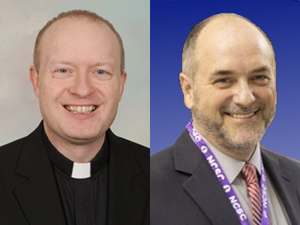 At this time, school is scheduled to resume in person as normal at the diocese’s 30 schools. However, this may change at any moment given the unstable circumstances related to the coronavirus pandemic. Government and health officials make the final decision regarding whether or not schools can meet in person, so the diocese itself is not necessarily in control.
Father Matthew Zimmer, the diocese’s new director of education technology, said the Education Technology Office is hoping for the best—but preparing for the worst.
Zimmer is one of two new staff members to recently join the Education Technology Office. He acts as a liaison between the office and the schools. He officially took on the role in June, but when steps needed to be taken as all diocesan schools moved online in March, he began offering part-time help whenever he could.
Chris Hobbs became the director of information technology in June as well. He said he was blessed to join a staff that could accomplish as much as they did in the spring.
“I’m amazed at what the staff here did,” Hobbs said. “The folks here that are running the operations are wonderful. To go from the normalcy of a normal school year to all online, all virtual, and to do it in just a few days, just a small time, that’s a testament to their abilities.”
While neither were a part of the office in the spring, both Hobbs and Zimmer bring unique perspectives on the whirlwind of moving schools online. Hobbs, having small children himself, saw what this transition was like from a parent’s perspective.
Father Zimmer, who is pastor of Ss. Mary and Joseph Parish in Valparaiso, was the assistant administrative officer at Bishop Neumann High School in Wahoo, so he could speak on what it was like for teachers to move to socially-distanced learning at the end of the semester.
“What really happened was a phenomenal amount of work on the parts of the teachers, what they were doing in moving online,” Zimmer said. “Some teachers were extremely prepared for that. Some needed a little extra help, but they were all willing to put the work in. The bulk of the work, the bulk of the effort, was really on the teachers to try to do this.”
Zimmer and Hobbs said, overall, the move to online learning went as smoothly as possible. There was infrastructure in place that helped guide the change.
“It went as well as could be hoped for but also about as badly as expected,” Zimmer said. “The reality is distanced learning is not nearly as effective as in-class; we all know that.... But given the scenario, given what we had to deal with, and given the speed, I think it went very well.”
As the upcoming school year approaches, the Education Technology Office is working out some procedural concerns so online learning can be more successful if enacted again. This includes changes such as standardizing what program students would use to access class materials. All diocesan schools will now use PowerSchool student information system.
The Education Technology Office is also determining how to best equip schools with the technology they need and is making sure all equipment is ready and functioning properly. It is also releasing documents on how to best sanitize equipment.
This summer’s training for diocesan teachers is focusing on the skills necessary to teach online.
