

Holy Thursday Mass of the Lord's Supper
Cathedral of the Risen Christ, April 2, 2021
Homily by Father Justin Wylie
“Do this in memory of me.”
Were ever any six words more obeyed in all of human history?
From the humblest wayside chapel to the most grandiose Gothic cathedral,
from baptisms to weddings to funerals,
from regal coronations to concentration camp barracks,
day after day, by every priest, in every church, chapel oratory and basilica
everywhere in the world
in every age, in every language,
from the south pole to the north,
on mountaintops, in caves and catacombs,
on ships and in stadia …
was there ever a command which more readily was taken up than this brief admonition,
“Do this in memory of me”?
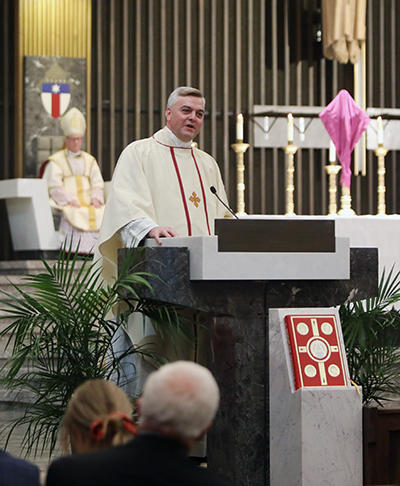 This command, this mandatum, lies at the very heart of what it means to follow the way we have come to call Christianity. But what does it command? A meal? A memorial?
Sharing food? Washing feet? What is it that we do in memory of Him?
Each Holy Thursday offers us this opportunity, anew: to delve deeper into the purpose of what Christ commands, what Christ accomplishes, what Christ invites us to participate in – we who name ourselves Christians after Him and follow His Way.
Yes, the Mass is a memorial.
But it is the memorial, not of a meal – the Last Supper.
We do not come here merely to “break bread” together.
After all, that meal in the Upper Room was itself the memorial of an earlier event: the Passover – a liberating event which had taken place in the mists of salvation history when the angel of death passed-over the households of those whose lintels had been smeared with the blood of a sacrificed lamb.
The Last Supper, on the contrary, was the institution of a memorial for an event which had yet to take place, the following day: the sacrifice of that Lamb of God, whose blood, smeared on the lintels of our lips, vanquishes the final enemy, death itself, the wages of our sin. The reality now supplants the figure as we mark the lintels of our mouths with the blood of the true Lamb of God of which we partake in the Eucharist, instituted this night.
The Mass is the memorial not of the Upper Room (per se), then, but of the whole self-offering that begins there but “is consummated” on the altar of the Cross at Calvary.
Calvary – the only sacrifice sufficient to satisfy for all the wretchedness of the whole world.
This is to speak also of a sacrifice.
It is the sacrifice of Christ: satisfying justice, because a divine victim, offered by a divine priest, Christ, the Son of God; applicable to us, because offered by a priest and victim also fully human: Christ, the Son of Mary.
And yet, the Mass also is our sacrifice: because we, too – the Baptized, a priestly people – become participants in this unique event; not because we have anything to add to the perfect offering which Christ made to His Father on our behalf – except our own wills. A sacrifice of praise.
We have our will. In the Mass we sacrifice our own wills with His in this great “sacrifice of praise” which resounds from Golgotha hill to every hill and dale in 2,000 years of Christendom.
We call the Mass the “Eucharist”, this Greek word for thanksgiving: because this memorial we celebrate at this altar is our “sacrifice of thanksgiving”.
The Mass is a memorial, yes; but not a memorial like a monument – a merely symbolic meal, which harkens our minds back to the real meal 2,000 years ago.
It is not a symbolic, but a sacramental, reality. Yes, a sacrament is a sign: signs make perceptible to the senses a reality that lies elsewhere - beyond. But a sacrament is not just a sign: it is an efficacious sign – for it accomplishes what it signifies. It makes it truly present what it represents. All other signs point to a reality beyond themselves (which they do not achieve). Those signs represent another reality. Sacraments achieve that reality – make it present, really.
The Mass, then, is a re-presentation, not a representation – not theatrical, but “making present again” here and now, what actually occurs. When we “do this in memorial” of Him, the ‘this’ which we do is the same ‘this’ which He accomplished in His self-offering. The same victim, the same priest. The bread and wine becomes the flesh and blood of the One who speaks again through the voice of the priest: “this is my body; this is my blood.”
The Mass, thus, is not other than the Sacrifice Christ made of His Body and Blood at Calvary – given up for you, poured out for you – it is not another Sacrifice, here and now, but the same, unique, inimitable sacrifice brought into the here and now: it merits, its applicability, its satisfaction, its sanctification, made present again in this place and at this time.
The greatest gift in all of history is the Incarnation, the making-flesh and blood of God Himself in the Child, Jesus. We commemorate it at Christmas. God gives the gift of Himself – bodily. It is this body which the author of the Letter to the Hebrews stresses fulfils and supercedes the former “sacrifices and burnt offerings … [which God’] has not desired; instead, a body you have prepared for me.” This gift appears wrapped in swaddling cloths in the manger (which means: eat!) at Bethlehem (which means ‘house of bread”). It is these swaddling cloths the priest presents when he opens the corporal. When he folds it neatly after the consummation of the sacrifice, it is the shroud left behind in Easter’s empty tomb. God’s gift to us; our gift to God.
But this is the night He consigns or “hands over” this immense and incomparable gift.
This is the night God consigns Himself to us; He delivers His very body up for us. In this is our deliverance; we are delivered from bondage in this act of His consignment unto death.
This is the hour.
The Eucharist, then, is not an add-on to the Incarnation – it is no optional extra to Christ – it is nothing less than the extension in time and space of the very same reality – Christ, Himself.
Now it is ours – He is ours – here and now. He hands Himself over to us, this night, here: quite literally, on a plate. Whenever we take hold of Him – in this plate, in this cup – it is that hour, again; and the question is posed anew: what will we do with Him?
It is this, intensely personal, question that confronts each one of us at every Mass – whenever we eat or drink of the flesh and blood of the Son of Man. How we respond – not with our lips, merely: but with our wills, with what is ours, with who we are, with our whole lives – this is what will make the difference for us: whether we eat or drink unto ourselves condemnation or salvation.
That unique hour of Christ’s perfect satisfaction – rendered unto the perfection of God’s justice to win for us, in turn, the perfection of God's mercy – hangs there suspended in time and space, like a great question mark, potentially linking heaven and earth even for us if we respond and assume its passage.
For all the other hours that will follow after this, until the end of time: the hour of Christ’s eternal sacrifice is prolonged and offered again and again to each of us in God’s mercy through “God’s project in history” – which is the Church. The Mass is a moment of eternity brought into time.
Tonight is not just the institution of the Eucharist, it is the institution of the Eucharistic Church: God’s vehicle for salvation for all peoples in all places at all times. Where there is the Eucharist, there is the Church. Without the Eucharist – without Christ – there is no Church. But, also – without the Church, there is no Eucharist. Here, too, then – of necessity – is also the moment of the institution of the priesthood. For ours is a priestly religion, we who follow Christ the High Priest of the New and Eternal Covenant.
We who are ministerial priests are sacramentally made sharers in that sacrifice, that hour, that we may extend its efficaciousness – its offer – to all men, in all times and in all places.
We are not priests but Priest. We do not speak in our own name but in His; “this is my body,” we say in persona Christi capitis: “this is my blood, given for you.” Such is the inscrutable mercy of our God!
Christ’s mandatum – to “do this in memory of me” – commands not just the sharing of this Eucharistic sacrifice, but commands also (through the washing of the feet of the other), our own corresponding willingness to stoop – as He did – for “the other”: to make of him our neighbour … to do the unthinkable: to demean oneself (to sacrifice oneself) for the benefit of another. To put “the other” ahead of the self. Without this dynamic – which the very logic of the incarnation, itself – our Christianity becomes meaningless. It becomes merely theatrical, imitatory, hypocritical pageantry: a dim facsimile of a long lost reality.
The consigning of this commandment – to “do this in memory of me” – includes the consignment Our blessed Lord made of Himself in His mysterious psychic suffering in Gethsemane. This is the night of the watch – the night watch – to keep vigil one hour with the Lord. It is the hour.
At our altar of repose, tonight, therefore, we, the men and women of this time and place are offered the opportunity ourselves “to watch with Him awhile,” to “stay awake” to “keep vigil with him” and fathom the depths of the agony which Our immaculate Lord confronted in that iconic garden – when He assumed the full horror of the burden all the world’s sin and wretchedness, for which He would, shortly, be made an atoning satisfaction.
The hour is upon us. The hour of our salvation is here. Iam hora est! It is now.
