

Story by Randy Porter
(SNR) - With the ordination of Matthew Hecker, Ph.D., as the first permanent deacon from the Catholic Diocese of Lincoln, others may follow.
Hecker, chief administrative officer of Lincoln Diocesan Schools, was ordained a deacon for the Lincoln Diocese May 28 by Bishop James Conley.
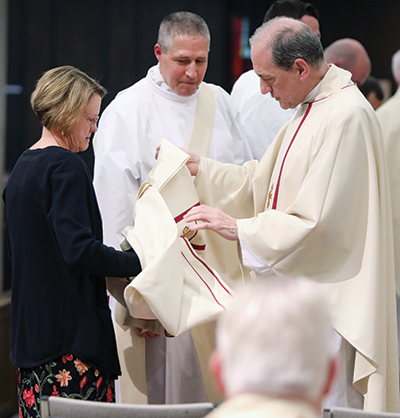
The Church allows men to be candidates for the diaconate if they are accepted by the bishop. Married men who become deacons are referred to as “permanent deacons.” An unmarried man may enter formation to become a deacon without the intention of being ordained a priest, but this scenario is less common. All priests were first ordained deacons and remain deacons.
A deacon may perform many liturgical functions. He may proclaim the Gospel, preach homilies, preside at wake services, and preside at funerals that are not Masses. He may also witness marriage vows as long as he has proper delegation from the pastor of the parish.
“Dr. Hecker has been great to work with throughout the diaconate formation process,” said Father Daniel J. Rayer, chancellor of the Diocese of Lincoln and current director of the diocesan permanent diaconate program. “He recognized that he is sort of a pioneer as first permanent deacon ordained for the diocese. We have both been learning together throughout this process.”
Deacon Hecker discerned the call to the diaconate in the Diocese of Lincoln which has no formal permanent diaconate formation program. He entered into the program offered through the Archdiocese of Omaha.
Deacons are commissioned for ministries of charity and service, he said. The presence of a deacon will expand opportunities for local parishes to serve their communities.
Hecker sensed calling to Holy Orders
“It is an ancient role in the Church from the wisdom of the apostles, and ties back into the earliest understanding of the Church,” Hecker said. “It is not something new, it is something old.”
He will continue his job with the diocesan schools, but will now wear an additional “cap.”
Hecker’s Ph.D. is in education administration. He also holds a master’s degree in counseling and a bachelor’s degree in history. He completed four years of formation in the Archdiocese of Omaha’s permanent diaconate program.
Raised in the Denver area, the archdiocese there was an early adopter of the permanent diaconate in the 1970s. On November 21, 1964, Pope Paul VI would promulgate Lumen Gentium, The Dogmatic Constitution on the Church. This document of the Second Vatican Council ushered in the restoration of the permanent diaconate, stating: “the diaconate can in the future be restored as a proper and permanent rank of the hierarchy,” leaving it “to the competent territorial bodies of bishops… to decide whether and where it is opportune for such deacons to be established for the care of souls.”
“I was aware of men who became permanent deacons,” the new deacon said.
Seeing them in that role, particularly after graduating from college, was eye-opening, Hecker said. He worked with them in service to the Church.
He witnessed their experience with good life management skills, balancing family and the role of the permanent deacon.
Formation, in essence, is the process of preparation and discernment for a man to the diaconate, Hecker said.
The question for the candidate is, “Can you configure your life to the demands?” he asked. “Either you do it, or not. Either in or out — full time.”
“One, can you conform yourself, and two, can you be credible both in the academic sense as well as the personal,” Hecker explained. “We’ve been formed as husbands and fathers. Now, can I conform my entire life to a whole new set of expectations, and integrate my family life?”
His formal formation included intensive studies one weekend each month. In between, he completed various assigned readings. He took tests on the Catechism of the Catholic Church. There were human formation and spiritual formation meetings and, of course, prayer.
During the last two years of formation, he actively engaged in different activities in deacon’s service.
“The challenge is making the time to balance it all together,” Hecker said. “It clearly is a challenge in that regard.”
Raised by devout Catholic parents with two sisters and four brothers, Hecker attended Catholic grade school. His parish left the lasting impression on him that being a Catholic was more than just going to Mass. It began his understanding of the fullness of Catholic life.
Hecker and his wife, Dani, a certified public accountant, have three daughters and two grandchildren.
“I’m tremendously grateful for the Lord’s calling and the bishop’s affirming the vocation,” he said. “Recognizing there is a lot of pain and hurt in the world, the deacon’s role is to be an instrument for God’s grace — to ease suffering and be an instrument of love and mercy.” He’s excited to begin that role.
Hecker approached Bishop Conley about this calling. Toward the end of 2016, Bishop Conley reached out to Dr. Hecker to see if he was still interested. He entered formation for the diaconate in 2017.
New Director of Permanent Diaconate Program
“Dr. Hecker’s ordination is an important moment in the life of the diocese, as is every ordination that occurs,” said Father Caleb La Rue.
Father La Rue is set to become Director of the Permanent Diaconate Program for the Diocese of Lincoln Sept. 1.
“I encourage every parishioner in the diocese to pray for (Deacon Hecker), and for all those who will be ordained deacons and priests for our diocese,” said La Rue. Father La Rue is currently preparing to receive a license in Canon Law from the Catholic University of America in Washington, D.C. in August. Ordained for seven years, the priest has lived in Lincoln the past 18 months, taking classes online due to the pandemic.
The ministry of the diaconate is one of service, hence the name deacon comes from the Greek “to serve,” Father La Rue said. The word “diakonos” is a Greek word meaning “servant” or “helper.” As such, the Church has traditionally understood the role of the deacon as being at the service of charity. During the early life of the Church, deacons were not primarily liturgical in function, but were rather entrusted with overseeing the charitable works of the diocese.
While the role of the deacon has shifted over the centuries, he said, the deacon is still primarily ordained to service to the Church. In the ordination ritual, deacons are called “Heralds of the Gospel.”
The bishop presents the Book of the Gospels to the man being ordained and says, “Receive the Gospel of Christ, whose herald you have become. Believe what you read, teach what you believe, and practice what you teach.”
For most of the faithful, this seems to be primarily fulfilled in the proper role of the deacon as the one who proclaims the Gospel at Mass. In reality, deacons are clerics envisioned as more in the world than priests or bishops.
They carry out the charitable works of the Church. As such, deacons are called to proclaim the Gospel to the world through their witness of service to the poor, the forgotten, the vulnerable, and anyone “on the fringes” of society.
When asked, La Rue had advice for a married man who sensed the calling. He said he would tell him to reflect on what his calling to the service of charity is, and why he feels being ordained a deacon is in service of that.
“I would encourage him to develop a strong spiritual life, as we can only give what we have received,” said La Rue. “If we are not being fed by the love of God, none of us can serve with love, especially those who are ordained.”
La Rue also would tell a potential candidate to look honestly at his life. He needs to determine if his other obligations, such as to his wife and children, would prevent him from being able to live out his life as a husband and father as well as a deacon.
Because this is a new initiative for the Diocese of Lincoln, Father La Rue will work on developing various norms regarding the role of deacons in the various ministries in our diocese, Father Rayer said. His role also will include working with Bishop Conley in discerning the authenticity of a vocational call for future permanent deacons.
