

Woman makes Passport Pilgrimage into a personal, silent retreat
By Cathy Blankenau Bender
Editor, Southern Nebraska Register
Bishop Conley: “I think our Eucharistic Passport Pilgrimage is bearing precisely the fruit that we were hoping for, reviving an appreciation, love and devotion to the holy Eucharist.”
When Bishop James Conley launched the “Eucharistic Passport Pilgrimage” Aug. 2, he said he hoped it would encourage people across the Catholic Diocese of Lincoln to “make a spiritual pilgrimage.”
“I pray that this might be an occasion of true encounter with our Eucharistic Lord, hidden in the Blessed Sacrament,” he wrote in his Aug. 4 column for the Southern Nebraska Register, “and an opportunity for true renewal and revival for our Eucharistic Lord.” 
The pilgrimage is simple – inviting people across the diocese to visit 17 locations across the diocese, specifically during exposition and adoration. “Passports” have been distributed to all parishes in the diocese, and each designated location included in the passport has a stamp, so pilgrims may stamp their passports when they visit.
Just weeks into the initiative, the bishop said, he has heard from several people who have completed the pilgrimage, sharing “how much they enjoyed traveling around the diocese and spending time in prayer with our Lord in our beautiful adoration chapels.”
While the pilgrimage is suggested throughout the year, concluding before the national Eucharistic congress to be held in Indianapolis in July 2024, some people have already visited all the sites. One person who has completed visits to all 17 locations in the passport is Phyllis Kool, a member of North American Martyrs Parish in Lincoln.
She began the pilgrimage Aug. 24, going to the Pink Sisters’ chapel in Lincoln. She then made visits to each of the remaining 16 churches, concluding her pilgrimage at St. Patrick Church in Imperial – more than 300 miles from home – just 18 days later. It’s worth noting that she completed the pilgrimage while also going to her regular adoration hours at her home parish each Thursday.
But Kool didn’t simply visit the churches and chapels. She created a pilgrimage of her own, and embarked on a journey of healing.
In late April of this year, Phyllis’ husband John, to whom she had been married 43 years, died after a long battle with cancer.
“With our faith,” Kool said, “we were not afraid of death, remained positive, and thanked God for all of our blessings, and every extra day we had together.”
Since the time of John’s death, however, Phyllis did not have grief “that left me crying,” but said that during July and August, she lacked motivation to get out of bed, and to get out of the house.
“Adoration of the Blessed Eucharist has always been my ‘oasis of peace,’” she said, “so when this pilgrimage came up, I knew God was calling me, and I was ready for the challenge.”
Kool turned the passport pilgrimage into a “silent retreat.”
The silence began at home. Since she lives with her youngest daughter’s family, she would sleep late in the mornings, so that the family would be off to school and work before she left. Likewise, as she visited each site, she tried not to arrive or leave at the top of the hour, so as to avoid as much conversation as possible.
And while driving “all of those hours,” she said, she was either silent, praying rosaries, or listening to Spirit Catholic Radio.
“This pilgrimage was so beautiful for me!” she said. “It gave me a reason to get up and out of the house daily, and centered my life on Jesus. I feel invigorated, and ready for life, again. I am open to do whatever God wants of me. I’m excited to live again!”
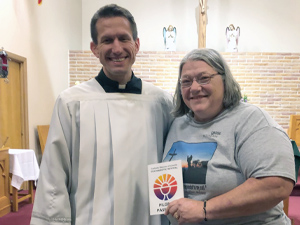 Kool thanked Bishop Conley and his committee for their work in organizing the Eucharistic pilgrimage for the Diocese.
“I highly encourage others to set a goal and make plans for taking this pilgrimage,” she said. Even if one cannot visit all of the churches due to work schedules or other commitments, “don’t let that keep you from going to as many as possible,” she said.
“Our Lord is waiting for you and is ready to help turn your life around.”
Bishop Conley was very happy to hear about Kool’s journey.
“What a wonderful testimony! It made my heart smile!” he exclaimed. “I am so pleased that our Eucharistic Lord, in a silent and hidden way, is calling people to make this pilgrimage. Jesus is even healing people in the process! This was a touching story of healing and recovery after great loss.”
The bishop encouraged others to try to make as many adoration visits as possible – and, perhaps, to reach out to those who cannot travel to various Eucharistic sites on their own. That, he said, “would be a supreme act of kindness and hospitality.”
“I think our Eucharistic Passport Pilgrimage is bearing precisely the fruit that we were hoping for,” the bishop said, “reviving an appreciation, love and devotion to the holy Eucharist.”
