

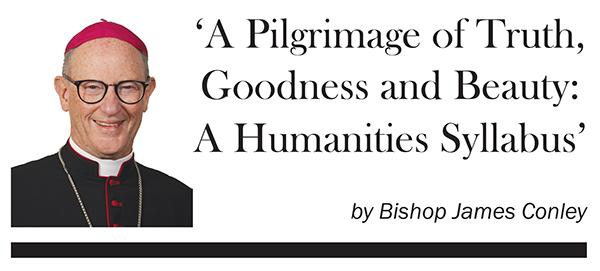
By Bishop James Conley
“Finally, brethren, whatever is true, whatever is honorable, whatever is just, whatever is pure, whatever is lovely, whatever is gracious, if there is any excellence, if there is anything worthy of praise, think about these things.” Philippians 4:8
 Summer is a time of rest and fun, and, with it, our Jubilee Year pilgrimage reaches its halfway mark. Midsummer Eve, the midway point of an historically longer summer season and also of the entire year, has been traditionally observed with bonfires (literally bone-fires) on June 23, the eve of the Nativity of John the Baptist. According to ancient reckoning, it was the time of the summer solstice, when the sun was at its full strength. From this point, the days become shorter, a natural sign that Christians linked to the symbolism of John the Baptist’s prophecy that he must decrease as the Messiah increases, whose birth was marked at the winter solstice.
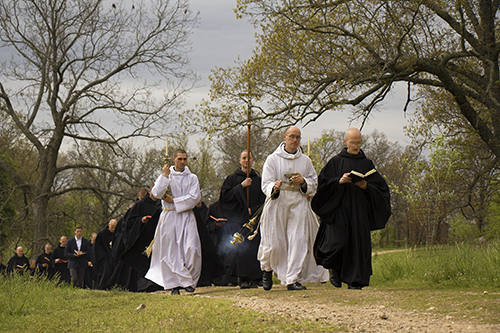
I recently made a visit with my seminarians to the Benedictine Abbey of Clear Creek in the Ozark foothills of eastern Oklahoma (clearcreekmonks.org). It happened to be during the Rogation Days of spring where the monks processed with the villagers through the fields and forests. The monks were chanting the major and minor litanies, interceding for God’s blessings on the land, crops, livestock and all of creation, sprinkling great quantities of holy water and swinging thuribles of incense, along the procession route, seeking the protection of God from all calamities. Shafts of sunlight shot through the trees as the sweet smell of incense rose to the heavens along with the melodic tones of Gregorian chant. It was something like perfection.
As we trace the natural signs of the seasons, summer manifests abundance and blessings which should flow to those who follow the way of the Lord. Catholics sanctify the liturgical year through festivity, redeeming time through the celebration of the mysteries of the faith. This does not override, but rather fulfills the natural rhythm of the seasons, marking the times of planting, toil, and harvest. These holy days offer a time of respite, when people can step back and enter into an imaginative merriment that transcends the demands and sorrows of everyday life.
During festivals and the pageants that would often accompany them in medieval Christendom, we often encounter the mysterious realm of Faerie. In his remarkable and timeless work, “Orthodoxy,” G.K. Chesterton relates the fundamental educational influence that fairy stories had upon his childhood:
The things I believed most then, the things I believe most now, are the things called fairy tales. They seem to me to be the entirely reasonable things. They are not fantasies: compared with them other things are fantastic. Compared with them religion and rationalism are both abnormal, though religion is abnormally right and rationalism abnormally wrong. Fairyland is nothing but the sunny country of common sense. It is not earth that judges heaven, but heaven that judges earth; so for me at least it was not earth that criticised elfland, but elfland that criticised the earth.
Fairy stories engage our childlike “interest and amazement.” “These tales,” he continues, “say that apples were golden only to refresh the forgotten moment when we found that they were green. They make rivers run with wine only to make us remember, for one wild moment, that they run with water.” In short, they help us to see reality more deeply. Following Chesterton’s childlike wisdom, we’ll dive into imaginative merriment this month.
Poetry
The modern world has become disenchanted, no longer able to see the fulness of reality because we have reduced our vision to what appears on the surface of things. We no longer see “the dearest freshness deep down things,” and how they reflect the grandeur of God.
We begin our exploration of summer merriment, therefore, with the help of the German poet, Rainer Maria Rilke. His poem “Entrance” invites us to see things anew, allowing them to shape our vision of reality, while remaining childlike, unable to contain and control what we encounter. The poem is masterfully translated by the great poet Dana Gioia in his collection “Interrogations at Noon” (2001):
Whoever you are: step out of doors tonight,
Out of the room that lets you feel secure.
Infinity is open to your sight.
Whoever you are.
With eyes that have forgotten how to see
From viewing things already too well-known,
Lift up into the dark a huge, black tree
And put it in the heavens: tall, alone.
And you have made the world and all you see.
It ripens like the words still in your mouth.
And when at last you comprehend its truth,
Then close your eyes and gently set it free.
Music
Just as we can look anew at reality to contemplate its depth, so we can listen to the mystery of enchantment. You can see the sunrise, of course, but what does it sound like? The Norwegian composer, Edvard Grieg, gives us a good indication in his “Morning Mood,” part of the incidental music he wrote to accompany Henrik Ibsen’s play “Peer Gynt.” Grieg collected highlights of this music for his “Peer Gynt Suites 1 and 2,” which offer many delights both of merriment and adventure. In addition to “Morning Mood,” listeners will most likely recognize “In the Hall of the Mountain King,” where Peer encounters the realm of the trolls.
Both Grieg and Ibsen engaged traditional Norwegian folk traditions but also their breakdown in a disenchanted world. Peer Gynt began his adventures by engaging in local mischief, which led him into the darkness of the hall of the trolls, before setting off on a surrealist adventure around the world, and ultimately back home again for a final reconciliation. Modern man is restless, and, like Gynt, struggles to balance the beauty of nature and the traditions of culture with the dominance of the self, our new religion. Grieg’s music, however, draws out the best of Ibsen’s scenes, and, through them, offers us a wonderful voyage of contemplation.
Book
Ibsen’s “Peer Gynt” raises questions of how the modern person, often dislocated from tradition and place, can find meaning and a place of rest. Shakespeare, the great Bard, points us to the dramatic nature of this search, “All the world’s a stage / And all the men and women merely players” (“As You Like It”). The Swiss theologian, Hans Urs von Balthasar, agreed, viewing Christ as the chief actor in the great drama of salvation history through whom we take up our own roles. Shakespeare’s plays, among the greatest works of literature ever written, illumine this drama in all its highs and lows, exploring black darkness, as in “MacBeth,” and the exultation of love, as in our work for this month, “Midsummer Night’s Dream.”
The play draws us into the delights and perils of Faerie as two young couples become entangled within a dispute of the fairy king and queen outside of ancient Athens. Shakespeare wrote “Midsummer Night’s Dream” about the same time as “Romeo and Juliet,” and, together, the two plays show the possibility of love’s realization or self-destruction. It requires a mysterious intervention in the former to save two young couples from peril, one that points to how ridiculous our infatuations may become. The spurned Helena laments: “Things base and vile, holding no quantity, / Love can transpose to form and dignity. / Love looks not with the eyes, but with the mind; / And therefore is wing’d Cupid painted blind. / Nor hath Love’s mind of any judgment taste; / Wings and no eyes figure unheedy haste; / And therefore is Love said to be a child, / Because in choice he is so oft beguil’d.” Only the intervention of the fairy king, Oberon, brings the lover who abandoned her back. In the meantime, he plays a trick on his own fairy queen, Titania, causing her to fall in love with a rustic actor, transfigured with the head of a donkey.
The imagination has great power to draw us into love of things both beautiful and grotesque, for it can misfire: “Or in the night, imagining some fear, / How easy is a bush suppos’d a bear?” Shakespeare helps us to recognize how laughable our loves may be, at other times destructive, but also that they can be turned aright. Dangers lurk, for love can stir up violence, as the dueling lovers almost come to blows, but, when vision is righted, and the heart attuned, peace follows as the play’s triple marriage brings resolution. The lion prows to disrupt but the moonlight can illuminate the mind to see with enchanted eyes.
We can remain stuck in a stupor. As Demetrius asks, “Are you sure / That we are awake? It seems to me / That yet we sleep, we dream.” But, Theseus, the king, will stir his people to celebrate his coming wedding, representative of a needed awakening: “Stir up the Athenian youth to merriments; / Awake the pert and nimble spirit of mirth.” The play invites us into this awakening.
Art
A Christian vision of reality goes beyond what we can sense. The Gospel is the true means of enchantment for it shows us the true meaning and love that suffuses creation. The celebration of human love given by the Bard is not bad per se, but it requires heavenly intervention to find its true goal. Pope Benedict XVI speaks of its elevation by charity in his great encyclical, Deus Caritas Est: “Evidently, eros needs to be disciplined and purified if it is to provide not just fleeting pleasure, but a certain foretaste of the pinnacle of our existence, of that beatitude for which our whole being yearns.” The joy our senses find in God’s creation points beyond itself to something greater that can discipline and purify them.
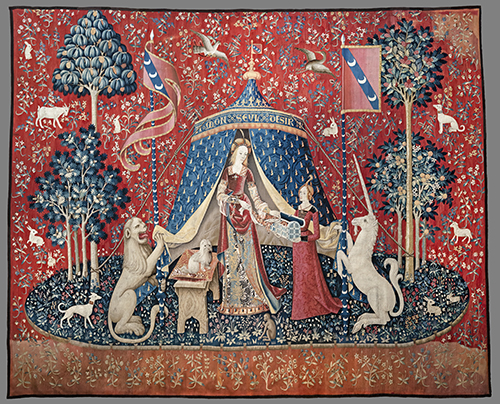
“The Lady and the Unicorn” series of tapestries, held at the Musée de Cluny in Paris, point to the tension and resolution of earthly and heavenly delight. They were woven of wool and silk in Flanders around the year 1500, in the mille-fleurs style that uses thousands of intricate flowers for decoration, and all feature a woman surrounded by a group of animals, most notably a unicorn, a beast that symbolizes a sexual desire that can be tamed by innocent chastity. Like all great art, the tapestries resist easy interpretation, and elaborate theories have been presented on their meaning, linked to historical figures such as the Queen of France, Mary Tudor, and even Joan of Arc. On a basic level, however, they engage the five senses in five separate tapesteries, with a final one depicting the woman draped by a tent with the inscription “À mon seul désir,” “to my only desire.”
In the tapestries of the five senses, we find the animals actively engaged: the rabbit tastes, a monkey smells a flower that the woman will weave into a crown, and the unicorn gazes at itself in the mirror, an artistic device to portray vanity. The woman sadly plays a pipe organ as the animals gather to listen, and she touches the unicorn’s horn in one hand while she holds a heraldic banner planted into the ground in the other, showing how rooted we are and dependent on our sense perception.
While the final tapestry is not often interpreted religiously, the tent, decorated with tongues of fire, creates an enclosed space, like a cloister, into which the woman withdraws, while laying aside her jewels. It may indicate a desire so deep that it cannot be fulfilled by the senses, and to which they can only point as a faint shadow. The animals, which symbolize to the passions, especially the monkey, have been largely subdued by sitting calmly around the woman, witnessing her withdraw from the world. These rich tapestries flow from the robust medieval imagination that understood the cosmos as God’s temple but also a temporary one from which we must ultimately withdraw.
Movie
We find a different kind of merriment, one that stands in playful contrast to Shakespeare’s vision of lost lovers in the wood, in Roberto Rossellini’s “The Flowers of St. Francis,” a 1950 black and white film tracing that holy troubadour and his early followers through vignettes of their holy escapades. It captures the Franciscan spirit so authentically, in part because it’s acted by Franciscan friars. The interplay between the fanciful longing for merriment in the realm of faerie and the true rest that only Christ can give finds a unique resolution in the innocence and delight of St. Francis. His merriment, that inspired him to leave everything worldly behind, enabled him to perceive the praise offered to the creator by all his works—the sun, moon, water, fire, and even death.
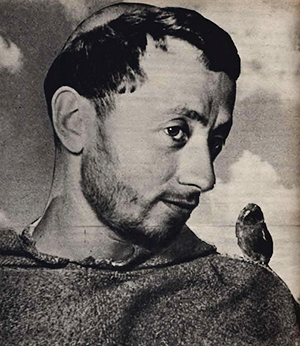
In a disenchanted world, however, we find it nearly impossible to follow Francis’s joyful merriment of abandonment to God. The deepest source of re-enchantment, however, comes from faith, which enables us to see reality as it truly is with all its depth and possibility. There is also a risk of false enchantment, against we must guard, as many who are lost turn to the esoteric and neopaganism, which only lead into darkness. True re-enchantment sees all things in light of the ultimate purpose, signs and invitation to enter into God’s eternal love. Francis and his friars serve as minstrels of this holy abandon that sees things as they truly are as signs and sacraments of a reality suffused with God’s presence and eternal consequence.
Conclusion
The humanities are meant to be experienced in a joyful and communal context. This summer calls us to rediscover the world’s enchantment through the beauty of nature and the arts. That beauty shines through the transformation of a heart in “Midsummer Night’s Dream” and the simple and pure faith in the movie “The Flowers of St. Francis.” We can undertake an adventurous journey through Grieg’s “Peer Gynt Suites” and then contemplate life with the awe it deserves in Rilke’s poem “Entrance.” This emotion-filled ride through summer includes the experience of “The Lady and the Unicorn” tapestries, a delight to our senses.
These masterpieces create in us a greater understanding of what St. Paul is talking about when he encourages us to think of the true, the honorable, the just, the pure, the lovely, the gracious, the excellent and those things worthy of praise. This summer let us rest in the joy of our journey through this year and recommit ourselves to seek out the good that awaits us ahead.
Bishop Conley’s Humanities Syllabus
June: “Midsummer Merriment”
Book:
“Midsummer Night’s Dream” by William Shakespeare
Film:
“The Flowers of St. Francis,” Roberto Rossellini, 1950
Music:
“Peer Gynt Suites 1 and 2” by Edvard Grieg
Poem:
“Entrance” by Rainer Maria Rilke
Art:
“The Lady and the Unicorn” tapestry series
ADDITIONAL SUGGESTIONS
Books:
“Orthodoxy,” G.K. Chesterton
“Leisure, the Basis of Culture” by Joseph Pieper
Movie:
“Dead Poets Society,” Peter Weir, 1989
Music:
“Hor che’l ciel e la terra” (Madrigals, Book 8) by Monteverdi
Poems:
“Shall I compare thee to a summer’s day? (Sonnet 18)” by William Shakespeare
“God’s Grandeur” by Gerard Manley Hopkins,
“To Mistress Margaret Hussey by John Skelton
“Daffodils” by William Wordsworth
“The Oven Bird” by Robert Frost
Art:
“Primavera” by Sandro Botticelli,
“The Dancing Couple” by Jan Steen
FOR CHILDREN
Books:
“The Princess and the Goblin” by George MacDonald
Movie:
“The Princess Bride,” 1987
Music:
“A Midsummer Night’s Dream Overture” by Mendelssohn. Listen for the donkey braying.
Poem:
“Sumer is icumen in”
Art:
“The Entry of the Animals into Noah’s Ark” by Jan Brueghel the Elder
Editor's Note: Click here for more Diocese of Lincoln Jubilee 2025 Resources
Click here for all the Humanities Syllabus postings
