Southern Nebraska Register
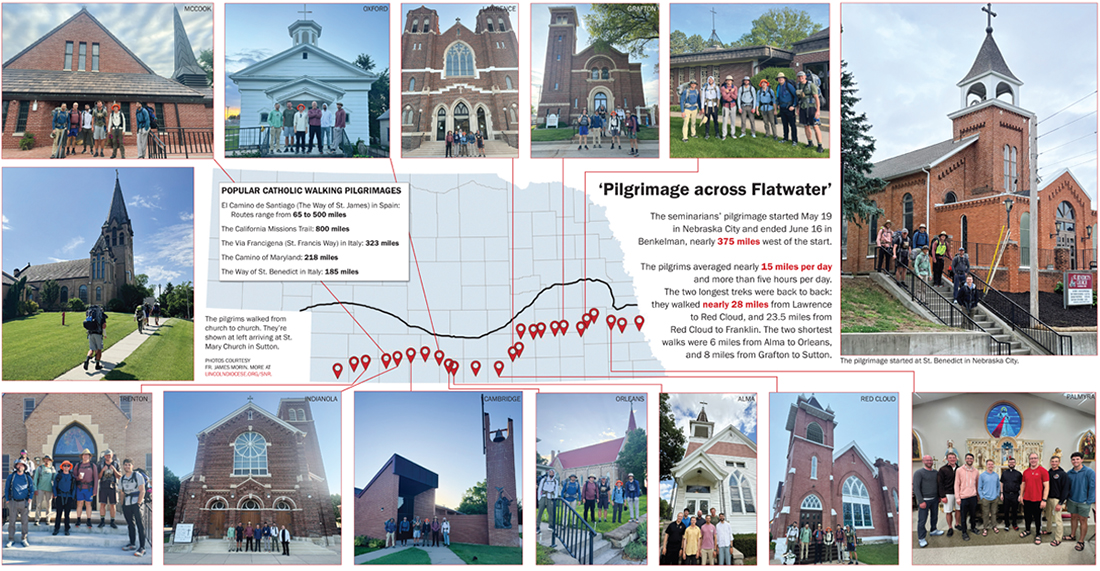
A group of seminarians walked nearly 375 miles this summer, visiting more than two dozen parishes in a walking pilgrimage across the Catholic Diocese of Lincoln.
They began May 19 at St. Benedict in Nebraska City on the Iowa border. The group then walked west, averaging nearly 15 miles per day, and concluded June 16 at St. Joseph Parish in Benkelman, just miles from the Colorado border.
The idea for the pilgrimage came from Colter Fulton, who attends Mount St. Mary’s Seminary in Emmitsburg, Md. He planned the pilgrimage with Father James Morin, the newly appointed rector of St. Gregory the Great Seminary in Seward. The two were joined on the pilgrimage by five seminarians who attended St. Gregory the Great Seminary in Seward this year – Dylan Beck, Nicholas Hanus, Jon Kadlec, Alec Langan and Eli Reiter.
(Story continues below)
Courtesy photos
In an interview with Corbin Hubbell, social media coordinator for the Catholic Diocese of Lincoln, Fulton said the pilgrimage was preceded by a potluck dinner at St. Benedict in Nebraska City, his hometown.
“It felt really special to start there,” he said. “It felt like we were leaving carrying those people with us — my town, my school, my parish, my family and friends — setting out with them in mind and heart.”
In some ways, he said, the pilgrimage was about “remembering and understanding our own stories, thinking about the place we’re from and the place we hope to give our lives to as priests.”
“God became man,” he pointed out, “and in that incarnation He took on a place, too. He walked a geographical location; you’d have been able to recognize Him by the language He spoke, maybe even His accent.… We’re all very particular to our place and location, and for better or worse, God uses those things to form us into the people He’s calling us to be.”
He said the pilgrimage helped illustrate that “God put you here for a reason, intentionally, and that He desires to form you through the places you visit, the places you go, and the people you know.”
He felt the pilgrimage was a successful endeavor, both for the pilgrims and those they encountered.
“It’s funny — when we came into town, it’s not like we had much to offer them,” he said. “We weren’t preaching or giving them the sacraments. We were just taking over their church for a night, sleeping in the basement, getting fed by them and their priest, and leaving early the next morning without much interaction.
“But attention costs something,” he continued. “For us to take time to pay attention to them and their place, when there were plenty of other places we could go, was powerful — both for them and for me. It gave them a kind of hope that there’s something important about being human that isn’t about making more money, moving faster, or gaining more power or fame. Reading books matters. Learning poetry matters. Walking matters. Visiting churches matters. Those things get drowned out or treated as secondary, but they’re actually what humanize us the most.”
Beck reflected on the human aspects as well. He said as they prepared to leave from Nebraska City, after the potluck dinner and encouragement from parishioners, “there was also that night-before feeling of, ‘I don’t know if we can actually do this.’ None of us had really walked this many miles before; hardly any of us had hiked at all.”
But when they left, he recalled taking those first few steps and thinking: “Wow, this is the start of a walk across the state. As we got further along, it kept dawning on me that by the end of this, I’d be able to say I put a step from one border of Nebraska to the other, a step across every length of it.”
Early on, he said, there was a bit of a comparison game: “Am I going to be the guy who doesn’t make it, or who didn’t pack the right things, or looks silly for what’s in his pack?”
But he said they learned as they went, “it’s really about this community, these brothers — we’re in this together, suffering together.”
And they all suffered in one way or another—hip pain, knee pain, blisters.
Father Lee Jirovsky, pastor of St. Mary Parish in Sutton, told the group early on: “anytime you’re suffering, throw up a prayer for St. Mary’s.”
“I’d think of that and offer it up,” Beck recalled. “I’d like to say I always did, but there were times I just complained.”
Sometimes when the suffering set in, he said, it usually got quiet, which meant guys “were in their heads.”
“But every once in a while,” he continued, one of the pilgrims, “especially Colter, would just blurt out in laughter—that hysterical laugh of his was one of the best things about the trip, especially those first few days. We’d all pick up on it and start laughing too, just because it was contagious and took our minds off the pain.”
Beck recalled that Fulton would say something like, “This is crazy, but this is so awesome,” and by the end of the night, the pilgrims felt that the trials of the day were worth the effort.
He added he was happy after the pilgrimage to know “a lot more priests, a lot more parishes, and what parish life is really like.”
“Having spent time in these parishes, I’ve seen that these people are worth serving, because every soul matters,” he said. “If I’m a priest one day, that gives me an assurance. It stretched my understanding of what diocesan priesthood looks like.”
Watch the full interview with Colter Fulton and Dylan Beck on the diocesan YouTube channel, @CatholicDioceseofLincoln.