

“The Rock, his work is perfect; for all his ways are justice. A God of faithfulness and without iniquity, just and right is he…. Is not he your father, who created you, who made you and established you? Remember the days of old, consider the years of many generations; ask your father, and he will show you; your elders, and they will tell you.” - Deuteronomy 32:4, 6-7
 The first words of the Bible, “In the beginning,” call us to harken to the great deeds of God in bringing forth creation, setting his works on a path that would lead to rest in him. Our verse this month from Deuteronomy calls us to remember that God is our father, who made us and has drawn us into relationship with him. When we forget this fundamental and all-important truth, we lose track of the way of life, seeking after a self-made identity rooted in this passing world.
We must remember who God is and who we are in relation to him. Memory does not simply focus on the past, as it also shapes the present. It enables us to hold together our identity, as we imaginatively stitch together past experiences, thoughts, desires, aspirations, and beliefs into a coherent whole. Memory speaks as much to the future as the past, as we draw things into our mind to inform and inspire us.
Memory can be illuminated or darkened, wounded and healed. In the modern world, we suffer from religious and cultural amnesia, unable to draw upon the rich store of wisdom and experiences of the past. We are historical beings, who find our purpose as part of a bigger story of the human family, our nation, and the Church. The humanities can help us remember—who we are, where we come from, and where we are going.
Book
St. Augustine’s Confessions, one of the most influential books in Christian history, remains essential for rejuvenating our memory. This extended exercise in memory does not simply dredge up the saint’s past sins; it confesses the greatness of God’s mercy, inviting us to situate our own story in relation to God, remembering it in light of God’s providence.
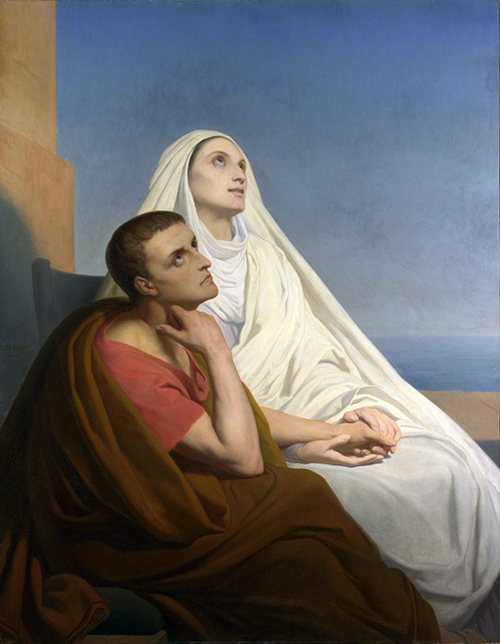
I wish to call to mind the ways I was befouled, and the fleshly corruptions of my soul, not because I love them, but so that I may love you, my God. I am doing this for the love of your love, retracing my wicked paths in the bitterness of my remembrance, so that you may become sweet to me, you, the sweetness that does not beguile, sweetness that is happy and free from care. So may you gather me up from the shattered fragments into which I was strewn, when I turned aside from you who are whole and one, and I wasted myself upon the many (2.1, Anthony Esolen translation).
The Confessions was actually the first Catholic book I read. I saw in St. Augustine someone who was searching for happiness and meaning in this world, in all the ways “the world” tries to satisfy our desire for pleasure. As a young college student in the 1970s, I too was looking for meaning and happiness and trying to find it in the pleasures that “the world” told me would satisfy but always left me empty in the end. This encounter with Augustine’s Confessions coincided with new friendships I made with fellow students who were already believers and who were living their Catholic faith. I could see that they were happy and joyful and serious about what they believed. And, perhaps above all, they were normal college students like me who enjoyed the same things I enjoyed, but who were different because of their faith. This made me very curious. Why were they different? What did they have that I didn’t have?
All of this, in a real and tangible way, became analogous to the life of Augustine and the discoveries made and he wrote about it. It was just about a year after encountering the Confessions that I was received into the Catholic Church. And, it was very clear and obvious to me that I should choose Augustine to be my Confirmation saint. He remained a model for the passionate search for truth that has guided me—as a young convert, seminarian, priest, and bishop.
We enter into his recollections, experiencing his thoughts and emotions, so that they might lead us to a similar kind of self-awareness and conversion. They can shape our own memory, helping us to speak to the Lord and process our story, with all its treasures and baggage. Augustine rightly points out just how “great is the power of memory, this thing to make us tremble, my God, a boundless multiplicity, profound as the sea” (10.17). It contains not only our experiences, but all the truth that we have perceived in God’s creation, and, when we contemplate the Creator, it can draw us even into God’s presence. It can draw us to recognize how God has led and guided us to him so that we can say with Augustine, “Thanks be to you, my God! Whence and whither have you led my memory, that I should confess these great deeds to you, which I had forgotten and passed by?” (9.7).
Art
To find a visual achievement to stand alongside of the Confessions, we turn to the Sistine Chapel, the greatest shrine to the beauty of the Catholic faith. Built between 1473-81 by Pope Sixtus IV, reserved for papal ceremonies and now elections, it stands as an unparalleled artistic achievement, whose decoration invites us to walk through the entire story of salvation history from beginning to end. It brings immediately to mind Michelangelo’s famous ceiling, painted with scenes from Genesis, and also his towering depiction of the Last Judgment, as two great bookends of the story of salvation.
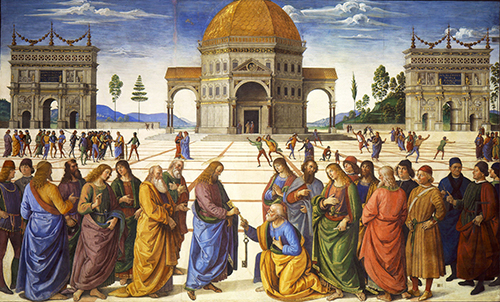
If we look more carefully, we’ll also find what falls in between. Some of the greatest painters of the quattrocento first worked there under the direction of Perugino, such as Botticelli, Pinturicchio, Ghirlandaio and Rosselli, who completed two series of paintings focusing on the lives of Moses and Jesus. The most famous of these Perugino’s “Delivery of the Keys,” provides a theological center for the whole space as an expression of the Petrine ministry. Perugino demonstrates how the Church has drawn together the whole heritage of Judaism, embodied by the Temple behind Jesus and the apostles (modeled after the new dome of Florence’s cathedral) and the legacy classical world depicted through the triumphal arches.
The ministry of the Church throughout time can also be seen through Raphael’s tapestries of Peter and Paul, hung occasionally on the lowest level of the walls, and portraits of the popes on the clerestory level.
The most famous image of the chapel, “The Creation of Adam,” draws our attention to the key elements of exploration of memory: our identity rooted in our creation in God’s image. As Irving Stone describes it in The Agony and the Ecstasy: “By setting forth Adam, the son, true creature of his Father: magnificent in body, noble in thought, tender in spirit, beautiful of face and limb, archetype of all that was the finest in heaven and on earth, there would be reflected God, the Father.”
Augustine ends the Confessions with a meditation on creation, because, as he overcame the Manichaean heresy, he had to accept the goodness of God’s material creation and his place within. His life, and our own, unfold within time as a movement of creation back to rest, finding its goal in the Creator. Michaelangelo ingenuously left a gap between the fingers of God and Adam to show both closeness and distance as he receives the gift of life. Though we are made in his image, we often remain far from him, our restless hearts unable to understand ourselves apart from him. Can we find ourselves in that painting? Earthbound though looking beyond? Alone yet almost touching the one who made us, trying not to let the gap increase?
The Vatican Museums offer an impressive virtual tour of the Sistine chapel.
Music
As we gaze at Michelangelo’s frescoes, Joseph Haydn’s oratorio “The Creation” provides a perfect musical accompaniment. Unlike the more secular opera, the oratorio focuses largely on sung narrations of spiritual texts. During his stays in London, Haydn encountered the most famous oratorio, Handel’s “Messiah” (which Mozart adapted into German). Inspired to make his own biblical oratorio, Haydn brought an English libretto back to Vienna portraying the story of creation, influenced by Milton’s “Paradise Lost.” Baron Gottfried van Swieten adapted and translated it into German and subsequently back into an imperfect English. It premiered in 1799, with a text for both languages, sung by three soloists—a soprano, tenor, and bass—accompanied by a full choir and orchestra.
Three archangels, Raphael, Gabriel, and Uriel (a figure from apocryphal literature) narrate the unfolding of the days of creation along with a choir of angels. The oratorio breaks forth with the original chaos as his prelude, followed by light’s grand entrance as “disorder yields to order” and the firmament’s choppy storm reduces to peace. As you might expect for angelic voices, there is much fervent praise, such as the chorus, “The Heavens are telling the glory of God,” in which we find God’s created works joining the angelic voices. This general praise takes a more personal turn on the sixth day through the wonderful and moving duet of Adam and Eve, who marvel at their shared contemplation of creation, recognizing self through the other.
By thee with bliss, O bounteous Lord,
the heav’n and earth are stor’d.
This world, so great, so wonderful,
thy mighty hand has fram’d.
…
But without thee, what is to me
the morning dew,
the breath of ev’n,
the sav’ry fruit,
the fragrant bloom?
With thee is ev’ry joy enhanced,
with thee delight is ever new;
with thee is life incessant bliss;
thine it whole shall be.
Haydn’s glorious canticle can help us to place ourselves in receptive wonder of the beauty of creation and humanity’s role in praising God with the angels.
Poem
The Sistine Chapel has inspired countless other artists to imitate its splendor. This has included music composed for its ceremonies, such as Allegri’s “Miserere” and the Masses and motets of Palestrina (whose 500th birthday we celebrate this year). St. John Paul II, returning to the place of his election, found his own inspiration there, composing a poem at its threshold, taking it for an image of looking into the entire threshold of creation with the Eternal Word. His 2003 poem, “The Roman Triptych,” written in three parts, portrays the dynamic power of memory, not simply to look back but also ahead, participating in the continuing unfolding of what has come before.
I stand at the entrance to the Sistine—
Perhaps all this could be said more simply
in the language of the “Book of Genesis.”
But the Book awaits the image—
And rightly so. It was waiting for its Michelangelo.
The One who created “saw:—saw that “it was good.”
“He saw,: and so the Book awaited the fruit of “vision.”
O all you who see, come—
I am calling you, all “beholders” in every age.
I am calling you, Michelangelo!
There is in the Vatican a chapel that awaits the harvest of your vision!
The vision awaited the image.
From when the Word became flesh, the vision is waiting.
We are standing at the threshold of the Book.
It is the Book of the origins—Genesis.
Here, in this chapel, Michelangelo penned it,
not with words, but with the richness
of piled-up colours.
John Paul calls us, like Michelangelo, to listen, look, and respond, becoming co-creators with God, putting flesh on his vision for the world and our lives.
Movie
Memory entails looking deep within, finding who we are and recollecting God’s presence within us. Augustine teaches us how we can process our memories in dialogue with God. A powerful modern example can also be found in Georges Bernanos’s 1936 novel, “Diary of a Country Priest.” The great French filmmaker, Robert Bresson, adapted three of Bernanos’s novels including his 1951 black and white masterpiece, “Diary of a Country Priest.” The film follows the narration of a young priest, masterfully portrayed by Claude Laydu, assigned to a small, yet hostile, village, Ambricourt.
Regularly misunderstood and falsely judged, the priest accepts humiliations as he attempts to break through the barriers erected by his parishioners. He temporarily broke through in one particularly dramatic moment, helping the Countess to deal with her bitter memories that had led her to hate others and even God. But backlash to this incident, along with his persistent illness, left his ministry doomed to failure.
His mentor, the experienced pastor of Torcy, consistently recognized the childlike innocence within the young priest. We see this coming out as he unexpectedly received a lift on a motorcycle: “Everything suddenly seemed simple. I realized that youth is a blessing, a risk to run. Even the risk is a blessing. By some premonition I can’t explain, I also realized that God didn’t want me to die without tasking some risk, just enough to make my sacrifice complete when the time comes.”
This sense of risk, which includes the inevitability of pain, points to the reconciliation of memory that we must perform, coming to terms with our limits and failures while also recognizing God’s plan to lead us forward in and through our littleness. As we trace the story of our souls, we can find, with the young curate, that God works in our lives in such a way that no matter what happens, we can find him there, for “all is grace.”
Conclusion
Memory leads us from the beginning to the end; from the reception of the gift to its completion in God’s own rest. This is the path each must follow, as St. John Paul II reminded us. To walk rightly along this path, we must remember what God has said and done, and allow it to shape how we think and live. Education largely concerns concentrating on what is worth remembering and holding these things together within a coherent whole. We can live in the constant memory of God so that he remains always present to us, with the prospect of his eternal rest before us as our goal.
Bishop Conley’s Humanities Syllabus
September: “Why We Remember”
Book:
“The Confessions” by Augustine
Film:
“Diary of a Country Priest” by Robert Bresson
Music:
“The Creation,” by Joseph Haydn
Poem:
“Roman Triptych” by Pope St. John Paul II
Art:
Sistine Chapel Frescoes, by Michelangelo
ADDITIONAL SUGGESTIONS
Book:
“Divine Mercy in My Soul” by St. Faustina Kowalska
Movie:
“Into Great Silence” by Philip Gröning
Music:
“Miserere” by Allegri
“Missa Papae Marcelli” by Palestrina
Poem:
“Lines Composed a Few Miles above Tintern Abbey” by William Wordsworth
Art:
“The Hand of God” by Rodin
FOR CHILDREN
Book:
“Where the Red Fern Grows” by Wilson Rawls
Movie:
“The Prince of Egypt” by Brenda Chapman, Steve Hickner, and Simon Wells
Music:
“The Carnival of the Animals” by Camille Saint-Saëns
Poem:
“I Remember, I Remember” by Thomas Hood
Art:
“The Miraculous Draught of Fishes” by Raphael
