

Lincoln is one of 12 sites nationwide chosen to host the Mass of the Americas. It will be celebrated on Friday, Dec. 12, at 7 p.m. in the Cathedral of the Risen Christ. The Mass of the Americas by Los Angeles composer Frank La Rocca was first celebrated in 2018. It blends a variety of music from different cultures and in different languages.
Dr. Richard Carrillo, an assistant professor and director of choral activities at the University of Nebraska at Omaha, will serve as the music conductor in Lincoln. This will be the fifth time he will conduct the Mass of the Americas.
Dennis Kellogg, director of communications for the Catholic Diocese of Lincoln, recently interviewed Dr. Carrillo via phone and email about conducting the Mass of the Americas, what people can expect from the upcoming Mass in Lincoln, and the impact his work with this project has had on his own Catholic faith. What follows is an edited transcript of those interviews.
Dennis Kellogg, Southern Nebraska Register: Describe for me your first experience with Mass of the Americas.
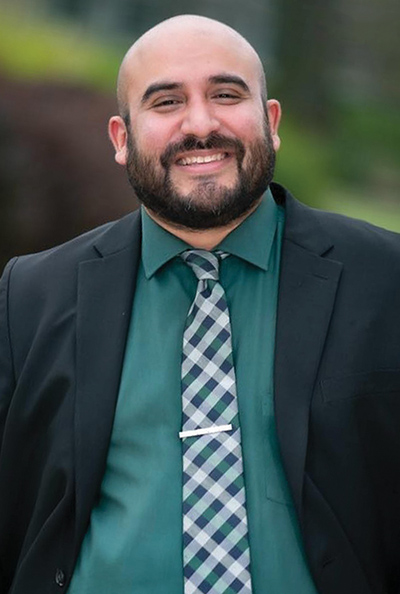
Dr. Richard Carrillo, conductor, Mass of the Americas; director of choral activities, University of Nebraska at Omaha: I actually first found out about this through social media. While I was searching for a source of my doctoral dissertation, I came across a link to this Mass and was shocked when I heard the melodies incorporated into the Mass that my grandmother used to sing, particularly the melody to the folk song La Guadalupana. I was instantly enthralled and thought “Wait, is this? Is this really mariachi melodies used in a classical style?”
As I began to explore the piece even further, I discovered it had the first known “Aue Maria” in the Aztec Nahuatl language that Juan Diego would have spoken to Our Lady. This is where the piece really began to resonate with me. Not only does it have my Catholic roots and the songs of my maternal grandmother but also contained the cultural aspects of my paternal side of the family as well, who has our roots in the Aztec culture. (My father’s side was Aztec and migrated up to the Texas region.) It was because of all of this I began my research journey into the Mass of the Americas.
SNR: How did you become involved with conducting the Mass of the Americas?
Dr. Carrillo: After deciding to make this the focus of my dissertation, I decided to create a festival choir of singers from across the Miami area to mount this part of an actual liturgy for the performance aspect of my project. Given that something like this hadn’t been done often, we found not only that many people were interested in participating in the choir (we had over 100 singers) but that we had over 800 people attend the Mass. I also found that many came for reasons other than from a faith perspective, but because they were curious, they wanted to see a large-scale Mass done in this manner, or they just loved the music. But regardless of why they attended, many expressed they were touched in ways they didn’t even expect! In addition, I received a grant to do field research in Mexico City where I was able to get recordings of the Nahuatl text and create a pronunciation guide of the words for future singers to use. It is because of all of this, that I believe I have been asked to conduct this multiple times since.
SNR: How would you describe the Mass of the Americas to somebody who really isn’t familiar with it?
Dr. Carrillo: It’s a large-scale choral Mass. Composers from throughout history (ie. Mozart, Beethoven, Haydn, etc.) have written the music of the Mass, but often it has been made for the concert stage, rather than for an actual liturgy. What makes the Mass of the Americas so remarkable, is it is written in the classical style, but was meant actually for a Mass. So the first thing people will notice is the Mass parts (Kyrie, Gloria, Sanctus, Agnus Dei, etc.) will be on a larger scale, but if one follows along with the text, one will find that the music is quite intimate.
Frank really does an incredible job of bringing the text to life. He even adds aspects of the liturgy within the music. For example, in the Mass, when the names of Jesus and Mary are said, the priest and faithful are to bow their heads. In the Mass of the Americas, La Rocca often includes a “musical bow” where he places rests on either side of the music of Jesus and Mary to showcase that. There is also the mariachi tunes of La Guadalupana and Las Mañanitas incorporated throughout the Mass. So if one is familiar with those Mexican folk melodies, they will hear that permeate throughout the Mass. Finally, the hauntingly beautiful Nahuatl Aue Maria, will showcase a movement for soloist, marimba, violin, and organ, to showcase this text at the moment of communion, which only adds to the beauty and mystery of the Mass.
SNR: You just conducted the choir for (the Mass of the Americas) at the Basilica of Our Lady of Guadalupe in Tepeyac outside of Mexico City. Can you put that experience into words?
Dr. Carrillo: I’ll do my best! A few years ago, the late Pope Francis asked the west to find ways to celebrate the upcoming 500th anniversary of the apparition of Our Lady of Guadalupe. San Francisco Archbishop Salvatore Cordelione, along with the Benedict XVI Institute of Sacred Music answered this call with the creation of Project Guadalupe 2031. (The year of the actual 500th Anniversary.) Part of that celebration is to sing the Mass of the Americas across the country, which is why we are singing this in Lincoln. But the peak of this was bringing the Mass of the Americas to Mexico City, where we created a festival choir of singers from across the US, to join professional Mexican instrumentalists and soloists to sing this at the Basilica Shrine of Our Lady of Guadalupe. So, to perform this Mass right next to the tilma worn by St. Juan Diego, which contained the image of our Lady, was an experience unlike any other I have had. To be at such a holy site and (to have) music that was written with her in mind, was truly life changing.
I can’t even fully put into words what that experience was like, but ... I think Guadalupan scholar Dr. Arturo Rocha put it best when he said, “I have been to hundreds of Masses here - great Masses with orchestra for visiting dignitaries — but never have I ever heard such beauty, in this place. I have never heard such profound and intimate music as on this occasion. The Old Basilica opened in 1709, so we’re talking about hundreds of years. It (Mass of the Americas) has been already written in the musical annals of the Basilica. It has been transcribed.”
SNR: I’m sure when these Masses of the Americas are celebrated there are similarities between them, but is there a uniqueness to each one? What will be different about Lincoln?
Dr. Carrillo: I think one of the main differences people will experience, is that this is an organ version of the Mass. While I love the orchestral version, there is something very intimate about having just the organ while the choir sings. Also, this is my first time getting to conduct the Mass of the Americas on the actual Feast of Our Lady of Guadalupe, which will be a very special experience. So, like the performance in Mexico that was at the Shrine, Lincoln’s Mass will also share the closeness to our Lady, given that it will be on the actual feast day.
SNR: As a lifelong Catholic, how has your involvement with the Mass of the Americas impacted your faith?
Dr. Carrillo: It’s hard to not be drawn deeper into your faith when experiencing this music. It is often said that the three transcendentals truth, beauty and goodness, lead to God. And it is the beauty of this music that does just that. I have yet to conduct or listen to this music without being drawn deeper in prayer. And to do this within the context of a liturgy, it’s hard not to fall even deeper in love of the Eucharist and the Mass. (And I have to believe that is just what Mary wants of us all as we sing!)
Learn more about the Mass of the Americas Dec. 12 at 7 p.m. at the Cathedral of the Risen Christ in Lincoln at lincolndiocese.org/americas.
