

By Bishop James Conley
“But you have come to Mount Zion and to the city of the living God, the heavenly Jerusalem, and to innumerable angels in festal gathering, and to the assembly of the first-born who are enrolled in heaven, and to a judge who is God of all, and to the spirits of just men made perfect, and to Jesus, the mediator of a new covenant, and to the sprinkled blood that speaks more graciously than the blood of Abel.” - Hebrews 12:22-24
 Our yearlong pilgrimage through the humanities has reached its goal. We have explored truth, beauty, and goodness through outstanding works of human culture, not as an end in themselves but as a means of approaching their ultimate source. The antiphon for Psalm 42, taken from Lauds, asks, “When will I come to the end of my pilgrimage and enter the presence of God?” Our souls thirst to enter into the Lord’s presence as the fulfillment of all our desires. Our pilgrimage has been directed toward the very purpose of our existence: to live in eternal happiness in union with God.
God does not simply wait for us to find him; he comes to us and seeks us out to immerse us in the infinite Truth, Goodness, and Beauty of his divine life. Advent focuses on this coming, not only at Christmas but also at the end of time. Christ’s coming is a great rescue operation, seeking to pull us out of the dominion of the devil, sin, and death to lead us into everlasting communion with him. St. Augustine spoke of this interior change as a move from one city to another, from the City of Man to the City of God, from a communion of death to life. “Two loves have made two cities. Love of self, even to the point of contempt for God, made the earthly city; and love of God, even to the point of contempt for self, made the heavenly city” (City of God, XIV, 28). At Christmas, the true king comes to establish his kingdom of peace within a fallen world, precisely through a sacrificial gift of self for God and others. His kingdom, however, suffers violence in this world, as those under his gentle yoke imitate him in suffering for the sake of righteousness.
Book
Charles Dickens seizes the spotlight this time of year for his story, “A Christmas Carol,” which captures the essence of the Christmas spirit in Scrooge’s conversion from selfishness to charity, a fitting description of leaving the City of Man for the City of God. He also wrote a historical novel that more directly evokes Augustine’s image in “A Tale of Two Cities.” Dickens’ two cities, both mundane—Paris and London—evoke a similar contrast between a revolution focused on putting this world first, the French Revolution, and a moral transformation moving from death to life. Despite the desperate state of France, with all the injustices of the ancien régime, the godless revolution brought even greater depravity, a demonic rage of death and destruction. There is no life apart from God, for only he can bring life out of death. Dickens actually uses the theme of resurrection to frame his novel, using a passage from John’s Gospel to show the power of self-sacrificing charity to overcome even the greatest evil: “I am the resurrection and the life, saith the Lord: he that believeth in me, though he were dead, yet shall he live.”
“Recalled to life,” the novel opens, as one of its main characters, Dr. Manette, emerges from a lengthy, unjust sentence in the Bastille. He slowly regains his faculties and establishes a new life with his daughter, Lucy, in London. In the last part of the book, the doctor must leave the safety of his adopted city to travel back into the chaos of revolutionary Paris to save his son-in-law, Charles Darnay, another French émigré, an aristocrat caught up in the crossfire for vengeance. On the very day of his execution, another man, Sydney Carton, unexpectedly sneaks his way into prison to take the place of Darnay, to reunite him with his family.
Carton, a gifted lawyer, but wasting his talent in London, falling into dissolute living, suddenly had a vision of something more. Walking the streets early in the morning, he embodied the lost wayfarer in the modern city.
Waste forces within him, and a desert all around, this man stood still on his way across a silent terrace, and saw for a moment, lying in the wilderness before him, a mirage of honourable ambition, self-denial, and perseverance. In the fair city of this vision, there were airy galleries from which the loves and graces looked upon him, gardens in which the fruits of life hung ripening, waters of Hope that sparkled in his sight.
Traveling by coach to Paris, he found there, instead of hope, the aspirations of humanity turning to terror. “Liberty, equality, fraternity, or death; — the last, much the easiest to bestow, O Guillotine!” That death-dealing instrument epitomizes the City of Man, throwing off the past—all authority and tradition—to force progress at any cost. Dickens describes how, for the Jacobins, “it was the sign of the regeneration of the human race. It superseded the Cross. Models of it were worn on breasts from which the Cross was discarded, and it was bowed down to and believed in where the Cross was denied… It hushed the eloquent, struck down the powerful, abolished the beautiful and good.” Isn’t that the goal of the devil? To use human selfishness and the desire to create a utopia on earth to destroy the order God has established.
The City of God overcomes it, however, through seeming defeat, suffering for righteousness to manifest the triumph of mercy over injustice. Carton, seeking redemption, decides to do something truly remarkable, something good and serviceable to another, opening the door to the heavenly city: “It is a far, far better thing that I do, than I have ever done; it is a far, far better rest that I go to than I have ever known.”
“A Tale of Two Cities” was the first book by Charles Dickens that I ever read. I was so struck by the book that I made a quiet promise to myself that before I die, I would read everything he ever wrote. I’m only about half-way there. The world of Charles Dickens is filled with human pathos, vivid characters, satire and humor, sanctity and evil, and everything in between. Dickens was able to humanize deep social problems becoming a powerful advocate for the disenfranchised simply through his fictional literature. G.K. Chesterton loved Dickens so much that he entitled his splendid biography of the author, “The Last of the Great Men.”
Movie
Pope Leo recently spoke of filmmakers as “pilgrims of the imagination, seekers of meaning, narrators of hope and heralds of humanity.” Film is a comprehensive medium that utilizes image, sound, storytelling, and drama to enhance its overall impact. “Cinema combines,” the pope continues, “what appears to be mere entertainment with the narrative of the human person’s spiritual adventure,” and can become “an expression of the desire to contemplate and understand life, to recount its greatness and fragility and to portray the longing for infinity.” Of any medium of art, it speaks most clearly for today’s city, embodying our tastes and sensibilities, though occasionally pointing beyond them, witnessing to our transcending longing.
This month, we explore two films to represent the two cities, both visual masterpieces set in late 19th-century Italy. The first, “The Leopard,” directed by Luchino Visconti and starring the American actor, Burt Lancaster, portrays the fictional Prince of Salina as he witnesses the annexation of his native Sicily and the passing of the old aristocratic order with it. Considering himself a leopard, a noble king of beasts with the world as his prey, he lives in luxury and pleasure while cynically tolerating the traditional Catholic life that saturates his family. Seeing a new class of lesser jackals rise around him, bureaucrats and businessmen, disillusions him, even to his princely splendor, represented by the lavish ball that transpires in the film’s final hour. He walks out of it, in the middle of the night, only to encounter Christ, falling to his knees as the darkness is pierced by a priest bringing viaticum to an impoverished home.
If life is transitory for princes, who represent the greatness of the world, it seems even more so for humble peasants. “The Tree of Wooden Clogs,” another beautiful portrayal of social change, set outside of Bergamo, Italy in 1898, directed by Ermanno Olmi, portrays the lives of four families on a tenant farm. Prayer saturates their community, and Olmi uses the organ as the soundtrack to accompany the agricultural rhythm of their work. The film’s first scene begins in the sacristy with the priest directing Batisti to send his son four miles away to school. With another child on the way, the peasant father, though overwhelmed with the difficulty of survival, reluctantly agrees. Later, the priest tells his congregation, on the anniversary of a miracle that took place in the church, that miracles “happen everywhere, every day” to “express the power of God’s love. We need that love as much as the air we breathe and the land that feeds us.” A widow, in particular, embodies this daily reliance through poverty and sickness. Batisti, however, responds to his son’s need for a new wooden clog by taking matters into his own hands, cutting down a tree that belongs to the landlord to make him another. This leads to his family’s expulsion from the farm, newborn and all, who set off like pilgrims, like the Holy Family on the way to Egypt, trusting in God’s providence.
Poem
The logic of God’s city, which belongs to the lowly, cannot be understood by the world. Within it, death leads to life, poverty to riches, and humility to exaltation. Jesus turns the world upside down (Acts 17:6), which means flipping it back right-side up. Sin puts us out of order as we desire material things more than heavenly things. Jesus’s birth in simplicity sets off a spiritual revolution, reordering the world and our desires by directing them back to God.
St. Robert Southwell, an English Jesuit and martyr, wrote many Christmas poems, focusing especially on the poverty of Jesus. His grandfather had participated in the dissolution of the monasteries in England, helping Henry VIII, who could qualify as a new Herod, to pillage the Church and establish his domination over it. Within his deadly mission back to his native land as a missionary, Southwell reflected on the reign of the Prince of Peace, who overcame the world by becoming a defenseless babe, reigning from poverty in the manger. Here is one of his nativity poems, “New Prince, New Pomp”:
Behold, a seely tender babe
In freezing winter night
In homely manger trembling lies;
Alas, a piteous sight!
The inns are full, no man will yield
This little pilgrim bed,
But forced he is with seely beasts
In crib to shroud his head.
Despise him not for lying there,
First, what he is enquire,
An orient pearl is often found
In depth of dirty mire.
Weigh not his crib, his wooden dish,
Nor beasts that by him feed;
Weigh not his mother’s poor attire
Nor Joseph’s simple weed.
This stable is a prince’s court,
This crib his chair of state,
The beasts are parcel of his pomp,
The wooden dish his plate.
The persons in that poor attire
His royal liveries wear;
The prince himself is come from heaven;
This pomp is prized there.
With joy approach, O Christian right,
Do homage to thy king;
And highly prize his humble pomp
Which he from heaven doth bring.
Art
No painter has captured the spirit of the fallen world, of the City of Man, better than Hieronymus Bosch, especially his “Garden of Earthly Delights” and “The Haywain.” These triptychs both depict the original goodness of God’s creation on the left panel, misdirected love in the main central panel, and the grotesque distortion of humanity revealed in hell on the right panel, where he allowed his surrealist style to run wild. Bosch’s triptych, “Adoration of the Magi,” a late 15th-century oil painting on wood, loosely follows this framework while offering a stronger depiction of redemption. We are drawn to an immediate contrast: the King of the universe sits naked, with his flesh exposed on white cloth (evoking the corporal of the Mass), in a dilapidated house, while a magnificent, strongly fortified city stands behind him. Representing the City of Man in glorious splendor, this city, nonetheless, provokes conflict, as armies gather before it.
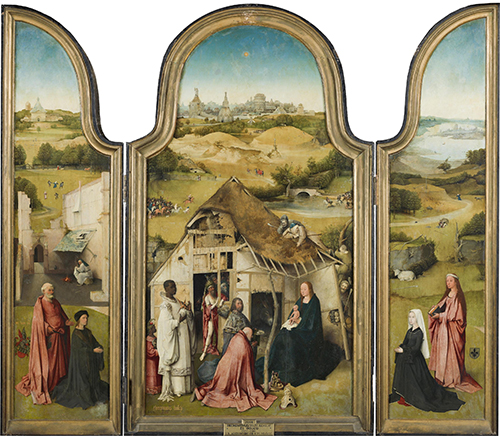
Following Bosch’s normal scheme, the left panel is more serene, with one small building sitting peacefully at its head, like a shrine or monastery, and those before it seem to dance or play. On the right panel, a city has fallen to decrepitude, showing the end of earthly life, and travelers along the road are ravaged by wild beasts. In the central scene, the wisemen represent humanity having found its goal, taking off their crowns before the Messiah. Yet, behind them, a mysterious figure stands, who refuses to take off his crown and who also presents himself without clothing. He seems to represent the world, with other kings standing behind, refusing to acknowledge its true head, yet also exposed by him as a fraud. Following Sigrid Undset, we could see him as an image of the Anti-Christ contrasted with the child: “Through the vision and dreams of the Middle Ages, one vision persists: Anti-Christ when he comes will suddenly appear as a full-grown man. He cannot make himself so small and humble as to become the son of a woman…. He cannot, therefore, possibly find time to play in a village street with other small children in a land which is only a small province of a world power” (Christmas and Twelfth Night, 4-5).
Bosch finds a way to represent the entire story of humanity in a single scene, with God’s city built up from one single building, which will grow into the Church that spreads branches throughout the world, represented by the patrons in the bottom corners flanked by their namesakes, St. Peter and St. Agnes. People continue to find their Lord in the manger, who, like the Magi, have followed the signs of truth, goodness, and beauty to their end.
Music
If one figure embodies the spirit of the world and the Anti-Christ at the birth of Christ, it would be Herod, a man of consuming ambition and jealousy, who murdered his own sons in addition to the Holy Innocents. Hector Berlioz convincingly captures his voice in his oratorio, “The Infancy of Christ,” within its opening movement, “The Dream of Herod.” The tortured king can find no peace amid fears of losing his kingdom, leading to a diabolical plot to kill his feared rival. The City of Man can find no peace, for, in essence, it wants a kingdom of this world, to find fulfillment in what cannot secure it. It’s not Herod’s voice, however, we want to hear to conclude our pilgrimage.
This entire year we have explored human experience as it develops throughout life and follows the course of the seasons, our hopes, suffering, joys, and longing. At its conclusion, we must recognize that we are still waiting for more. The humanities can bring us to the threshold that only the Savior can cross. The Messiah has come, it is true, yet we still wait for him to come again in glory. It is only then that the City of Man will fade away as creation finds its renewal in the full flowering of the City of God.
This great longing for the Savior and the completion of his work of renewal finds fitting expression in the great Advent classic, Handel’s “Messiah,” a melodious meditation on biblical passages that trace the unfolding of the great rescue mission. The English oratorio begins with the expectation that the Lord’s glory shall be revealed and will purify Israel to offer a sacrifice in righteousness. “For unto us a child is born,” then gloriously breaks forth in fulfillment of Isaiah’s prophecy, the one who takes the government upon his shoulders as the Mighty God and Prince of Peace. After the angels and shepherds give him glory, the oratorio moves to the mission of Christ, who opens the eyes of the blind and feeds his flock as he imparts his gentle yoke. The second part of the oratorio draws upon Isaiah’s prophecy of the Suffering Servant to narrate the inauguration of the Messiah’s Kingdom through suffering, which leads to his vindication and ascension into heaven. The famous Alleluia chorus serves as a great victory march for his triumph over all the nations, which leads into the third part, also important for Advent, which narrates the end—the final judgment and defeat of death in eternal life.
Conclusion
Thank you for joining me on this yearlong pilgrimage through some of the great works of the humanities. As we walk as pilgrims to the City of God, we remember St. Paul’s words to the Philippians: “Whatever is true, whatever is honorable, whatever is just, whatever is pure, whatever is lovely, whatever is gracious, if there is any excellence, if there is anything worthy of praise, think about these things” (4:8). I hope that you have received from these monthly syllabi much that will help you in thinking, contemplating, and living out what is true, good, and beautiful. May this coming Christmas celebration confirm you in the Lord’s gentle rule and peace that he offers from the throne of his simple manger.
Bishop Conley’s Humanities Syllabus
December: “The Two Cities”
Book:
“A Tale of Two Cities” by Charles Dickens
Movie:
“The Leopard” (1963), Luchino Visconti
“The Tree of Wooden Clogs” (1978), Ermanno Olmi
Music:
“Messiah” by George Frideric Handel
Poem:
“New Prince, New Pomp” by St. Robert Southwell, S.J.
Art:
“Adoration of the Magi” by Hieronymus Bosch
ADDITIONAL SUGGESTIONS
Book:
“The City of God” by St. Augustine
“Home for Christmas: Stories for Young and Old” compiled by Miriam LeBlanc
Movie:
“The Lion in Winter” (1968), Anthony Harvey
Music:
“The Infancy of Christ” by Hector Berlioz
Poems:
“Journey of the Magi” by T.S. Eliot
“To My Little Brothers in Heaven, the Holy Innocents” by St. Thérèse of Lisieux
“Ring out, wild bells” by Alfred Lord Tennyson
Art:
“Beaune Altarpiece” by Rogier van der Weyden
A Children’s Syllabus
Book:
“A Christmas Carol” by Charles Dickens
“Letters from Father Christmas” by J.R.R. Tolkien
Movies:
“The Muppets Christmas Carol” (1992), Brian Henson
Music:
“Amahl and the Night Visitors” by Gian Carlo Menotti
Poem:
“A Christmas Carol” by G.K. Chesterton
Art:
“Adoration of the Magi” by Bl. Fra Angelico and Fra Lippi
