

Dr. Jennifer Bryson is a writer who has translated into English several books centered on the Catholic Church. She has a PhD from Yale in Greco-Arabic and Islamic Studies and worked for the Department of Defense at Guantanamo Bay, Cuba, interrogating al Qaeda fighters from Saudi Arabia. She is currently a fellow for the Ethics and Policy Center in Washington, D.C., and lives in Lincoln, where she attends St. Francis of Assisi.
Dennis Kellogg, director of Communications for the Catholic Diocese of Lincoln, talked with Dr. Bryson recently about her techniques regarding interrogating detainees, her work translating the writings of a German Catholic author into English, and her advice on balancing a busy career and faith life. What follows is an edited transcript of that conversation.
Dennis Kellogg, Southern Nebraska Register: You are a convert to the Catholic faith. Tell me about that decision. Why did you become Catholic?
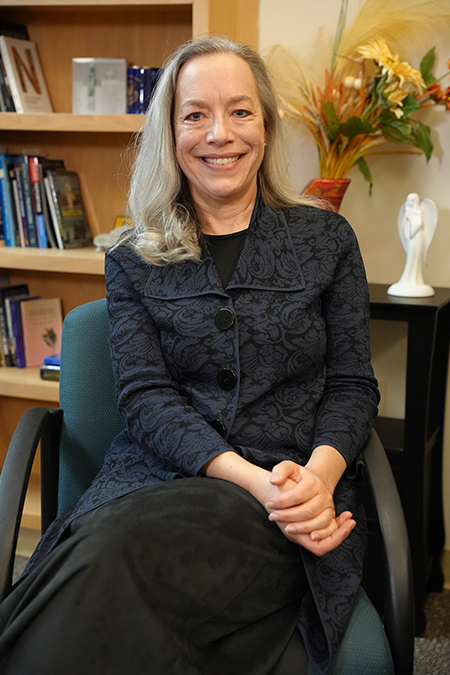
Dr. Jennifer Bryson, Fellow in Catholic Studies at the Ethics and Public Policy Center (EPPC) in Washington, D.C.: I had a vague Lutheran upbringing as a child, but decided I didn’t want anything to do with religion. Didn’t need it...
I went to the former East Germany, when it was still East Germany in 1986, 1987, to the Karl Marx University. And while I was there, I chose to spend the year studying Marxism, Leninism. I was curious, and I was fascinated by it... And at that point in my life, God “broke in,” is the only way I can say it. I had an experience of God that changed my life forever.
My best friends that year were Polish students, so I was quite anti-Catholic, but they were amazing, and the Catholics in East Germany were a constant witness to me. And a few years later, I came into the Catholic Church, especially once I realized who Jesus is, and Jesus didn’t write a book. He founded a Church. I had to go be part of it.
SNR: How has your Catholic faith kept you grounded throughout your career?
Dr. Jennifer Bryson: It has been solace, inspiration. It’s also been what has sort of reined me back in at times when my career interests were too much about me and the world.
And throughout the whole world, my Catholic faith has always connected me with the most amazing people, whether it was going to Mass in Yemen or when I’ve lived in Austria, when I was overseas at a military base. That has also been a constant connection between my faith and the places my work has taken me.
SNR: The work you’re doing now includes work on translating the writings of a Catholic author, Ida Görres. You are translating her works from German to English. Why should a Catholic today be concerned about what Ida Görres had to say in the mid-20th century about the Catholic Church?
Dr. Jennifer Bryson: I discovered her in 2019, and the first book I read by her was so beautiful and insightful and clearly so in love with the faith that when I discovered that it had never been translated into English, I had two thoughts. One, “how is this woman not completely famous today?” And, “this has got to be available for Americans and others in English.”
I find her a voice I think the Church needs today. She was born in 1901 and lived until 1971... She suffered through the second World War; comes out of that with her masterpiece, which is a book on Saint Thérèse of Lisieux called “The Hidden Face”... She combines being a highly learned woman and very well read, with always wanting to write for the laity. Her heart’s passion in life was, “how can I move the laity from faith as maybe a vague cultural identity, cultural habit, to an encounter with God and Christ in His Church on fire”...
She is friends with people some may have heard of, like Josef Pieper and another, Joseph Ratzinger. They become friends and correspond, and she just had amazing insight, understanding problems that are emerging in the modern world.
SNR: The most recent book that you translated of Ida Görres is “Bread Grows in Winter,” just published by Ignatius Press. What can we learn from that book? And what did you learn translating that book?
Dr. Jennifer Bryson: “Bread Grows in Winter” contains six chapters that she composed from 1967 to 1970, and so they’re all at a time when there’s dramatic upheaval, dramatic challenges to what people know as the Church and the faith. And she addresses in these six chapters a variety of topics, from “who is Christ” to “what does it mean today to have so many laity suddenly studying theology”—it wasn’t that way before—to “is celibacy still relevant?” She says yes, spoiler alert by the way, even to the last question in the final chapter, “can we even trust the Church anymore?”
And she addresses all of these questions with beautiful prose, insight, wisdom, and I find an unusual balance, because she sometimes says things rather sharply. She doesn’t hold back. When she sees a problem in the Church, she identifies it and names it and calls a spade a spade. She loves the Church and trusts the Church. So, she isn’t saying, “Don’t worry, everything’s fine.” She says, “Yes, we’re facing challenges, deep ones,” but she draws on Church history, which she calls her great consolation in times of trouble, and helps us to step back and see the bigger picture.
SNR: Let’s talk about another part of your career, and that’s one with the Department of Defense. You worked in interrogation at Guantanamo Bay in Cuba, in the detention camp there, and you wrote about that in an article for “Public Discourse” a number of years ago. You wrote, “torture and interrogation are opposites.” And you also wrote about the humanity of the detainee. And you said building a rapport is much more effective than torture when it comes to interrogation.
So, my question is, when you were building that rapport with the detainees, did you share your Catholic faith with them? Did that ever come up?
Dr. Jennifer Bryson: I prayed to God. This is something very personal that I’m going to share, that was, how I personally approached my professional responsibilities, but as a Catholic. I prayed that the interrogation room, what we call the “booth,” would be a place where I would not be a barrier to the Holy Spirit. My role was not there as a direct missionary. I had professional responsibilities to the U.S. government in what I had agreed to do, and I really enjoyed working for the military... But it doesn’t mean that I left my faith outside the room.
Also, at Guantanamo, I worked with the Saudi detainees in particular. We had detainees from many different countries, and the Saudi detainees, most of them—not all, but most of them—were really deeply religious. Thus, religion was simply a part of our conversations. And what was interesting is that most of them, really almost all of them, because keep in mind, this isn’t the Saudi on the street. These were al Qaeda fighters who were in the fight against the West. They viewed Americans... their stereotype was godless, debauched heathens. They met a whole number of interrogators who were decent human beings.
I was there as a woman. Their stereotype of the American woman was sexually loose and wild. There I was, professionally dressed, modestly dressed, treating them with respect, earning their respect. I remember one time I had an interrogation on a Monday morning, and the detainee and I would talk. I asked him how his weekend was. He was somebody I would talk with often, that building rapport, human conversation, human connection. He would tell me about his weekend... and he would ask me how my weekend was. I would say it was fine, I was glad to have a break on Sunday, and I went to church yesterday, and then rested in the afternoon, and the conversation would go on, but he would be very interested in the fact that I had gone to church. He was aware of this.
Also, my Catholic faith informed the way I dealt with my colleagues. And I would like to hope that my faith also helped to guide my conscience... One of the most important lessons I learned at Guantanamo is that formation of conscience has got to happen ahead of time. It’s something that has to be part of our Catholic lives, because that moment when you’re suddenly called to make hard decisions that are going to have, perhaps, a life-or-death impact, that isn’t the moment that you have time to stop and think, “Oh, I wonder what the Catechism says. I think I want to go look and see what Thomas Aquinas says.” There is no time. You have to decide then...
My experience at Guantanamo taught me the importance of formation of conscience because that developing the interior prayer life, being with the sacraments regularly, and accepting the grace that can come through them, so that when we have a tough decision to make, our discernment mechanism for God’s will can be more finely tuned.
SNR: You were in charge of the interrogations, which meant you had to make some tough, difficult decisions. And you’ve written about how some of your colleagues wanted to maybe take a harsher approach, and you again tried to emphasize the dignity of the detainee and develop that rapport with them. And yet, in the end, that probably proved to be more successful than the harsher techniques. Is that what you found?
Dr. Jennifer Bryson: It was more successful. And I actually was able to measure the success, because when I arrived, I only worked with the Saudi detainees, and I was a team supervisor for that group, and that team was doing terribly for many months, but it was just thought, well, Saudis are extra difficult, more difficult than the other detainees, because they were some of the more sophisticated al Qaeda members we had. So, it was just too hard.
And I didn’t accept that. I said, “these are human beings.” An interrogation is a conversation between two human beings. We can do this. And so, I rejected requests to use some harsher techniques—not torture, but harshness that would degrade rapport between two people that was completely outside the very clear guidelines I had from the U.S. Army, which had a written interrogation manual.
And then I worked with my whole team, terrific interrogators. I got to supervise enlisted personnel and some contractors who’d been former enlisted interrogators, and we worked on how you build that connection. And six months later, the team, in my last week there, was the top on the island in its success, but it came through being open to a human conversation.
SNR: You worked for the Department of Defense for a couple of years and now it’s 20 years later. What impact did those two years have on your life and your faith?
Dr. Jennifer Bryson: Being an interrogator at Guantanamo was, for me, one of the most eye-opening experiences I’ve had in life, in having to face the question of, “what is a human being?” I had to think about “who am I?” “Who will I answer to at the end of my life, in eternal terms?” That had to inform my decision making. And “who is this person sitting across from me?”
And when one learns to be able to have a conversation with one’s enemy, who’s boasted about joy for what the terrorists on 9-11 carried out, who would love to kill some of my fellow American citizens, finding a way to have a conversation and try to discover “who is this person” forced me to just question on a deeper level, “what is a human being?”
And with this question of human dignity, I had to be aware this detainee is a human being. God created this human, there is a level of dignity there, and that doesn’t mean I agree with everything.
I also had to consider the wellbeing of the interrogators. If interrogators are being asked to do something awful that has an impact on them, there’s a humanity to the interrogator. I had to consider the humanity of the civilians that we could protect if we did our job with excellence in gathering information. So, it really was a very deep experience for me, that I’ve spent many years since then, and still today continue to work through.
SNR: Currently, you’re working for the Ethics and Public Policy Center, and you were just named the Mickey Shapiro Free Speech Fellow. That will involve some unique work... What can we expect to find out from that research, and how is it going to help us protect free speech today?
Dr. Jennifer Bryson: I’m very excited about this prize that I won from a group called the Kirk Center, named after the great American conservative thinker, Russell Kirk. They are offering these fellowships to understand free speech better in order to protect it.
And so, my particular project is looking at how did Catholics, in one particular Catholic journal, under Nazi Germany, use satire as a way to push back on and circumvent restrictions on free speech? The center of my research project is going to be studying a satirical sermon by Satan to celebrate the anniversary of the fall of man, that was written by a great Catholic thinker who’s not well known, but yet again, one of those we have a lot to learn from, but almost none of his work is translated into English.
So, I’m going to be studying how they used satire, because he’s—through satire—criticizing those who are excited about Satan’s work, and so he’s criticizing those with visions for society that are profoundly problematic. But he does it through satire, to use creativity and also so that it’s too sophisticated for the censors entirely to see what’s going on.
SNR: You’re accomplished in so many different areas of work and study, I want to get your advice to people on balancing a career and balancing your Catholic faith. How do they work together?
Dr. Jennifer Bryson: Faith comes first and it comes last. It needs to be the informative starting point. But also, when we think of a telos or end, where am I trying to get to, my faith has got to be what’s going to inform that...
I had a very secular upbringing in the San Francisco Bay Area in the 1970s and I was raised, especially as a girl, to know two things: excel in your career and show the boys you can beat them. I honestly knew nothing else, and it took the Catholic faith crashing into my life and reorienting me, and then having to grow in my faith over time to realize life isn’t about your career.
Career needs to be about your life, and your life is built by your faith and on your faith and for your faith.
