

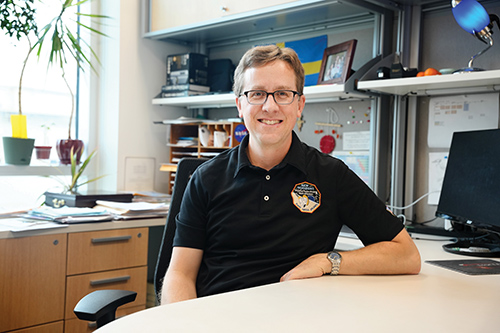
Dr. Nathaniel Cunningham is a professor of Physics, Planetary Science, and Astrophysics at Nebraska Wesleyan University in Lincoln. He is also a member of the Society of Catholic Scientists and recently attended the group’s annual conference. Dr. Cunningham’s love of both the Catholic faith and science grew as a student at St. Teresa Catholic School and then Pius X High School, where he graduated in 1995. He earned his bachelor’s degree in physics from the University of Notre Dame, and then Master’s and doctoral degrees in astrophysical and planetary sciences from the University of Colorado at Boulder.
Dennis Kellogg, director of communications for the Catholic Diocese of Lincoln, interviewed Dr. Cunningham about his work and life at the intersection of science and faith. What follows is an edited version of that conversation.
Dennis Kellogg, director of Communications, Catholic Diocese of Lincoln for the Register: Our topic is the intersection of faith and science, and there’s a lot to cover here, but I want to talk a little bit about both your faith journey as a Catholic, and your professional journey as a physicist. You faced a dilemma at one point where you were deciding whether to pursue physics or philosophy, and you chose to specialize in astrophysics, and you chose the science part of it. Why did science win out, and do you have any regrets about that?
Dr. Nathaniel Cunningham, professor of physics, planetary science & astrophysics, Nebraska Wesleyan University: Good question. So, as a senior in college, I’ve been majoring in physics and minoring in philosophy for all college, and I knew I loved physics coming into college. Sort of discovered philosophy while I was there. Both of those are kind of analytical pursuits, but one much more in the math and the nitty gritty of the Earth and the other, maybe a little more in the mind. What finally pushed me in that direction? I wonder. I think really just having fallen more in love with physics. I love science broadly, and sort of was raised to get outside, touch things, get to know the natural world, but it was really a revelation to me in high school and college when like the tools of math could open up so much about the world. That there are so many things that we can really get to know, get to predict sort of how they work, motions of the planets, the way something’s going to fly
through the air.
So maybe that’s a little bit of left brain, right brain, both I don’t know, but sort of fell in love with that. And also just with some counsel. I had a theology professor, a priest, when I was in college at Notre Dame and went to him to ask questions about paths I should take, both as far as my vocation, I was discerning marriage or something else. So a lot of good counsel, and I probably, in the end, really the joy for me of the pursuit of science and physics, and then astrophysics. Why that direction? When you choose grad school, it’s sort of like you can just jump in and find out, but when choosing that institution, how do you pick one that really plays to your strengths?
The sense I have about astrophysics and planetary science, about astronomy, sort of in general, instead of concocting an experiment, we’re going to shoot these particles at these particles, where we’re going to create something here, and then measure it, it’s sort of like it’s already created, and all we’re going to do is receive what the planets and stars and galaxies -- the experiments are already set up. God’s already set up the experiments, if you will, and now we’re just going to record what they’re telling us and use those to learn.
Also, what’s interesting about astronomy is it’s some of the most extreme environments. We can create particle accelerators that reach amazing energies, but they are nothing compared to the cores of stars and the gamma ray bursts and the black holes that are doing things out in the galaxy. So those kinds of considerations directed me toward astronomy, even though I didn’t take even a single astronomy course in college, and really kind of learned a lot about astronomy while teaching, while taking my own graduate courses and teaching a couple of undergraduate labs and being a (teacher’s assistant), basically, for that first year of college.
SNR: You’re in the classroom. You’re teaching (at Nebraska Wesleyan University), but I want to know more about some of the work and the research that you’ve done in your career.
Dr. Cunningham: My graduate work was actually focused on supernova remnants. Supernovas are when a massive star dies and explodes. I was working with a group focused on instrumentation. How do we measure, in particular, very hot gas in the universe, gas that’s at hundreds of thousands of degrees? It emits in the ultraviolet, and of course, we know ultraviolet here on Earth -- what can give you a sunburn. But it turns out that at higher energies or shorter ultraviolet wavelengths, that light doesn’t even make it through the atmosphere.
That’s part of the reason that we have space telescopes, like the Hubble Space Telescope. If we were to try and look at some of these ultraviolet phenomena from the ground, we would just see just a blacked out sky or a haze, so we have to launch instruments out of the Earth’s atmosphere to get through the water vapor and things in our atmosphere that are blocking that. So, I designed an ultraviolet instrument that was going to be launched on a rocket, but lost funding for that project part way through. So, I switched to working on a camera for a ground-based telescope to look at star forming regions, but basically then when I started working professionally after getting my degree, I took those instrumentation skills and was invited to come work on some projects using the Hubble Space Telescope to look in the ultraviolet at bodies within the solar system. Then two instruments were launched about that time -- in 2005, the Rosetta mission, a European Space Agency mission that visited a comet in the decade following, and the New Horizons mission was launched in 2006, visited Pluto in 2015 and is still in the outer solar system. Both of those spacecraft have an ultraviolet spectrometer, so I was invited as kind of an ultraviolet instrument specialist to come work on those.
I’ve continued with the New Horizons mission all the way to this date, and as I say, it covered its main mission in 2015 and did a close flyby of Pluto, but since then it’s continued to fly further. It has visited another object out of the outer solar system that wasn’t even known before the mission, it was discovered in the mission, and now we’re still using New Horizons out in the outskirts of the solar system to do things like measure just how dark is the deep sky when we’re not inside the solar system with a lot of scattered light from the sun to confuse that question.
SNR: So, all this work in science, how has that influenced your Catholic faith? And then flip it around, how has your Catholic faith influenced the work you’re doing in science?
Dr. Cunningham: Obviously, both fit together well with the idea of wonder, and I obviously won’t be the first one to tell you that to just be outside under the majestic star-studded sky or watch a sunrise or a sunset fills you with a sense of wonder, and as scientists we have the opportunity to not just sort of step back and observe that and soak it in, but to really dive in and start to piece that apart and find answers to the top level of questions, and then every question you answer uncovers new questions and interests.
So, that’s been a joy to put those together. Having some background in philosophy is really helpful for kind of, how do I situate myself, how do I situate my work, how do I think of that? It’s great to have the Catholic intellectual tradition to draw on, which has sort of joy in the materiality of the world, even of ourselves. Kind of the sacramental vision of the Catholic Church, that we are not just physical machines. We are not just spiritual entities, kind of ghosts in the world. No, we really are a harmony of the two. So, it’s a joy to think about this awesome universe that God has made, to learn more about the intricacies of how planets and stars and galaxies work, and to be able to think about that in the sense of how God is at work as a creator.
SNR: Has the science and faith ever conflicted for you?
Dr. Cunningham: That’s a good question. There have been times where I felt like maybe faith requires me to put up a little bit of a wall. Some speculations that are maybe a little bit closed off because of faith, but I think usually when I’ve come across those, I’ve later realized that those are of my own design. So, for example, people think about, and I had thought about maybe as a high school or college student, could there be intelligent life elsewhere in the universe? I thought, there’s intelligent life here, and we need a savior and God in the person of Jesus, in the second person of the Trinity, came and became man, redeemed us. That’s going to preclude God from ever doing that again. So, Christ is now at the right hand of the Father, in His human body. So He’ll never be able to do that, take that approach for some other intelligent race somewhere else. And I realize St. Thomas Aquinas has things to say about this. It’s a mistaken notion to think that God taking an action, taking on flesh in the second person, now limits God’s nature or possibility. So that’s an example of someplace where I had thought maybe faith kind of rules out some possibilities of what might be going on in the universe until I realized that actually thinkers of Catholics have already thought about this and God’s not circumscribed by those things.
SNR: What do you think are the biggest misconceptions out there that science has about religion and religion has about science?
Dr. Cunningham: That’s huge. I don’t know if it’s particularly American, but certainly in the West, we have this sense that science and religion are at odds. That maybe there’s a battle, especially on the fronts like evolution. How did the human organism come about, about just the origin of the universe, kind of cosmology. So, I think big misconceptions kind of go both ways. One that science and religion are at each other’s throats. I’ve had students say, “That talk must have been kind of challenging -- some lecture on campus or something -- that must have been kind of challenging to you because that was pretty prickly toward faith,” and I think, do sometimes students really think that if you’re a committed scientist, that must mean you’re really not serious about faith, or if you’re serious about faith, you’re only sort of partially serious about being a scientist? So, I think that’s a big misconception. I think maybe there’s even can be a little bit of misconception the other way. Like our job as scientists, especially maybe in astronomy, is can we map out the moment that the universe was created in the Big Bang, and that’s going to be the smoking gun for God’s existence. And I think it’s great to see some insights and connections there, and how things can fit together, but I think it’s probably a mistake to try and say we’re going to come up with the experiment or the physical proof that shows, yes, there must be a God.
SNR: So science leaves room for mystery.
Dr. Cunningham: Yes, absolutely. And especially science leaves room for a huge amount of the human experience and human thought, right? There are people who think that science is kind of the only source of truth, the only location of truth, but any of us who have loved or thought deeply or consider what’s the meaning of our own lives, what’s the meaning of this great big universe. Well, science isn’t here to answer questions about meaning. There’s no experiment that has a meaning sensor, so science leaves lots of room for all the rest of the human experience that we would just have to sideline if we pretended that we were some kind of scientific robot.
SNR: As an astrophysicist, you’re studying things on the largest possible scale. Does that help you when it comes to trying to comprehend a God that is all everything to everyone?
Dr. Cunningham: Yes, I think so. I just gave a talk here in the spring about how we measure size scales in the universe. How have scientists done this over time? And something I splashed in at the end of that talk was kind of a chunky quote from Thomas Aquinas about why is there so much variety and diversity in creation? Why do we have everything, from the vent worms under the ocean next to those hot thermal vents, and the tiniest bacteria deep in the Antarctic ice, to distant everything? I’ll just share a little bit of what Thomas Aquinas says. He basically says the amazing extent of God’s nature and his goodness can’t be shown in one thing or 10 things or a dozen things. So, why has God created so much variety in the universe? Well, because every little slice of what is of creation shows a different facet of God’s nature, God’s wonder, God’s goodness. So, I guess that’s something I’ve had a sense of for a long time, but it’s great to see it right there in an 800-year-old writing, to say yes, that’s a true sense.
SNR: You recently attended the meeting of the Society of Catholic Scientists. What were the hot topics? What are people talking about in this community?
Dr. Cunningham: The Society of Catholic Scientists is pretty young. It’s been around for just 10 years, and I’ve been a member since at least 2019 and have attended four of the conferences. Some of the themes are quite consistent about evolutionary biology. How do we understand human origins, and maybe the origins of life, kind of cosmology and astronomy? We had a talk this time on how will the universe die? What does the future have in store for this physical universe as we know it, with its stars and black gold? But something that’s been definitely on the rise in the last couple years is AI, so more presentations each year about artificial intelligence. Of course we’ve all been hearing lots about artificial intelligence, but it’s really a treat to be able to hear about Catholic researchers in computer science or in other fields that intersect with it, thinking about this, because it’s a joy to see the Catholic Church and Catholic philosophers have been thinking for a long time about what makes humans distinctive. What is it to have a rational mind, and to be able to see that all put together. I think there’s a lot more meat there than sometimes we see these more freewheeling ideas of thinkers who don’t have that kind of intellectual heritage to draw on to think about these things as though this is something completely new under the sun to even consider.
SNR: Of course, Pope Leo XIV weighed in on it recently with his encyclical Magnifica Humanitas, and the subtitle Safeguarding the Human Person in the Time of Artificial Intelligence. I thought that was intriguing as well. As a scientist and as a Catholic does AI concern you at all? Should we be concerned?
Dr. Cunningham: It certainly poses some concerns, and I’ve only waded into the beginnings of that long encyclical, but I’m excited about it. I think, like any big technological kind of revolution, I think that’s part of why Pope Leo is writing on it with the name Leo, following on Leo XIII, 130 years ago, writing about how the Industrial Revolution was impacting humanity. So, I think it obviously has big, and others can speak better to it, it has big implications for how humans work, and whether there’s space for us to do our work, or whether we’re going to turn it all over to machines, whether if humans have to be somewhere at the reins of these machines. But are we kind of replaceable cogs because the machines can handle so much? I think as these discussions about what is intelligence, can machines have it, again especially those untethered from a deeper philosophical tradition, I think those have the potential to again degrade what the value of humans is, what the value of human thinking and reasoning is. So, I think there are a lot of concerns with where it could take us. I like that the title of the encyclical helps try and reinforce the fact that humanity as created is magnificent, and we don’t want to lose sight of that, no matter how magnificent these machines seem to be.
SNR: Taking the discussion broader than just AI, but for science in general, is there anything Catholics should fear about science?
Dr. Cunningham: No. Part of what the Society of Catholic Scientists exists for is so that Catholics who are practicing scientists can really, with a community, learn to integrate more deeply those parts of our lives. That’s one thing, how it’s oriented toward the community. So, I think that helps break down fear. I’ve already mentioned ways that we might think that maybe there’s some doctrine or dogma that says don’t think outside this box, don’t go doing scientific explorations outside this box, but the society and the conversations among scientists and the kind of illuminating presentations really help us each see how other scientists are being fully Catholic while being fully and very carefully scientific. So, that kind of breaks down fear. Then also the role we have, I think, for the public is to see that science and religion aren’t at odds; that we don’t need to worry that some discovery about the human genome or evolution is suddenly going to mean we have to throw something of our theology out the window. The unity of truth is a big idea in Catholic thought, and so it’s great to think that whatever we’ve learned through revelation, through scripture, and the Church, whatever we’ve learned just through carefully thinking about this world God has given us, is God’s world just the same as it’s God’s scripture, and so He hasn’t built two different conflicting realities. So, I think the sort of being led by other Catholics who’ve thought carefully about this interface really breaks down the fear, doesn’t foster it.
SNR: You brought up truth, and when it comes to the transcendentals -- truth, beauty, and goodness -- we hear that in relationship to faith, but do you find truth, beauty, and goodness in the work you do in science?
Dr. Cunningham: Certainly, beauty. Obviously, we can talk about truth. Let’s see some mathematical truths, and math gets pretty complicated, but still has a lot to say about truth. And, of course, there’s an amazing amount of elegance and beauty in what math reveals. There have been really interesting places where part of, for example, discovering different particles in physics and realizing there’s this amazing symmetry, but there’s a gap. There’s a particle we have never seen, but if it existed, it would flesh out this symmetry, and then that’s led people to use the math to consider what the properties would be and find it. So, there have been places where even that sense of beauty of logical proportion and symmetry has led from math toward physical discoveries. So, I do share that sense. Now, philosophers, especially philosophers of science, have some arguments about whether is science really just about learning what experiments tell us? What role does something like beauty and elegance have to play, or is that really not part of the scientific method? Well, maybe I’ll leave that to the philosophers of science, but we know there is lots of beauty there. And then, goodness. It’s good just knowing that everything you know God created in each day that he created. He said this is very good, and so to watch scientists at work, when I attend or tune into a planetary science meeting, scientists, whether they’re Catholic or religious or not -- they’re not wearing that badge on their sleeve when they’re given a scientific presentation -- but they are in love, if I can say that figuratively, with the richness of what they’re dealing with. And again, every time a scientist dives deeper than the field has gone yet and discovers more intricacy, then you see that there’s just more sort of richness there. So, maybe that, in a sense, has that savor of goodness, not goodness in the moral sense, but…
SNR: So, you experience the cosmos. You worship the God that created it. To me, the “sense of wonder monitor” for your work and your life has to be off the charts. Do you ever just sit back and look through the telescope or look into the night sky and just say, “Wow, what an amazing world we have before us?”
Dr. Cunningham: I do. I do a little bit, not as much as I should. But really, part of what I do is I look at the sky, and I say, “Oh, wow, hey, Jupiter happens to be close to Venus tonight, and they’re lined up with the sun,” and usually those moments of real joy and wonder for me happen when I’ve got other people I can show it to. I went out to the seventh graders from St. Teresa’s when they were out at Camp Kateri in April, and I set up a telescope for them. And I don’t just set up a telescope and look through it myself as often as I should, but when I have a chance to do that with the kids, and then I line that up and say, “Oh my goodness, there is Jupiter with its stripes and three visible moons all in a row,” and I’m just like a kid in a candy store, I’m like, “OK, you got to see this. OK, next you got to see this.” And it’s great to see the impact of that on students.
Then, sometimes I give planetarium talks, and sometimes it’s the second graders from St. Peter’s or St. Teresa’s that are coming in to get those, and I really groove on sharing. So, that’s where I really find my wonder, and I get to go deeper in it, because I’m not just thinking about what do I need to assign for class, or how does this help finish writing the next paper, but I really think, “Oh, I get to plumb this a little bit deeper, so I can share the details with somebody else.”
SNR: Dr. Nathaniel Cunningham, professor of Physics, Planetary Science, and Astrophysics at Nebraska Wesleyan University, thanks so much for taking a little bit of time. This has been a fascinating conversation about that intersection between faith and science.
Dr. Cunningham: You’re very welcome, and I would encourage your listeners and readers to consider going to look at the website of the Society of Catholic Scientists, that’s CatholicScientists.org, because it’s got great stories on amazing scientists in history who have been Catholics, who’ve discovered amazing things about genetics and about astronomy, for example, and there are lots of stories there to help break down these myths that science and religion are at odds. That’s a great trove with a lot of material that’s for the general public and not just for the scientists.
Watch a video of the full conversation on the diocesan YouTube channel, @CatholicDioceseofLincoln:
