

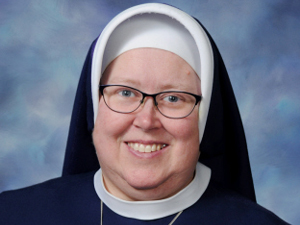
Guest column by Sister Mary Cecilia, C.K.
Chair, Liturgical Commission for the Diocese of Lincoln
In reading through “One Heart In Christ” and Bishop Conley’s vision for the Pastoral Plan of the Diocese of Lincoln, one cannot help but be struck by his emphasis on relationship. The goal to “achieve full active participation in liturgical worship…” is one that is dear to my heart. As the chair of the Liturgical Commission for the Diocese, I want the liturgical life of the Diocese to flourish, to continue to lead the hearts of everyone in the diocese into greater relationship with the Father through communion with Christ in the celebration of the Mass and the sacraments. The question on how to make that happen is one that I and the members of the Liturgical Commission have pondered over the past few years.
 Over the course of the past few months, the members of the Liturgical Commission for the Diocese have worked on a letter to musicians to encourage musicians to continue to bring beauty to the liturgy through the element of music. As Pope Benedict XVI said in Sacramentum caritatis, “Beauty… is not mere decoration, but rather an essential element of the liturgical action, since it is an attribute of God himself…” (35).
We know that many of our parishes have dedicated musicians who volunteer their time to offer their gifts in sacrifice to make beautiful liturgies happen. We are very thankful for their generous service to the Church. We also know that many of these same musicians would like to understand more about what the Church asks of us in bringing beauty to the liturgy through music, how to make that happen with the resources at their disposal, and what they can do, together with the pastors and priests of the diocese, to help foster the relationship with God that is present at each liturgical sacrifice. The letter that we have sent out to the musicians across the diocese is one of the first steps in assisting in that journey. We know that the relationship that the members of the Liturgical Commission have with musicians across the diocese is important. We want to make ourselves available to assist in a variety of ways, whether that be in helping to plan music for the liturgy, helping recruit new musicians for the parish, providing workshops for choirs, or even assisting priests who want to take the next steps in learning how to sing a specific part of the Mass. Relationships are at the heart of what we want to foster.
The letter to musicians has a three-fold purpose. It instructs in what the Church gives us as “Sung Degrees of the Mass;” it encourages musicians to be diligent in the selection of hymns for the Mass; and it acknowledges that every parish and every priest is at a different place on the journey and encourages everyone to take the next best step in growth in liturgy. Each one of these three purposes is important. When we understand what the Church puts forth as a guide to what should be sung, it gives us a roadmap to where we need to grow, both individually and as a parish. We don’t want or expect everything done right away, but rather we encourage parishes to honestly examine where they are and what the next step should be for them at that moment in time.
The choice of hymns is one that is so integral, as the texts of the hymns forms our prayer, shaping and molding us to become more like Christ. If a hymn is sound in doctrine, then we are formed as such. If a hymn presents questionable doctrine, that is what forms us. What we want to do is provide a roadmap for where to begin the journey.
The Liturgical Commission does want to be at the service of the people in the diocese, not to police the liturgy, as that is not our role. What we want to do is to walk the journey with the priests, musicians and people in the parishes to help make liturgy beautiful. Beautiful liturgies come from the ars celebrandi, the art of celebrating, which is something that all people, priest, musicians and the parishioners in the pews, are to bring to the liturgy. It comes not only in the actions of the priest, but also in the reverence and participation of the faithful, fed by the music that is sung.
For those interested in the text of the letter to musicians, it may be found on the Liturgical Commission page of the diocesan website at lincolndiocese.org/liturgy.
