By Andrew Winter
1.
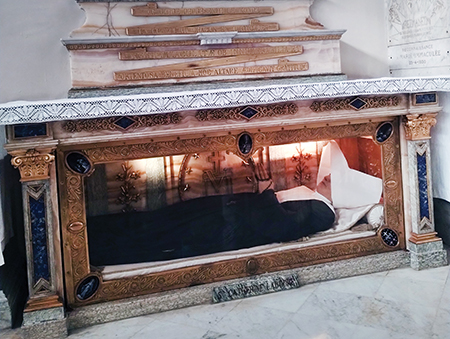
An incorruptible is any saint whose body has resisted the natural decay of normal corpses. Often today, these saints are preserved on public display in churches across the world. They stand as a testament to God’s love of the entire human person, and the coming resurrection of the body.
2.
Not all incorruptibles look like they died yesterday. Many have decayed somewhat, but have lasted longer than they should have naturally. In some incorrupt bodies, only certain organs or body parts remain untouched. For example, St. Vincent de Paul’s heart and bones are incorrupt, while the rest of his body decayed naturally.
3.
Some bodies even escape rigor mortis, and some emit fragrances not of this world. St. Teresa of Avila’s body was exhumed in 1914 and remained flexible, even though she died in 1582. Her body gave off a very pleasant but unknown smell. Similarly, Albert the Great’s body emits a pleasant fragrance.
4.
The oldest known incorrupt saint is St. Cecilia, who was martyred around A.D. 177. At her exhumation in 1599, 1,422 years later, her body was still in the exact position it had occupied when she was buried. The wound on her neck from her martyrdom was visible, as well as blood on her well-preserved dress. A marvelous statue copying her form and position was made to commemorate the miracle, and it stands over her grave in Rome today.
5.
St. Charbel Makhlouf’s story of incorruption includes not only perfect preservation but “sweat” as well. Pilgrims to his grave noticed a liquid seeping out from his tomb in 1950. Upon opening the tomb, the Church found that his body exuded a sort of translucent oil. This liquid was collected and given out as relics, and effected many cures.
6.
Incorrupt bodies are always examined by doctors to prove their truly supernatural preservation. One renowned Lebanese doctor examined St. Charbel’s body 34 times over a 17-year span and never found any natural reason for his excellent preservation.
7.
Even though St. Charbel’s body remained undamaged by floods and mud and lack of a coffin, it did eventually decay in 1976. His is not the only incorrupt body to decay after a time. We can only guess why God chooses to preserve a body temporarily, though sometimes decay has been triggered by natural damage long after death.
8.
St. Rita of Cascia and St. Bernadette Soubirous are among the best-preserved saints in history. St. Rita’s body began to mummify in 1700, but she looked like she was only sleeping up until that time. St. Bernadette died in 1879, and though she wears a light wax mask on display today, her body is still in perfect condition.
9.
The Church used to accept incorruption as one of the miracles required for canonization (at least two miracles must be attributed to a saint’s intercession after their death in order to be canonized), but no longer does so as incorruption does not give a great example to the faithful of a life of heroic virtue.