

By Andrew Winter
1. Joan of Arc, called in France “la Pucelle,” or “the Maid,” was born in 1412. As one of five peasant children, she received little education, but at age 13, she began hearing “voices,” and was visited by St. Michael, St. Margaret, and St. Catherine of Alexandria. They were calling her to save France from the English invasions of the Hundred Years’ War.
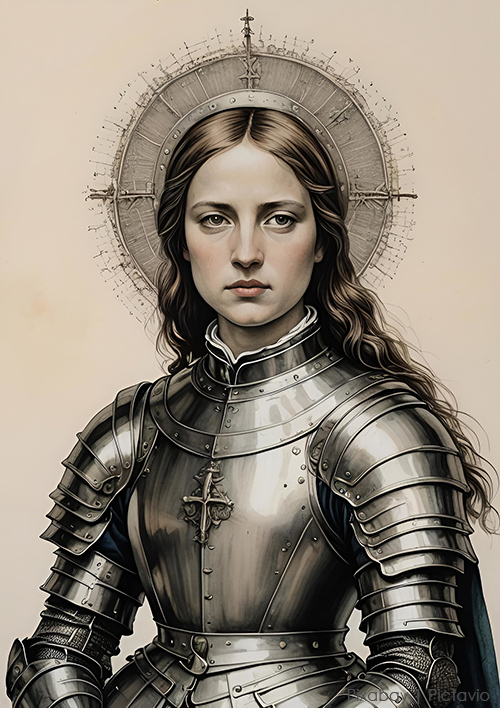 2. At the command of the voices, Joan attempted to see Charles VII, the dauphin (or crown prince) of France. After some difficulty, she persuaded the commander at Vaucouleurs to send her to the dauphin’s court at Chinon. Charles disguised himself from Joan in his court, but she miraculously recognized him, and by virtue of a secret sign, he came to believe in her mission. We are not sure what this sign was, for Joan showed it to Charles privately, but certainly it came from her guiding saints. After appointing a council of clergymen to examine her religious sincerity and orthodoxy, Charles finally gave her command of an army.
3. The English had built several impressive forts around the large French city of Orleans, but Joan threaded the siege lines and brought troops and supplies into the city. After only one week of brilliant fighting, Joan and her army defeated all the main English forts and freed the city, though she was wounded (as she had prophesied) on the last day of the fighting.
4. Charles VII was crowned in Rheims June 17, 1429, following Joan’s campaign on the Loire River. She stood by the altar with her banner in hand as Charles received the crown of the true king of France.
5. Joan attacked Paris itself, which was held captive by English forces, but failed to take the city due to lack of support from Charles. Here again she was wounded by a crossbow bolt on the feast of the Nativity of Mary, Sept. 8.
6. The Burgundians captured Joan outside of Compiegne in 1430. She was withdrawing her troops into the city after leading a raid, and the commander inside Compiegne raised the drawbridge before she could make it through the gates. The Burgundians later sold her to the English for approximately $110,000 (in modern dollars).
7. French clergymen, under the direction of the English occupiers, put Joan on trial at Rouen. She answered their confusing questions so wonderfully that the leaders were forced to move the examinations to a private location, to interrupt her growing popularity. They finally found her guilty, and handed her over to the secular authorities for execution. She remained faithful to her voices, and as she was burning at the stake she called continuously on the name of Jesus. She died in 1431 at the age of 19.
8. Twenty-two years after Joan’s death, the French won their final victory in the Hundred Years’ War against the English.
9. In 1455, the pope re-opened her case at her family’s request, appointing a new court to examine the sentence passed by her executioners in 1431. This appellate court found her innocent. She was canonized in 1920. Her feast day is May 30.
