

By Andrew Winter
1.
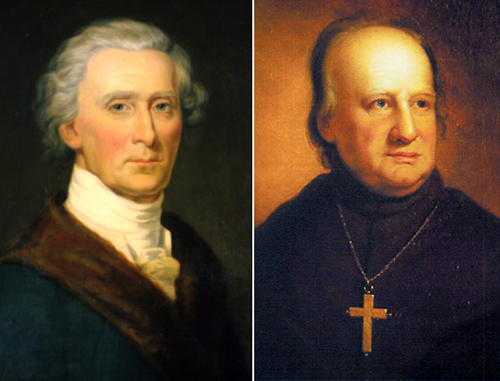
Charles and John Carroll were distant cousins and prominent Catholics crucial to the founding era of the United States. Charles, born in 1737, became the only Catholic to sign the Declaration of Independence; John, born 1735, was the first bishop of the United States.
2.
Although the colony of Maryland had been founded by Catholics with the specific goal of avoiding the anti-Catholicism of the other colonies, John and Charles grew up in an anti-Catholic Maryland. Public Mass was forbidden, and Catholics could not practice law or politics, or vote. Catholic schools were illegal. So after being homeschooled as children, the two traveled to France together for further Catholic education.
3.
Charles spent 15 years abroad, attending university on the Continent and studying law in England. In 1764 he returned to America, angry at the excesses of the English government and the lack of religious freedom in the colonies. Though he was barred from politics and law, he became famous for his political articles in the Maryland Gazette under the pseudonym “First Citizen.”
4.
John did not return to America until 1774. By that time he had been a priest for 13 years, and had spent time teaching at the Jesuit College of Bruges. Both Charles and John spoke out enthusiastically for American independence, and hoped that anti-Catholic laws and sentiment could be eradicated in the new America.
5.
Also in 1774, Benjamin Franklin asked Charles to accompany him to Canada to ask for their aid against Britain. Thanks to his French education, Charles knew the language well. In 1776 Charles and John traveled with Franklin together to Canada. Franklin was very impressed with both of them.
6.
On July 4, 1776, Charles was elected to the Continental Congress. Though Charles was too late to vote on the Declaration, John Hancock allowed him to sign it Aug. 2. Though he knew that signing the Declaration jeopardized his enormous fortune and his own life, he still signed the Declaration “Charles Carroll of Carrollton,” destroying any chance he might have to pretend a different Charles Carroll had signed it.
7.
Meanwhile, the Holy See named John prefect apostolic of America, meaning that he was now the priest in charge of all 25,000 Catholic souls in the country, with only 24 priests at his command. In 1789, the first diocese in the United States, Baltimore, Md., was created, and John became its first bishop. John worked wonders for the Catholic Church in America, holding the country’s first synod of clergy in 1791. He also built America’s first seminary, founded Georgetown University, and erected the country’s first cathedral, the Basilica of the Assumption of the Blessed Virgin Mary, in Baltimore.
8.
After refusing re-election to the Continental Congress, Charles served as a United States senator, 1789-1792, and Maryland state senator, 1781-1800. He was on the committee which finalized the draft of the Bill of Rights. He also helped pass the Maryland state constitution, which lifted many of the laws restricting religious freedom.
9.
John died in office in 1815, and Charles died in 1832 at 96. Charles was the last surviving signer of the Declaration. His statue stands in the U.S. Capitol as one of Maryland’s two representatives in the National Statuary Hall.
