

By Andrew Winter
1.
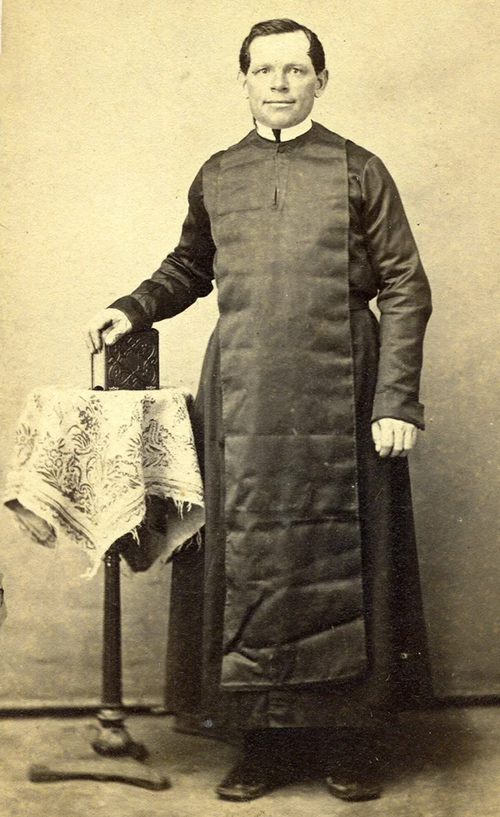
From 1861 until 1909 Father Emmanuel Hartig, a Benedictine missionary, served the Lincoln Diocese tirelessly. Because he traveled constantly across southeast Nebraska, serving the small groups of Catholic settlers for so many years, he has earned the title “Lone Ranger of the Lincoln Diocese.” Without his life and work, the diocese as we know it today would not exist.
2.
Father Hartig was born in 1830, the son of a flour merchant, in Inchenofen, Bavaria. He came to the United States in 1855 and joined the Benedictine community of St. Vincent in Latrobe, Pa. He moved to the Benedictine monastery in Atchison, Kan. and was ordained a Benedictine priest in 1861. That same day, his superior sent him to minister to the Church in Nebraska.
3.
Coming to his first assignment, Nebraska City, Father Hartig was practically in charge of the entirety of what would later become the Diocese of Lincoln. At that time Nebraska was a vicariate, and was not divided into dioceses. There were almost no priests, and Nebraska’s first Catholic church, St. Benedict in Nebraska City, was unfinished. Father Hartig completed the church building in 1861 and took the spiritual care of southern Nebraska into his hands.
4.
For the next 48 years, Father Hartig spent himself traveling on horseback among the towns and settlements of Nebraska, bringing the sacraments to the hungry faithful, often celebrating Masses in homes, and riding up to 50 miles a day. While a pastor at Nebraska City, he made regular visits to Tecumseh, Lincoln, Dawson, Steinauer, Palmyra, Rulo and Avoca. He celebrated the first Masses at Brownville, Manley, Greenwood and Elmwood, and for a few years served as pastor in Syracuse.
5.
During his extensive travels, Father Hartig was occasionally detained by suspicious native Americans. All he had to do was show them the crucifix in his saddle bags, and he was always immediately freed. Father Hartig credited this safeguard to the Jesuit missionaries, who had made the crucifix a known and loved symbol among those they encountered. During the Civil War, Father Hartig was once detained by U.S. soldiers, who suspected he was a spy. When he showed them his missal and holy vessels, they let him go.
6.
Father Hartig oversaw the construction of at least five churches: St. Benedict in Nebraska City (1861), St. John in Plattsmouth (1862), St. Theresa Pro-Cathedral in Lincoln (1868), St. Andrew in Tecumseh (1868), and St. Leo in Palmyra (1874). He also replaced the church in St. Benedict, Kan., with a larger building and built a school for St. Benedict in Nebraska City around 1862.
7.
To give an idea of the distances Father Hartig traveled on horseback: from Greenwood to Rulo is 110 miles; the circuit of the five churches he built is 183 miles; the circuit of the towns he regularly visited at some point in his ministry is 240 miles.
8.
In 1892, Bishop Thomas Bonacum, the first bishop of Lincoln, traveled to Rome and made Father Hartig apostolic administrator of the new Diocese of Lincoln in his absence. When he returned the next year, he appointed Father Hartig the first vicar general of the diocese. Father Hartig filled this post until 1909. As vicar general, Father Hartig went where the bishop was too busy to go. He dedicated St. Mary Church in Wymore, and helped Bishop Bonacum build St. Thomas Orphanage in Lincoln.
9.
Father Hartig retired in 1909. He had been pastor of St. Benedict in Nebraska City 1861-1874 and 1881-1908. He moved back to the abbey at Atchison, where he died in 1910.
