

By Andrew Winter
1.
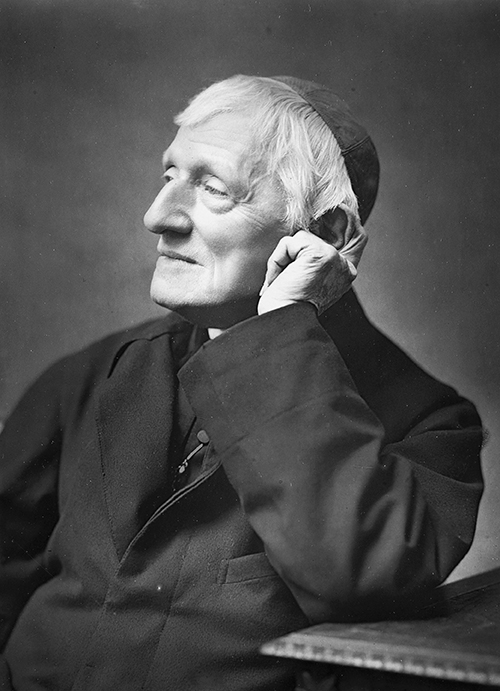
The Newman Center at the University of Nebraska-Lincoln is named after St. John Henry Newman, the patron of Catholic education and the 38th Doctor of the Church. He wrote extensively on the purpose, method, and integration of proper Christian learning, and is the only canonized novelist in history. He was also crucial to Bishop James Conley’s conversion to Catholicism.
2.
Newman was born in 1801 in London, and attended Trinity College at Oxford. In 1824 he was ordained in the Anglican Church and eventually came to serve as a tutor at Oxford and as chaplain of St. Mary the Virgin University Church for 17 years. In this position, he was the leader of the Church of England’s pastoral presence at Oxford.
3.
While a Fellow of Oxford, Newman became the most famous leader of the Oxford Movement, which sought to rediscover beauty in architecture, liturgy and tradition within the Church of England. In this capacity, Newman began to study the Church’s ancient history, and its Catholic beginnings began to dog his studies.
4.
In 1843, Newman forced himself to resign as chaplain of St. Mary the Virgin, and retired to Littlemore to study, pray and fast. He was slowly becoming convinced that the Catholic Church was the one True Church, the only Church that could trace its roots back to Jesus and His Apostles.
5.
In 1845 he published his most famous work: Essay on the Development of Christian Doctrine. This book-length essay was the distillation of his diligent study of Christianity’s roots. In it he argued that development, far from corrupting doctrine, only fulfills it. He likened doctrines to trees which begin as seeds and grow up into ever more beautiful maturity: the seed and the tree may look very different, but they are always consistent with each other.
6.
That same year, 1845, Newman joined the Catholic Church, leaving behind his job, his friends, and much of his prestige. Many Anglicans followed his example. Newman was ordained to the Catholic priesthood at Rome in 1847. He was made a cardinal in 1879.
7.
Newman was a member of the Oratory of St. Philip Neri, and founded two oratories, one in London and one in Birmingham. Author J.R.R. Tolkien would later attend Mass regularly at the Birmingham oratory.
8.
After his death in 1890, Newman quickly became a popular figure on the Catholic literary stage. He has been called “The Silent Father of Vatican II” because his view on the development of doctrine was later echoed by the Council. He was beatified in 2010 and canonized in 2019, and on Nov. 1, 2025, Pope Leo XIV named him a Doctor of the Church. His feast day is Oct. 9.
9.
In addition to his extensive academic writings, Newman found time to pen 17,000 letters. From among an infinitude of good quotes, here are a few:
“To live is to change, and to be perfect is to have changed often.”
“I will trust Him, whatever I am, I can never be thrown away. If I am in sickness, my sickness may serve Him, in perplexity, my perplexity may serve Him. If I am in sorrow, my sorrow may serve Him. He does nothing in vain.”
“The reason why Christ is unknown today is because His Mother is unknown.”
“When you feel in need of a compliment, give one to someone else.”
