

By Andrew Winter
1.
More than a dozen sacred objects appear at every Mass, and for especially solemn Masses (such as those celebrated by a bishop), many more can be used. A sacred object is anything used by the priest, deacon, servers, acolytes, etc. for the ceremonial offering of the sacrifice of the Mass.
2.
The ciborium (plural: ciboria) is used to hold hosts for distribution of the Eucharist to the people. It is always lined with gold out of respect for its contents.
3.
The chalice is nearly always lined on the inside with gold as well, because its purpose is to hold the Precious Blood of Christ. Above the chalice at the beginning of Mass sit a number of sacred objects in particular order: first the purificator, a cloth used to clean the chalice and ciboria after Communion, then the paten; a golden plate used for holding the priest’s large host; above that the pall, a square piece of stiff cloth used as a sort of lid for the chalice to keep dust and insects out of the Precious Blood; then the corporal, a large piece of folded linen laid out on the altar below the chalice to ensure the Eucharist sits on a holy surface; and finally the chalice veil, a large and decorative square piece of cloth fitting the liturgical color of the day and covering the entire chalice assembly.
4.
A burse may also be used, which is a sort of envelope, matching the liturgical color of the day, that holds the corporal. If a burse is used, the corporal goes inside it, and both are placed on top of the chalice veil.
5.
At the offertory, when the altar is prepared for the Consecration, the priest puts water and wine in the chalice using cruets. These are small glass jars, usually with lids, one holding water and the other holding wine. After he fills the chalice, the priest makes ready for the Sacrifice by washing his hands in the lavabo bowl and drying them with the finger towel. The word “lavabo” is from the Latin: “I will wash,” from an old offertory prayer.
6.
Usually on a table to the side of the altar is the ablution cup, in which the acolytes wash their hands after Communion to wash away any particles of consecrated host. Usually on the same table are the server’s patens, made of gold, which altar boys use to catch hosts and parts of hosts that fall or break off during the distribution of Holy Communion.
7.
All the prayers that a priest says during Mass can be found in the Roman Missal, a giant book that sits on a stand on the altar. It contains both the prayers said at every Mass and the special prayers said for the varying feasts of the liturgical year.
8.
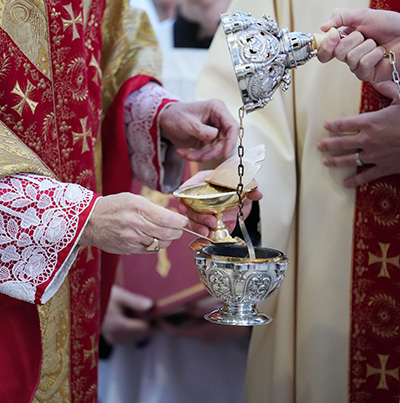
A few sacred objects are reserved for special use: during weddings, when rings are blessed, funerals, when the coffin is blessed, and at certain other times, the priest sprinkles holy water using a wand called the aspergillum. The holy water which the priest sprinkles is held in a metal bucket, the aspersorium. The thurible holds burning coals and incense for solemn Masses, and the boat holds extra incense with a spoon for putting the incense in the thurible. The pyx is like a tiny ciborium, and is usually used for distributing low-gluten hosts or for taking the Eucharist to the sick or homebound.
9.
When the host is exposed at adoration, it is put in the monstrance, which is in turn set on an ornamented stand called the tabor, named after Mount Tabor, where Jesus revealed Himself in all His glory at the Transfiguration (Mark 9:2-9).
