“Return to Learn” Concussion Intervention Program Launched at Pius X
As fall high school sports kick into full gear across the state, Pius X has put in place a new program designed to monitor and assist students who have suffered sports-related or accident-related concussion or traumatic brain injuries (TBIs).
The Return to Learn Protocol (RTLP) is a nationally recognized program that is now just beginning to be implemented in Nebraska high schools. RTLP is a response to legislation passed by the State Legislature in January. The law, LB 782, requires schools to have a policy in place to address concussion-related injuries among students and to facilitate their safe return to both the classroom and onto the playing field.
Starting last February, Pius X became one of approximately 6% of schools in the state to move forward with design and implementation of a Return to Learn Protocol. Full implementation began with the new school year just in time for the fall and winter sports season, which is statistically the time of year when incidences of concussions spike nationally.
The establishment of the new program at Pius X included the creation of a Concussion Management Team comprised of Athletic Director Tim Aylward, Academic Success Coordinator Raina Volkmer, and Athletic trainer Drew Erks, MSEd, ATC. The team works closely together – along with teachers, guidance counselors, medical personnel and parents – to ensure that students who are referred to the program receive coordinated attention, monitoring and communication as they recover from a concussion or other brain injury.
“We need to make sure everyone at Pius X is aware of the effects of concussions,” Aylward says. “In addition to this awareness, we designed the Return to Learn protocol to help students who suffer from a concussion return to the classroom and be able to learn as effectively as possible.”
According to the American Academy of Pediatrics (AAP), “allowing adequate cognitive rest may help minimize a worsening of symptoms and potentially facilitate a quicker recovery without significant disruption to the student's life." In following with this recommendation, the RTLP at Pius X emphasizes that rest is considered “the best medicine” for those suffering from brain injuries. The concussed brain is affected in many functional aspects as a result of the injury. Memory, attention span, concentration and speed of processing all significantly impact learning. The protocol further explains that the concussed student returning too soon to the stimulating school environment may delay the resolution of symptoms needed for recovery. Consideration of the cognitive effects in returning to the classroom is also an important part of the treatment of concussions and head injuries.
The RTLP involves a series of steps and accommodations that are made for students in coordination with teachers, parents, medical personnel, and the guidance department. For some students, returning to normal school and extra-curricular activities may take just a short period of time. For others, the process can take weeks if not months or longer. “Every student is different,” Volkmer explains.
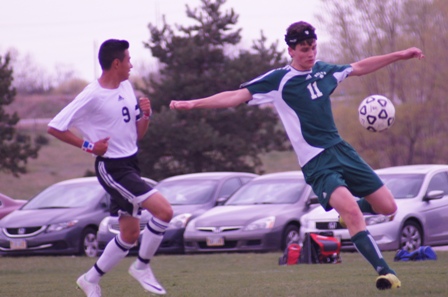
Already, the program at Pius has helped approximately 30 students, including Senior Scott Schieuer. Scott suffered a head wound and concussion in March of this year during the junior varsity opening home soccer game versus Lincoln East. “I was playing and went up for a header,” Schieuer explains. The contact caused a large gash to the head, and he was taken to the emergency room, where he received two staples.
It was not believed at that time that he had suffered a concussion. “Drew asked me where I was, what half we were in, what the score was, who was winning, who scored – and I was able to remember everything,” Schieuer says. When he was treated at the emergency room, he was asked similar questions by doctors, which he was able to accurately answer.
The next day, Schieuer attended classes as usual, and went to check in with Erks as he was experiencing severe headaches. “Drew told me to see how it went over the weekend and to get lots of rest and not do anything,” he recalls.
Following this advice, he went home and rested all weekend. On Monday, Scott was to attend the junior class retreat. His family requested that Scott do light work instead of the usual physical service project.
As the week wore on, Schieuer felt extremely fatigued. “I stayed at home and slept pretty much all day for about a week,” he recalls vaguely. When he made a return visit to his physician to have his staples removed, the doctor advised him to wear sunglasses as he was very sensitive to light, even indoors. “Also, when I came back to school, Drew told me not to go to band for a while because of all the loud noises,” Schieuer says.
Approximately two weeks had transpired before Scott returned to class at a routine but slow pace, beginning with only two classes the first two days back.
When he returned to a full class schedule, Schieuer was exempted from participation in morning band practice allowing him to sleep longer and arrive to school for second period. For a time, he resumed regular class schedule, however, was given extensions on when he would be given tests and quizzes, and a speech assignment was exempted altogether.
“Teachers were really willing to work with me, and were very flexible about when I would be able to do assignments again,” he recalls. “They knew that I could not do as much work in the evening because I would get tired very easily. I would come home and go to sleep immediately for a couple of hours, and then wake up and do my homework.”
As part of his adjustment back to school, after meeting with the athletic trainer the first two days, Schieuer would meet daily toward the end of the school day with Volkmer to assess his tiredness, ability to focus, light sensitivity, nausea, or other symptoms that would affect his ability to learn.
Schieuer’s concussion symptoms seemed to fluctuate on his road to a full recovery. “There would be several times when I would be feeling better, and then the next day I would have a headache,” he recalls. “Drew and Mrs. Volkmer were helpful with planning when I could resume regular activities.” Although it was believed originally that he had a milder concussion and that he would be able to re-enter after one week, Scott did not return to his full schedule of extra-curricular activities for close to a month following his injury.
Throughout the ordeal, the new RTLP program served as a tremendous asset and relief to Schieuer’s concerned parents. “What Raina did was tremendous,” reflects Scott’s father Kevin. “I cannot overstate how valuable her ability to coordinate with the teachers, the trainer, and, in particular us as parents. She listened to and heard what we said, and was able to coordinate with teachers to make progress.” He adds that corresponding with one contact person at the school versus all eight teachers made a challenging time much easier. “It was obvious that helping our son was Raina’s primary concern. She made it so efficient so we could stay on track in dealing with the health issues.”
Scott’s mother Heidi agrees. “Raina was phenomenal in helping us manage it, stay on track, and do what was appropriate,” she recalls. “I felt like Raina was an advocate for the family. I talked to her multiple times on the phone about Scott. She took the information I shared with her and communicated it to the coaches and teachers day to day. She grasped our perspective of how he was doing and put it into words and got everyone on the same page.” Volkmer also assisted with structuring Scott’s day, including mandatory rest time and meeting daily with him to monitor and log his symptoms.
“Raina helped with determining and prioritizing what assignments Scott really needed to do, with a focus on the main part of what needed to be learned,” Heidi continues. “The teachers were very accommodating to make adjustments and kept an eye on him as they were made aware that not getting enough rest prolongs recovery. We are really blessed to have this program at Pius.”
Image: Scott Schieuer