

By Reagan Scott
for the Register
On Friday, May 23, at the Cathedral of the Risen Christ in Lincoln, Patrick Burke will be ordained the second permanent deacon for the Lincoln Diocese.
Burke’s ordination marks the continued growth of the permanent diaconate in the diocese, and follows that of Dr. Matthew Hecker, ordained the first permanent deacon for the diocese four years ago.
Burke and his wife Angie moved to Wahoo from Cedar Rapids, Iowa, in 1999. They are members of St. Wenceslaus Parish. The two, married almost 38 years, have four children and six grandchildren.
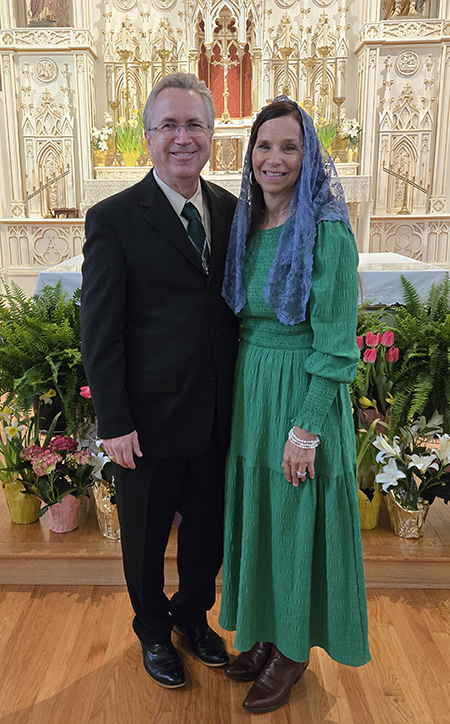
It was during an Ignatian retreat at Our Lady of Good Counsel Retreat House in Waverly almost eight years ago that Burke first felt a calling to serve the Church in some way. He would continue to hear this call through time spent in front of the Blessed Sacrament in adoration.
Burke had seen the permanent diaconate lived out in Cedar Rapids during his time there, but it wasn’t until he learned that Deacon Hecker was undergoing formation that he began to question whether the vocation was something that he wanted to discern as well.
Burke entered formation for the diaconate in 2021, through the program run by the Archdiocese of Omaha. The program consists of monthly formation weekends in Norfolk and Omaha. Burke said the program provided an opportunity for some real growth.
“There’s been a number of good things that have come through that process,” he said.
As his ordination nears, Burke is looking forward to seeing how he grows into the role of deacon, and how the vocation will continue to grow in the diocese.
All priests and bishops are, by their nature, “permanent deacons” having been left with an indelible mark from their own diaconate ordinations. However, the term “permanent” deacon is used to refer to those men who will be ordained only to the diaconate. In contrast, seminarians who are ordained deacons may be referred to as “transitional” deacons until they are ordained to the priesthood.
While the vast majority of permanent deacons are married, if the spouse of a deacon passes away, he cannot remarry. Anyone unmarried when ordained a deacon cannot later marry.
Deacon Hecker, the director of the permanent diaconate program for the Lincoln Diocese and serving as a deacon for St. Joseph Parish in Lincoln, explained that the permanent diaconate has been a part of the Church for a long time, first referenced in chapter six of the Acts of the Apostles. The the apostles selected seven men to serve as the first deacons for the church.
Over time, the role was phased out, until its reinstatement by the Second Vatican Council in 1964. While some dioceses were early adopters of the permanent diaconate, like the Archdiocese of Omaha and Deacon’s Hecker’s former home in the Archdiocese of Denver, others, like the Lincoln Diocese, have been more slow to adopt the role.
Deacon Hecker explained that, while the Church has a need for priests and their ability to administer the sacraments, the role of a deacon isn’t necessary for the day-to-day functioning of the Church.
Deacon Hecker explained that while priests act as an “Alter Christus,” an “other Christ,” to do the work of sacramental ministry, the role of the deacon is to be the servant heart of Christ present in the world, ministering to his flock by performing such acts as taking Communion to those who can’t attend Mass, teaching OCIA classes, conducting Bible studies, helping in homeless shelters, and more.
In fact, the origin of the word deacon comes from the Greek word “diakonos,” which means servant.
“By its nature, the servant role is one that comes with humility. It has to be washing the feet, it has to be the model of our savior,” Deacon Hecker said.
There are liturgical functions for deacons, such as assisting in the celebration of the Eucharist, proclaiming the Gospel and preaching homilies, but Deacon Hecker said that this isn’t their primary function. He likened it to the parable of the lost sheep, when the shepherd leaves the 99 to look for the one that is lost.
“Is a shepherd really going to leave his flock to look for one sheep? Not from an economic perspective,” Deacon Hecker said. “But the heart of Christ is to never, ever abandon his sheep; to never, ever leave one behind. The heart of the deacon, much like the heart of Christ, is to go in search of those lost sheep, to go and find them and bring them back to the fold. And there are so many places and so much need for that kind of ministry.”
Another example Deacon Hecker gave was that of a priest who may go into a prison once a week to celebrate Mass, but with his other responsibilities, doesn’t necessarily have the time to lead men and women in discipleship and fellowship, or hold Bible studies, along with all of his other parish duties. This is where a deacon could fill the gap.
The ministerial work performed by a deacon is something that he and the bishop discuss. The bishop may identify a need and assign duties that are consistent with the deacon’s skills and abilities. Deacons are attached to a diocesan bishop and assignable where the bishop chooses, but that doesn’t necessarily mean that they’ll end up too far from home.
“While we are assignable where the bishop might choose, bishops are also pragmatic realists,” Deacon Hecker said. “By and large, deacons are married and have families and jobs, and those aren’t transferable like a priest. Bishops are very acutely aware of that.”
Burke will serve as deacon for St. Wenceslaus Parish and has been working with pastor Father Jeffrey Eickhoff to determine where Burke can use his gifts, and make sure there’s balance in all areas of his life.
Burke works full-time managing the software development staff at a telephone company. He said that it’s important to have the support of a pastor, both in his openness to the diaconate, and given the reality that deacons don’t work for the Church full time.
“Part of working with Father Eickhoff is determining what I can take on without overloading,” Burke said. “It’s going to be a balance of work, family life and the diaconate, being able to work around busy times… and being able to make all of those meld together.”
Burke has been part of a group of parishioners who take Communion to shut-ins for the last 20 years, which he’ll continue to do. He said he may also start holding Communion services at a nursing home. He and his wife became involved in prison ministry at the Saunders County Jail a year and a half ago, and he said that’s been a good experience in learning how to share the faith.
Another thing that drew Burke to the diaconate was being able to offer Benediction, as his call to the vocation came out of time spent in Adoration, and he looks forward to being able to do that.
As his ordination nears, Burke is feeling the gravity of the event more and more.
“It is a serious, significant commitment and it’s sort of somber. Not in a negative way, just the reality that this will be a change, and I don’t know for certain what exactly all that change will entail. In a way it’s like marriage—you know it’s going to be different; you just don’t know how until you’re in it,” he said.
Reflecting on his own marriage in this process, Burke said his wife Angie has been a key part of in his discernment and incredibly supportive, attending almost every formation weekend with him and joining him in his ministry. The most important thing for them, he said, is their time spent in prayer together.
“That has been a gift that Angie and I have had, to really be able to share our faith together and to feel like we’re equally yolked between the two of us,” he said.
Every two years, the Archdiocese of Omaha starts a new class of deacons. There are currently two men in formation from the Lincoln Diocese who plan to be ordained in 2027.
Deacon Hecker said he credits these vocations to Bishop Conley for his willingness to accept permanent deacons in the diocese. He said the bishop’s vision for growing the permanent diaconate is, “let’s plant seeds and let them grow.”
Deacon Hecker said Bishop Conley wants men to feel a calling to the diaconate in their own hearts first, and he’s already seeing that strategy pay off.
He said, “I didn’t do anything to go out and ‘recruit’ Pat Burke. He identified that he felt called to this, and the same with the other two candidates that we have. It’s beautiful because it’s the vision of the bishop playing out in real time.”
As the diocese continues to work on its blueprint for what the diaconate should look like, there’s no rush to have all the answers now. As Deacon Hecker pointed out, the Omaha Archdiocese has a 50-year head start. The Archdiocese of Omaha had to start slowly, and so will the Diocese of Lincoln.
