

Pope Leo XIV declared a ‘Special Year of Saint Francis’ to honor the 800th anniversary of the death of St. Francis of Assisi. Diocesan parishes and institutions welcome visitors throughout the year.
By S.L. Hansen
for the Register
On Jan. 10, Pope Leo XIV proclaimed a “Special Year of Saint Francis” honoring the 800th anniversary of the passing of Saint Francis of Assisi. This gift to the entire Church is an opportunity to learn more about the saint and his teachings, and experience authentic spiritual renewal during a time of strife in the world.
“The Year of Saint Francis must not become yet another chapter rich in special spiritual effects, but a silent passage from enthusiasm to deep maturity, from spectacular celebration to imitation in daily life,” urged the Holy Father.
Through Jan. 10, 2027, the faithful can obtain a plenary indulgence while making a pilgrimage to any Franciscan conventual church or place of worship dedicated to St. Francis anywhere in the world. Furthermore, the elderly, the sick, and those who, for serious reasons, cannot leave their homes can obtain the plenary indulgence by spiritually joining in the jubilee celebrations and offering their prayers, pains, or sufferings to God.
Any of the faithful who, with a heart detached from sin, participate in the Year of Saint Francis can receive this plenary indulgence under the three usual conditions (making a good confession, receiving the Holy Eucharist and praying for the intentions of the pope), along with making a pilgrimage to any Franciscan conventual church or place of worship.
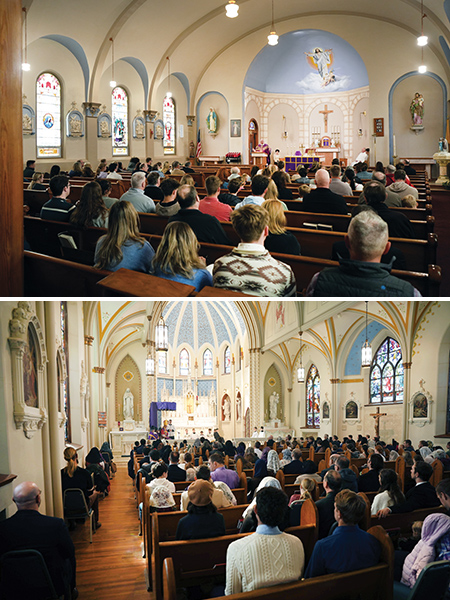
There are sites within the Catholic Diocese of Lincoln appropriate for this particular indulgence: St. Francis Church (Center) near David City, St. Francis Oratory in Lincoln, and Our Lady of Good Counsel Retreat House in Waverly (see the accompanying story). Several religious institutions in the diocese also have a Franciscan charism, such as the motherhouse of the Franciscan Sisters of the Sorrowful Mother in Nebraska City.
While at a Franciscan church or place of worship, pilgrims should devoutly engage in a jubilee event, or spend at least “a reasonable period of time in pious meditation” and prayers to God. The pilgrimage is to conclude with the Our Father, the Creed and invocations to the Blessed Virgin Mary, Saint Francis of Assisi, Saint Clare and all the Saints of the Franciscan Family.
The parish council of St. Francis in Center recently began talking about what sort of celebration they will have during this jubilee year. Father Adam Sughroue, pastor, said he expects they will plan an event close to St. Francis’ feast day, Oct. 4. The parish has been holding its annual fundraiser that month for the last few years, so the timing makes sense.
Father Sughroue said the parish, established in 1879 to serve primarily Dutch and Bohemian Catholics in the area, definitely feels like one big family. Multiple families have been in the parish for three or four generations, and people are always willing to help with whatever is needed. (See photos from a recent Mass)
The parish has already welcomed one couple who came to Mass for the Jubilee Year of Saint Francis. They look forward to receiving many more visitors. The church is open for confessions a half hour before the 6 p.m. Vigil Mass every Saturday and again a half hour before the 10 a.m. Sunday Mass. The church is located off Highway 15 at 3071 P Road southeast of David City. While the church is locked when there is not a Mass, Father Sughroue said a visit to the church and cemetery behind it, while fulfilling all the other conditions, would enable a person to receive the plenary indulgence.
Saint Francis of Assisi Oratory in Lincoln (see photos from a recent Mass) is equally eager to welcome pilgrims during the Jubilee Year. Built in 1921 as an addition to the original St. Elizabeth Hospital operated by the Poor Sisters of Saint Francis Seraph of Perpetual Adoration, the chapel was sold to the City of Lincoln in 1970 to be used as a nursing home. It was saved from demolition in the late 1980s, thanks to its historic significance, though the original hospital building was removed around it. The City of Lincoln sold the chapel to the Priestly Fraternity of Saint Peter (FSSP) in 1998. Saint Francis of Assisi Oratory has been an active, thriving parish since then, offering the Traditional Latin Mass and sacraments according to the 1962 Missal of Pope St. John XXIII.
Pilgrims may visit St. Francis Oratory for daily Mass at 8 a.m., Monday through Thursday, and Saturdays. On Fridays, Mass is celebrated at 12:30 p.m. and 6 p.m. A Low Mass is celebrated on Sundays at 8 a.m. and noon, and a High Mass is celebrated at 10 a.m. The Sacrament of Reconciliation is offered 30 minutes before Mass Monday through Thursday, and 45 minutes before Mass on Fridays and Saturdays.
Missals are available with both Latin and English texts to help the faithful who are not as familiar with the Traditional Latin Mass. These contain the prayers of the Mass as well as instructions for how the faithful may participate and explanations for what the priest and altar servers are doing. The Oratory also provides leaflets with the readings of the day.
It can be helpful to arrive 10 to 15 minutes early to look through the materials and to take in the beauty of the chapel. Veils for women and girls are available in the vestibule, though not required. Visiting women and girls may also choose to wear their own head coverings, such as a hat or scarf.
The Oratory also has other gatherings throughout the year, such as holy hours and youth and young adult gatherings. Consult the parish website at www.stfrancislincoln.org to see what opportunities are available.
What is an indulgence?
Praying for the dead is amongst the oldest Traditions in Catholicism. It is something we all should do as often as possible.
But, obviously, just because we should do something that does not mean we do it. Sometimes we need an incentive to do something we know is good for us. This is true in all aspects of life, including our faith.
This is why the Church in Her wisdom grants indulgences. Indulgences are ways to essentially incentivize Catholics to do things we should just ordinarily do. In this case, the incentive is the partial or full remission of temporal punishment for sins whose guilt is already forgiven (CIC c. 992).
Indulgences DO NOT forgive sins, nor are they ways of buying, literally or figuratively, our way into Heaven. They simply remit whatever temporal punishment has not yet been remitted for sins we have already received sacramental absolution for.
Temporal punishment can be understood as the “debt” we still owe God for our sins. It is analogous to a child stealing money from a parent. The child steals the money, feels bad, confesses the theft to the parent, and asks forgiveness, promising to never do it again. The parent forgives the child. But the money still needs to be returned. If the child already spent the money and has no way to raise the money necessary to pay the parent back, then he or she offers to do chores or something as way of erasing the debt.
When we sin, feel contrition, and have a firm resolve to amend our life, confess our sins to God through a priest, and receive God’s forgiveness, we still “owe” God for the inequality our debt has caused. That’s why we are assigned a penance every time we go to confession. It is us “paying” God back in the only way we can; in a way He wants us to, offering prayers to draw us closer to Him, or on behalf of others so they draw closer to Him.
Indulgences are ways the Church has identified that we can “pay” God back for our sin and erase whatever “debt” remains outstanding. We can also apply them for the dead (CIC c. 994).
This description of indulgences was included in a 2023 “Ask the Register” column by Father Caleb La Rue, chancellor of the Diocese of Lincoln.
