By Andrew Winter
for the Register
Catholic explorers, traders, and priests first opened this unknown land to the rest of America. Catholicism in Nebraska stretches back before the Founding, and it was the indispensable strength of this Catholicism that laid the foundation for the Nebraska Territory, which eventually became the 37th state of the American Republic.
Nebraska celebrates the 250th anniversary of the Declaration of Independence with the rest of the nation, and as America commemorates its beginnings, it is fit to recall the brave Catholic men who built Nebraska’s own beginnings.
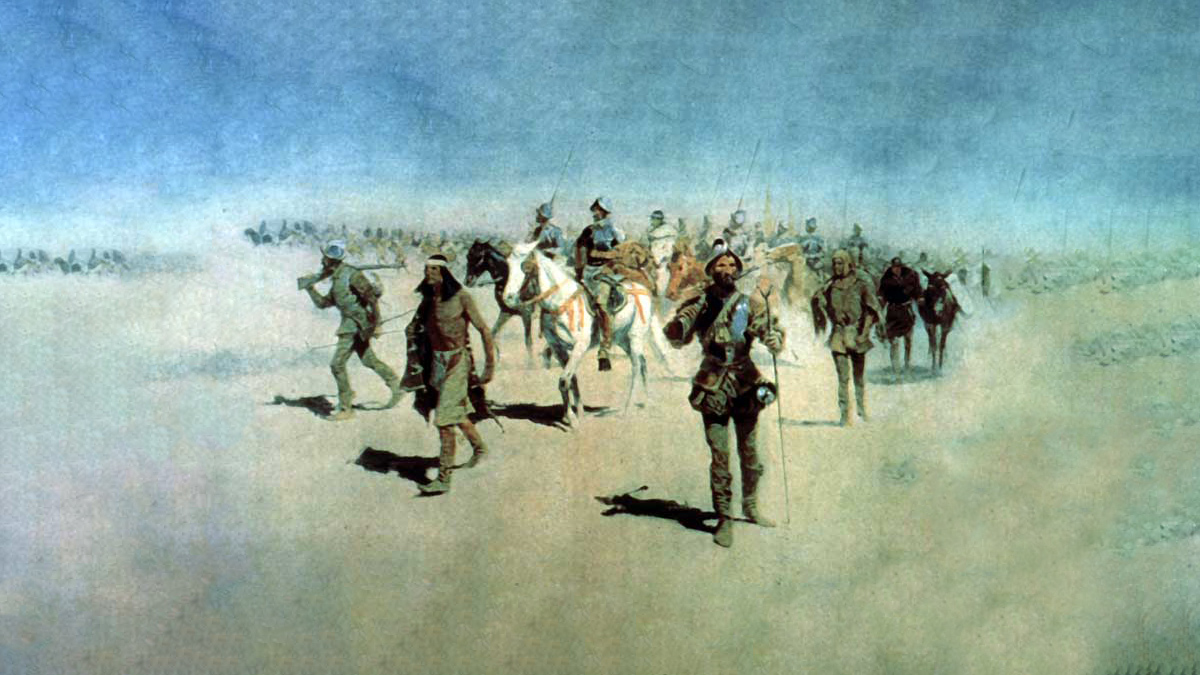
The first Spanish expedition came to Nebraska perhaps as early as 1541, bringing with it several Franciscan priests. Francisco Vasquez de Coronado led this excursion, and his goal was the fabled land of Quivira, a mythic kingdom rich with gold. Although most historians today believe that Coronado never made it north of Kansas, he may have entered southern Nebraska – territory that is now the Catholic Diocese of Lincoln. One of his chaplains was Father Juan de Padilla, who would later become the first martyr of the United States. For 16 years Father Padilla ministered to the Mexican and American natives, going where even the Spanish soldiers would not go, and preventing oppression of the Indians by the Spanish authorities. He was killed by natives as he knelt in prayer, c. 1544.
The most important Spanish Catholic expedition into Nebraska occurred in 1720. Pedro de Villasur, with about 40 soldiers, 60 natives and one Franciscan priest, traveled across most of Nebraska in an attempt to discover French movements in the region. Probably near Columbus, Villasur’s party was attacked and almost completely destroyed by Pawnee and Otoe natives. Father Juan Minguez, the Franciscan, was killed in the battle while administering Last Rites to the dying Villasur and his men. He may have been the first priest to visit Nebraska, and was certainly the first to die there. A marker near Columbus erected by the state of Nebraska still commemorates Villasur and Father Minguez.
French Catholics also came to Nebraska before the founding of the United States. It was a Frenchman, Etienne Veniard de Bourgmont, who first recorded the Otoe name for our state: Nebraskier, or “Flatwater.” It was also a pair of Catholic French explorers, Pierre and Paul Mallet, who first named the Platte River in 1739. In French, platte means “flat.”
Nebraska first came under the jurisdiction of the Catholic Church in 1682 when Rene-Robert Cavalier de la Salle claimed the Louisiana Territory for France. Although la Salle never came to Nebraska, his claim over central North America put Nebraska under French dominion, and thus it became territory of the Diocese of Quebec. Francois de Laval, as the first Bishop of Quebec, was the administrator of the Louisiana Territory, and in a way became the first bishop of Nebraska. de Laval since 1658 had been apostolic administrator of all New France, and he served faithfully as bishop until 1683. He founded the first seminary in Canada, and spent his episcopacy tirelessly suppressing the sale of alcohol to natives. In 2014, de Laval was canonized by Pope Francis.
We do not know of any definite Catholic presence in Nebraska in 1776. There were probably some French fur traders and some Native Americans who had been baptized by the Europeans, but certainly there were no priests in the territory to minister to them.
In 1803, when President Thomas Jefferson bought the Louisiana Territory from France, Nebraska became U.S. territory. Immediately it came under the jurisdiction of John Carroll, Bishop of Baltimore and the first bishop of the United States.
Related item: Learn about Bishop Carroll and his brother, the only Catholic to sign the Declaration of Independence in "9 Things to Know."
As white settlers entered Nebraska, the Catholic Church came with them, this time as a permanent establishment. Around 1840 the famous Jesuit missionary Pierre-Jean de Smet celebrated Mass in Nebraska during his journey down the Missouri River. Nineteen years later, the Holy See created the Vicariate of Nebraska. In 1885 the Diocese of Omaha was erected, and in 1887 the Diocese of Lincoln followed.
Examples of the Catholic Church’s influence on the American Founding can be found everywhere, but few remember these heroic and intrepid men who risked their lives exploring, settling, and sanctifying what would become Nebraska. The examples of men like St. Francois de Laval, Father Minguez, and Father Padilla remind Nebraska of its Catholic infancy, and provide us models for our own virtue as Nebraskans. Likewise the hardihood, courage, and thirst for the unknown that motivated Villasur, de Smet, and the early French trappers still remind us of the relentless pursuit of the Kingdom to which Christ calls every Catholic.
As we observe the 250th anniversary of the birth of our great nation, these men bear witness to the fact that America today stands on the same virtue that steadied its beginning. And the history of Nebraska’s Catholic roots, going back at least to 1720, remind us that Catholicism predates, permeates, and elevates all 250 years of American history.