

By Andrew Winter
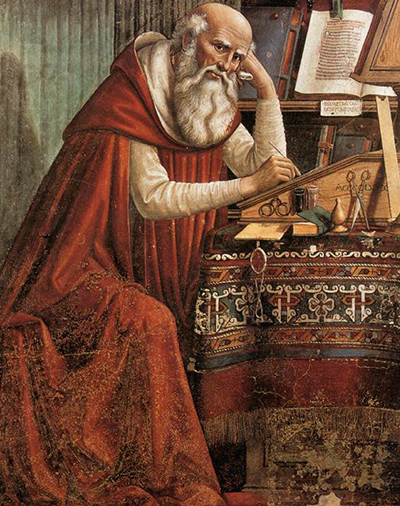
1. Commissioned by Pope Damasus I in the late 4th century, the Vulgate is the definitive Latin translation of the Bible. It was made by St. Jerome – whose feast day is Sept. 30 – and for the most part, translated from the original Hebrew and Greek texts of the Old and New Testaments.
2. Jerome the great translator was born in modern-day Yugoslavia c. 347. He studied in Rome as a young man, and after some years as a monk went to the Syrian Desert, where he learned Hebrew while living as a hermit. He became the secretary to Pope Damasus I, who commissioned the Vulgate in 382. Jerome moved to Bethlehem in 385, where he did most of the translation, and died c. 420. He is one of the Four Great Western Doctors of the Church.
3. The hodge podge of Latin Scripture translations written before the Vulgate is collectively called the Vetus Latina, or “Old Latin.” Before Jerome’s Vulgate, the Latin translations of the Bible were scattered and fragmentary. Some translations were unreliable, others incomplete, and yet the Latin-speaking Catholic West desperately needed a Latin version of the Scriptures.
4. Jerome took three years, 382-385, to complete just the translation of the Gospels. He then moved to Bethlehem to begin with the Old Testament. Over the next 20 years he produced the “Gallican Psalter,” translated from the Vetus Latina, as well as the other books of the Old Testament. He did not, however, translate the Deuterocanonical books—the seven books which the Jewish and Protestant traditions do not accept—with the exceptions of Tobit and Judith.
5. Some scholars hold that Jerome’s friend Rufinas translated the non-Gospel books of the New Testament, while others maintain that Jerome translated them himself.
6. The completed Vulgate became the standard Latin text of the Bible, and remains so to this day. Before the printing press, however, copies of the Vulgate were written by hand, and many typos and errors appeared. Fortunately, some good copies have survived to modern times. Two of the most complete copies are the Codex Amiatinus from the 8th century and the Codex Fuldensis from the 6th century.
7. Largely due to Jewish influence in the region of Bethlehem where he lived, Jerome did not at first think that the deuterocanonical books—Tobit, Judith, Sirach, Wisdom, Baruch, 1 Maccabees, and 2 Maccabees—should be in the Vulgate. But he bowed to the wisdom of the universal Church, eventually translating Tobit and Judith, as well as Daniel chapters 13 and 14 (which the Jews rejected in their Old Testament). The other five deuterocanonical books were often still included in editions of the Vulgate, taken directly from the Vetus Latina.
8. The Catholic Church has made several statements in favor of the Vulgate since the 4th century. The Council of Trent declared it to be “authentic” and forbade Christians from rejecting it. Pius XII said the Vulgate is “free from any error whatsoever in matters of faith and morals.” John Paul II released a revised Vulgate (the Nova Vulgata) in 1979, and of this he said: “We declare the New Vulgate edition of the Holy Bible as ‘typical’ and we promulgate it to be used especially in the sacred Liturgy but also as suitable for other things.”
9. The Vulgate is still used in the Traditional Latin Mass, and probably the most famous passage from the Vulgate—taken from John 1:1-14—is read every day at Latin Masses in the Lincoln Diocese and the world over:
In principio erat Verbum, et Verbum erat apud Deum, et Deus erat Verbum … (In the beginning was the Word, and the Word was with God, and the Word was God …)
