

By Jay Sorgi
for the Register
Years ago, Mary Sweeney of Lincoln saw her son Henry endure a lot of unintentional moments of “standing on the outside looking in”; moments of finding doors to education and even faith opportunities closed, all because the child she loves so much has Down syndrome.
“Especially when [my kids] get older and it starts time to think of sacraments, he can’t go to the same school that my other two boys can go to,” she said.
But she and other Catholic families in Lincoln who have children with Down syndrome have seen the Church find new, more inclusive ways for their families to feel more fully embraced, in many cases because of their proactive work to help them establish everything from sensory-friendly Masses to adaptive teaching kits so their kids can receive sacraments of initiation.
“It’s 2026. We should be able to belong,” said Sweeney, who owns Mary Catherine Marketing and serves as a grants and fundraising specialist for the Omaha-based Down Syndrome Alliance of the Midlands.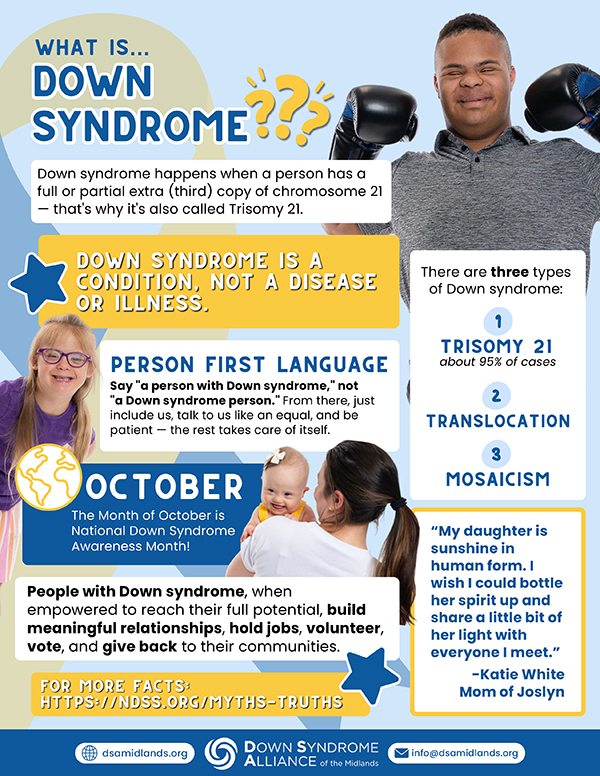
The sensory-friendly Mass is held the second Sunday of each month in the chapel at the Pope St. John XXIII Diocesan Center in Lincoln, including a post-Mass light breakfast and opportunity for families whose children have Down syndrome and other disabilities to connect.
“The lights are a little bit lower. There’s no music. It’s a shorter Mass, just because it’s hard to keep attention,” Sweeney said.
“I always have to laugh because we say low sensory, but our kids bring all the sensory things. You’ve got kids humming. You’ve got kids that are yelping throughout it. There’s typical kids there, too. Then there’s siblings that are having sibling fights, like my little boys, so it usually ends up being a very loud Mass, but what’s nice is everybody just gets it.”
Sweeney and a group of friends started building a Catholic group for families with children who have special needs. She grew a friendship with Father Louden Redinger, who at the time was assistant pastor at St. Joseph Parish in Lincoln, and now serves at Ss. Peter and Paul Church in Falls City and teaches at Sacred Heart High School.
One night, with just a few words, she said, he created a seminal moment in the journey of Catholic families with special needs in the Diocese of Lincoln.
“He came in and said, ‘As a priest, on behalf of the Church, I just want to apologize for any ways you feel we have not done your families justice. As a Church we all need to do better. I’m sorry. We’re trying to figure out the best ways [to] be there for you, and I’m hoping I can be,’” Sweeney recollected.
“For him, a first-year priest, to come in and say that, he had the room like in tears,” she said. “You could tell everybody was just like, ‘I needed this. I needed to be seen. I need to feel like I’m part of something.’ Without even realizing it, I think he created the beginnings of that culture there.”
Father Redinger recalled that gathering of the “Catholic Special Needs Parents’ Network” that now exists for Lincoln Catholics. Mary and Luke Sweeney hosted the meeting in St. Joseph Parish’s Resurrection Hall, and Father Redinger was asked to attend.
“I joined them all for a time of community and they invited me to say a few words, and then lead them in prayer,” he said. He was pleased to know the words resonated and said special needs awareness is “a very important topic and one that’s close to my heart.”
He recommended the group’s Facebook page: www.facebook.com/groups/lincolncatholicspecialneedsparents/.
“It’s a place for parents to find community and connect over love and support for their kids,” he said.
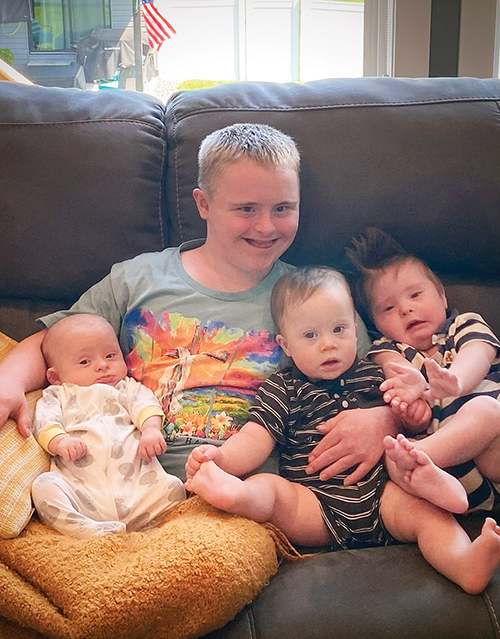
Sweeney and fellow Catholics in Nebraska like Elizabeth Draney, the executive director of the Down Syndrome Alliance of the Midlands and mother of a young son with Down syndrome, are advocating to further expand the culture they see the Church working to improve.
“I’m not trying to say that every single Catholic school should have special education, but what are we doing to try to make sure that we still are in some way, shape or form exposing Catholic school kids and the community as a whole to people who are different than us?” Draney asked.
“The important thing for me and my husband is that we’re still there,” she said. “To feel like we’re not getting a bunch of stares, [and] people could look and see he might have different needs, but I just appreciate not feeling like I have this massive target on our back, because we’re there.”
The initial group of Lincoln-area parents whose children have Down syndrome has expanded since the sensory-friendly Masses began in 2025, and families are now linking more deeply in faith as well.
“We’ve been trying to have an evening of recollection, if you will, getting some families together where maybe we’d have an opportunity for confession,” Sweeney said. “How do you go as a family to confession? Do you leave the kid in church that’s going to call 911 the second that you walk away from them?”
Henry has received adaptive sacramental preparation designed for neurodivergent children, like the ones used for reconciliation, using kits that both help educate children on what the sacrament means and those which they can use with priests in the confessional space.
“He could just be like, ‘Here, these are like my sin cards, and then here’s my I’m sorry card,’” Sweeney explained of a way the Church allows children like Henry to receive the sacrament.
“The priest goes through them, and then Henry comes out. It’s been neat to see that aspect of it.”
She said her son had trouble physically receiving the Body of Christ at Communion because of sensory issues with his tongue that don’t let him take in the host, but they discovered and advocated for their parish to offer an alternative solution in receiving the Blood of Christ.
“Every time he would try and receive Jesus in the Eucharist, he’d spit [the consecrated host] out,” she explained of Henry’s unintentional reactions.
“All of a sudden, it dawned on us: Will he drink the [Precious Blood]? Would we do that? He was totally down for that. I was the parent that had to call the priest to [ask] ‘What would be the most similar-tasting wine so we could practice at home?’ Since then, he knows he runs into Church first and he runs up and says, ‘Do you have an extra chalice for me?’ Then they make sure they bring up an extra chalice.”
Those are just examples of ways they see the Catholic Church embracing their son, the kind of embrace she believes Christ would offer young Henry Sweeney today.
“I know that if Jesus was sitting right next to me right now, he would still want Henry to be in church here,” his mother Mary said. “That’s all that I need to care about.”
Courtesy photos
+++
‘The beauty is worth the effort’
“Our diocesan Catholic schools have always made an effort to serve every child that comes through their doors,” said Sister Mary Angela, CK., assistant principal at St. Joseph School in Lincoln. “All of our schools serve children verified with various degrees of learning disabilities in conjunction with federal services provided through the local public school. Primarily, the degree of disability that a school can serve comes down to funding for extra personnel needed.
In the past 10 years, she said, more diocesan schools have been able to hire special education coordinators to oversee the services and assist classroom teachers with modifications and accommodations.
“Unfortunately,” she lamented, “parish budgets are not so expansive that they can cover every degree of need. It takes not only a heart commitment, but a financial commitment to serve these children as they deserve.”
She said St. Joseph School is blessed to have a parish commitment to staffing three special education teachers in the building, which expands the capacity to serve more children.
“However, we, too, have limits in that we are not able to provide for students who need one-on-one assistance.”
If a family with a special needs child reaches out at St. Joseph, she described, the school will “carefully examine what the needs of the child include and then determine if we will be able to serve them well or not. It is a delicate and difficult balance.”
“While we have known the joy and enrichment of having students with Down Syndrome or autism, we cannot take every child we would like to,” she said. “It really comes down to a case-by-case basis.
Still, she encouraged parents to reach out to their local Catholic schools to explore the possibilities.
“Sometimes people think their Catholic school can’t serve any children with special needs and that simply is not the case,” she said. “We want to be as inclusive as we can. The beauty of how these children can enhance our whole school culture is worth the effort.”
