

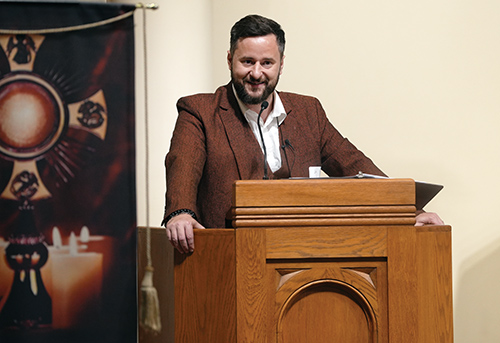
Joe Heschmeyer is a popular Catholic Answers apologist and author. He is a former litigator in Washington, D.C. and a former seminarian of the Archdiocese of Kansas City. He has earned a law degree as well as degrees in philosophy and sacred theology.
Spirit Catholic Radio recently brought Heschmeyer to Nebraska for several presentations, including a talk in Lincoln.
Dennis Kellogg, director of communications for the Catholic Diocese of Lincoln, interviewed Heschmeyer about defending the Catholic faith, the early Christians, the Real Presence of Jesus in the Eucharist and how to talk with a child who has left the faith. What follows is an edited version of that interview.
Dennis Kellogg, director of communications, Diocese of Lincoln, for the Southern Nebraska Register: You are a former litigator in Washington D.C., a former seminarian. You have a law degree. You have degrees in philosophy and Sacred Theology. So, how does that deep and varied background all come together to make you an apologist?
Joe Heschmeyer, Catholic Answers apologist and author: I would say two things. Number one, you don’t have to have that particular background to become an apologist. God will use whatever gifts and talents you have. But the flip side of that is whatever you are capable of bringing to the table, build on that as much as you can, and watch God do something incredible with it. In my own case, I was sure I was going to become a lawyer, and in fact, I was a lawyer for a little bit, and then I was sure I was going to become a priest. And God allowed me to kind of continue on what I thought I was meant to do and then use those gifts in a totally unexpected way that I didn’t really see coming.
SNR photos | Natalie Bender
SNR: In all the work you have done with apologetics, what do you think is the one or two Catholic beliefs that a Catholic should be able to defend against someone who may be questioning them?
Joe Heschmeyer: The standard we’re given in 1 Peter 3:15 is to always be able to give a defense for the hope that lies within you. So, you should be able to give what is called your witness. You should be able to explain why you are Catholic. That may or may not be something that resonates with the other person. You don’t have to know every answer to every doctrinal question under the sun. But if someone says to you, “Why are you Catholic?” you should be able to give a personal and honest answer to that question that is something more than that’s the way I was raised. Now I think in addition to that, it’s very helpful to be able to show Jesus founded a Church. So if somebody already knows that there is a God, if they already believe that Jesus is who He says He is, to make that next step and say He did found a Church, it is a visible Church, and then to even say, look at the special role that He gives to Peter, that goes a long way towards answering the questions about why be Catholic instead of some other kind of Christian.
SNR: You have written a number of books, and one of them is “The Early Church was the Catholic Church,” and that’s also the topic of your presentation in Lincoln. So, what do we truly know about the early Christians, and how can we definitively say they were Catholic?
Joe Heschmeyer: The wonderful thing is many people want a faith like the early Christians. They say, “Why can’t we just go back to the simplicity of the early Church?” And a great challenge there is to say, well, let’s go read what the early Christians had to say, because we actually have a great many of their writings, including people who knew the apostles personally. So, when you read what are called the apostolic fathers, people like Ignatius of Antioch, people like Polycarp of Smyrna, you’re getting this incredibly early insight into what Christianity looked like in the very early 100s and even before that. First Clement is believed to have been written by Saint Clement, the Pope of Rome, around the year 96. So, being able to say what did they believe, what did they talk like, what were the things that really motivated them to write, helps to reveal what that Church looked like, and the more people delve into that, the more they find themselves drawn to the Catholic Church and realizing just how Catholic these early Christians were.
SNR: With that evidence that’s out there, would you say that most of the top non-Catholic biblical scholars would at least acknowledge that the Church Jesus Christ founded on Earth came to be the Catholic Church, even if it maybe needed reform later on?
Joe Heschmeyer: The problem with that way of posing the question precisely is it raises the question of what does that scholar believe the word “Church” means, and here’s where a lot of theological biases come in.
What you can certainly say is, if you ask the early Christians what they considered the Church, they would be very clear that the Church is something that is a structured, visible institution. For example, Ignatius of Antioch says, if you don’t have the three tiers of bishop, presbyter, what we now call priest, and deacon, you don’t have a Church, but many modern Christians, and including many modern scholars, will take their own idea of what a Church is of just any kind of gathering of people, or it’s a much more disorganized idea, or it’ll just be well, a Church is a collection of all the saved people. So, you might get some pushback on well, what does it mean to be a Church?
What does it mean to be the Catholic Church? But in terms of showing the continual institutional identity of this body that we call the Catholic Church and has called itself the Catholic Church since at least 107, that is, I think, pretty easily shown historically.
SNR: How important are the writings of the early Church fathers and the early Christians to making a convincing argument that someone should be Catholic, keeping in mind what John Henry Cardinal Newman said that “to be deep in history is to cease to be Protestant”?
Joe Heschmeyer: Everybody’s journey is different, and for some people, they’re able to see the truth of Catholicism from just their reading of Scripture, or from the profound witness of Holy Catholics, but for a great many people, being able to see, it’s not just the way I happen to read John 6, or it’s not just the way I happen to read Matthew 16 with “upon this rock.” That no, when you trace the history, you see this visible Church living and acting in very much the way that the New Testament presents it is acting at. For example, in Acts 15, when there’s a theological controversy, the Church comes in and settles the issue on behalf of God, saying it seems good to the Holy Spirit and to us. That’s a really profound declaration on behalf of the Church that its own view of itself is that it has the authority to speak on behalf of God. That it is, as Saint Paul says, the pillar and foundation of truth. First Timothy 3:15. And when you can trace that pillar and foundation of truth throughout history, then these Catholic claims that somebody says, “Well, where did that thing come from?” It becomes much more obvious where that thing came from. Now, some of these doctrines are immediately clear. Some of them become clearer over time, but all of them you see them present in some form, and then you just see increasing clarity around it.
SNR: Another one of your talks while you are on your Nebraska speaking tour is on the “Eucharistic Heart of Christianity,” based on your book, “The Eucharist is Really Jesus: How Christ’s Body and Blood are the Key to Everything We Believe.” That’s a pretty bold claim. How do you back it up?
Joe Heschmeyer: I mean the Second Vatican Council refers to the Eucharistic sacrifice as “the source and summit of the faith.” Even the terms Old Testament and New Testament, those terms are referring to the Old Covenant and the New Covenant. The Testamentum is the Latin that roughly translates the word covenant, and so the early Christians named the two parts of the Bible after the fact that they are about two different stories of God creating covenants with His people. First, the covenants He made of old with Israel, and then when He gathers the remnant of Israel and brings the Gentiles into this new covenant people, and so that’s critical. I would say if you don’t understand the New Covenant, you don’t understand the New Testament. The whole book is named after it. Like if you don’t understand the lion and the witch and the wardrobe, if you’ve missed all of those parts, then you’re probably not reading the book very carefully. And so, the New Covenant is absolutely central to the Christian story, and that’s how it was understood from the very beginning. Yet, do you know how often Jesus explicitly mentions the New Covenant? One time, and the one time he mentions it is at the institution of the Eucharist when he lifts up the chalice and declares of the New Covenant in his blood. So, if you don’t understand the New Covenant, you don’t understand the Bible, and if you don’t understand the Eucharist, you don’t understand the New Covenant. It’s really that central.
SNR: There’s a study that came out this month in the journal Sociological Inquiry, which aims to examine the Catholic belief in the real presence of Christ in the Eucharist. This study revealed that 29% of those who identify as Catholics believe in the Real Presence, and this matches with Pew’s study in 2019. It showed the figure was 31 percent. Going all the way back to 1992, a Gallup poll shows 30 percent believe that Jesus is the Real Presence in the Eucharist. So, the numbers haven’t seemed to change, at least with people who identify as Catholics. Obviously, they’re higher if you look at weekly and daily Catholics. But my question would be: When you’re talking about such a central tenet of the Catholic faith, how can it be that less than a third of Catholics actually believe it’s true?
Joe Heschmeyer: I think there’s several aspects to answering that question well. One of them is to recognize that this is a hard teaching. We’re told that in Scripture itself, a lot of Jesus’s followers don’t accept it, so we aren’t going to hit 100%. Jesus doesn’t get 100% while he’s on Earth, and so if we imagine that if we just change the messaging or something that we can solve the problem completely, we can’t. This is a hard thing to accept, and we should know that going in.
Second, there is a two-way street between Mass attendance and belief in the Real Presence. If you go to Mass more often, you’re likely to come to a deeper faith in the Eucharist, and if you believe in the Eucharist, you’re more likely to go to Mass. So, it’s hard knowing which problem to solve first, but either of those, solving the one should help the other. Not perfectly. There are people who go to Mass and don’t believe in the Real Presence, and there are people who believe in the Real Presence but don’t go to Mass. But they’re definitely connected.
One thing that is absolutely true is when we have a large-scale loss of reverence in the Mass, that communicates more. I mean, everyone grew up hearing from mom and dad, your actions speak louder than your words. And so, if our liturgical actions undermine belief in the Real Presence because of a lack of reverence by the priest or by the musicians or by the other people in the Church, it’s hard to believe that everyone there thinks this is really Jesus because they’re not acting like it, and that’s the message. one of irreverence that gets communicated.
Now I will say, you should believe even if no one around you seems to. But in terms of how do people come to believe? Well, the people around them make a tremendous impact on that. And so, if you want people to believe in the Eucharist, surround yourself with other people with piety. Surround yourself with other people who take the Eucharist very seriously and allow that devotion to really flourish in your life and in the life of your family.
SNR: Along those lines then, what would you say is the most convincing and convicting way for a Catholic to share their faith with, say, an adult child who has left the faith or is now attending a different church?
Joe Heschmeyer: I think the more you lean into your Catholicism and become a better and holier person for it. The false way is to kind of, preach the gospel always, use words when necessary. That kind of cheapens it. But there is a real sense in which mom and dad lecturing on why you should be Catholic has a near 0% success rate, if we’re being honest. I mean this is something that every parent of a child who’s wandered away, they want to talk them back into it, and that often isn’t going to work, and they’re not going to want to hear it from mom and dad.
So, you can do these things. Number one, be a better person than you were before because of your Catholicism, and let them realize that you being more Catholic makes you more pleasant to be around, makes you holier, makes you more willing to sacrifice for them and to help them out with the grandkids or whatever the situation is. The more they see you behaving in a truly saintly way, the more those other parts of your testimony are going to have credibility.
But then, second thing is know when to look to outside help. One of the reasons we have things like Catholic books and podcasts and YouTube channels and all of these things, is that sometimes you need to hear it from somebody you’re not as close to. There’s a saying in business that an expert is somebody who comes in from outside. You might have the most qualified person in the world, but if they’re your teacher or if they’re your coworker, if they’re your mom or dad, you might be less willing to listen to them. A prophet is not without honor except in his own native place.
I mean, Jesus dealt with this directly. So, sometimes having somebody else say the exact same thing Mom or Dad would have said, but you don’t have all the baggage that you do with Mom and Dad, you’re more willing to listen. There’s not as much humility required to be able to receive the message, and people are able to absorb it a little more graciously and fruitfully.
SNR: If you are sitting across the table from those parents and looking into their eyes, and they’re telling you “It’s never going to happen, I don’t see any way they’re ever going to come back,” what’s the sliver of hope you could give them?
Joe Heschmeyer: Pray for them. Give them books. Ask how you can serve them. So, one thing that just in general with evangelization and apologetics, nobody wants to feel like a project. And if somebody views you and says, “Oh, you’ve got this major problem in your life that you need to fix, and I’m going to spend all of our time together trying to get you to fix the thing I’ve identified as your problem,” you’re probably not going to want to spend as much time with that person.
If you’ve got a friend who’s a health nut who’s like, “You got to stop eating red meat,” and every time you talk to them, they talk to you about how you’re eating too much beef, you’re probably going to find an excuse to not hang out with them at a certain point. Whether they’re right or not, they’re just being obnoxious.
And so being able to present the gospel, but also to live the gospel, where every conversation isn’t just this unpleasant, uncomfortable, “Why aren’t you going to Mass on Sunday?” but you’re really delving into repairing whatever needs repair in the relationship, and you’re serving them.
Let them see that the most gracious, charitable person in my life is my dad, Is my mom. If they can say that, and the holiest people they know are also the most Catholic, they’re more likely to give Catholicism a second look. Won’t always happen. If we had some one-size-fits-all solution that just immediately brought your kids back to Church, we would have announced it everywhere. You would have read about it in the news. But we know what doesn’t work. We know which ways are likely to just create resistance and hostility and more complication and baggage. And so, being able to kind of cut through that.
And then the final thing, this is one thing the Catechism says that’s really unpopular: to know when to apologize to your kids and to seek their forgiveness. One of the ways they will learn mercy is not just by receiving the mercy of God, but by getting to be merciful themselves. And so, when you can go before them and acknowledge the ways that you have fallen short of the example you were meant to give as a Christian, as their father, as their mother, that can be this incredibly powerful witness that can be an incredibly healing moment for everyone involved.
Even if you don’t think the relationship needs it, even if you don’t think what you did was that bad, I bet every one of us, as parents and as kids, can point to things that were like, there was an issue there. And if you were a child and your parent did something and didn’t apologize, you learned from that, and if you were a child and your parent did apologize, you learned from that, too. It’s important that we experience and show mercy, and this is something that calls us to greater humility. So, one thing you can do if your kids aren’t ready to come home is just live this kind of radical vulnerability of acknowledging maybe all the ways you fell short, where you’re no longer just trying to fix their problem for them, but you’re actually allowing them to bring some healing into a problem maybe you created.
SNR: Great advice. I want to broaden the conversation out just a little bit. I’m curious about what you think is going to be the impact of Pope Leo’s papacy on the non-Catholics. Do you think he’s the type of pope that can bring non-Catholics to the Church?
Joe Heschmeyer: Yes. I think it’s he’s a really interesting figure. I love Pope Leo. I think he is his own man. Some popes are more out there creating a lot of media headlines for better or for worse, frankly, and some are quieter. John Paul II was very much out there. He was constantly kind of in the news. Benedict was more subdued.
Francis was out there a lot. I think Leo’s more subdued, and so I think he’s not going to create as much of a splash, perhaps. But just having the stability and he has an incredibly charming and charismatic presence in terms of this quiet fatherly presence that I think that he brings, and I think people are really drawn to that. But more than anything, I think they’re drawn to Jesus and His message, and I think Leo is a conduit for that and lets people see that.
SNR: Last question: What do you love most about being an apologist?
Joe Heschmeyer: Being told every now and then that I helped remove an obstacle somebody had, that they were then able to enter OCIA and they were able to become Catholic. You write a book and you’re not there when somebody reads it. You record a video, but you don’t sit down and watch it with the person watching on the other end. So often the work of an apologist, there’s a certain strange anonymity to it. I come and speak at events, and there you can actually see in real time people’s reaction. You can see which things make sense and which things don’t, which things kind of land and which things don’t. But frequently it’s not like that. You do the best you can, and then you just trust that God will use that in some way. And sometimes it goes viral, and sometimes it’s a complete dud, and it’s very hard to know ahead of time what’s going to happen. But to know that it actually makes a difference, that people have actually said, “I became Catholic in part because of your work.”
Now, obviously, God is the one who gives them the gift of faith, but if we can do the work to help remove some of the barriers and the obstacles to get them to pray for that gift, it’s incredibly rewarding.
Editor’s Note: See the video of this interview with Joe Heschmeyer on the Catholic Diocese of Lincoln YouTube channel.
